• About

Rabbi John Rosove's Blog

Rabbi John Rosove's Blog

Category Archives: American Jewish Life

Talking with 5th Graders about Prayer and God

16 Monday Oct 2017

Posted by rabbijohnrosove in American Jewish Life, Beauty in Nature, Ethics, Health and Well-Being, Jewish Identity, Musings about God/Faith/Religious life, Social Justice

≈ 1 Comment

jewish-identity-popkin-fb
This past week I spent an hour with 40 fifth grade Day School students talking about prayer, faith, rational and intuitive thinking, science, religion, and God.
 
I found these eleven-year-olds not only keenly interested in our conversation but sophisticated thinkers already at their young age.
 
My goal was first to open with them a conversation in which they felt comfortable thinking freely and expressing themselves without being judged. I explained that when it comes to matters of faith there is no right or wrong, that faith is deeply personal.
 
I explained to them the fundamental Jewish idea of achdut, the oneness of God, the Jewish people, humanity, nature, and the metaphysical, and that this idea is carried fully in the Sh’ma. They understood.
 
I also talked about the limits of the rational mind and the intellect, that faith is a function of the non-rational mind that it is beyond linear thinking and does not depend upon that which can be proven through observation or empirical evidence. Faith is founded, I explained, upon the intuitive capacity and is based on our experience of awe and wonder.
 
I asked the students what they believe is the purpose of prayer. They responded that prayer is our opportunity as individuals and as a community to praise, to give thanks, to feel appreciation, to forgive, and to hope. These were their words, not mine.
 
I asked whether prayer changes us or God. They said that prayer changes us, not God, though one boy said that prayer is also about asking God for things. I probed – “What kinds of things?” He answered, “When we most need something from God, when we’re sad or sick, and when people we love die.”
 
“Yes,” I said, “but what is it that we are likely to receive?”
 
We kept talking. I suggested that when we’re really sad prayer can help us feel less alone, that God is the loving unifying and creative force in the universe and that can be a source of comfort. When we pray, I explained, many people gain the sense that we are all part of something far greater than ourselves and beyond our capacity to understand, that we can gain in courage through prayer to face the sadness and loneliness we feel and feel inspired.
 
One girl asked about the fairness of human suffering and why God allows people to die when they are young. I spoke to them about two of the many names for God in Jewish tradition. The holiest Name is YHVH, the Name we call God that appeared to Moses on Mount Sinai and inspired the writing of the Torah. The other common name is Elohim, the God of the Book of Genesis Who creates the heavens and the earth (the Torah portion last week was Bereishit, the first chapters of Genesis). Elohim is the Name of God that sets the physical world according to the laws of nature.
 
Whereas Elohim is the Name of God that is the author of natural disasters, illness, and death, I explained that I do not believe that God singles out any individual human being to suffer. We are human and mortal and some people unfortunately get sick while others stay healthy for most of their lives.
 
I emphasized, however, that YHVH is the Name of God that met Moses on Mount Sinai and inspired Torah, and that when we act in a Godly way by virtue of our being created in God’s image, we bring God’s love and generosity into the world. When we do that, we inspire hope.
 
As is the case in the adult Jewish population, there were doubters among my fifth-grade students. I asked, “Do you think you can be a Jew without believing in God?” Some thought so but others weren’t so certain.
 
I told them “Yes,” because Judaism is far more than a religion. We are a people, a culture, civilization, and a faith tradition with a vast literature, four Jewish languages (Hebrew, Aramaic, Ladino, and Yiddish), philosophy, rite, ritual, holidays, life-cycle events, and ethics codified in law. I explained as well that Judaism is the longest continuous surviving tradition on the planet reaching back to Abraham and Sarah 3600 years ago.
 
I reminded our students that a Jew is someone born of a Jewish mother in traditional communities or of a Jewish parent in the American Reform movement, and that Jewish identity is established and thrives when we study Torah and our tradition, perform the mitzvot (commandments), stay close to Jewish community, and identify with the people of Israel around the world and support the State of Israel.
 
Our mission as a people, I explained, is Tikkun Olam – repairing an imperfect, unfair, and sometimes unjust world. There is much work to do, I said, and that each one of us has the responsibility to make a contribution to a better world.
 
I left this conversation feeling hopeful. Our young people are thinking, smart, kind-hearted, and committed to our community, and they are asking all the right questions and struggling to understand who they are in these initial decades of the twenty-first century.
 
We are not the “ever-dying” people. We are alive, and when I am with young people like these fifth-grade students, I feel alive!


When attacked on Kol Nidre, President Obama was my model of dignity

03 Tuesday Oct 2017

Posted by rabbijohnrosove in American Jewish Life, American Politics and Life, Divrei Torah, Ethics, Holidays, Jewish History, Jewish Identity, Jewish-Christian Relations, Jewish-Islamic Relations, Social Justice, Women's Rights

≈ 5 Comments

1450201190773

For the first time in my 38 years as a congregational rabbi during a High Holiday sermon, a visitor to our congregation stood up, yelled out in protest, and slammed the sanctuary door on his way out.

It was Kol Nidre and our Sanctuary was packed with 1200 worshippers. My sermon that so disturbed him is posted on my synagogue website and it can either be read there or watched on Youtube – see https://www.youtube.com/watch?v=HQyxdgcspw0 – I ask only that you read or listen to the entire address, which this man did not do.

As I do for all my High Holiday sermons, I spent a great deal of time over the summer thinking, researching, writing, and rewriting. It is important for me to be as clear and considered as possible while being as edifying and uplifting as I can be in these addresses. In this Kol Nidre sermon (“We the People”) I sought to address issues that transcend the daily politics that have consumed and stunned our nation in the last two years and focus instead on the greater Jewish and American values at stake.

I drew parallels between our liberal Jewish values based on the Biblical prophetic tradition, the ethics and compassion of the rabbis, and the values of American democracy, inclusivity, and exceptionalism. I called out the intolerance, bigotry, extremism, racism, nationalist nativism, Islamophobia, and xenophobia of “American Firsters” and drew parallels to a movement of the same name that was supported by 80% of Americans before World War II.

I offered thoughts about the long generational trend in America that put President Trump in the White House, and noted that he is there in part due to the Balkanization of America, the ignorance of American history so rampant in large portions of the population, the dismissal of the virtues embodied by American exceptionalism, and self-centered “me-ism” that Trump reflects in his own life, stokes and encourages among so many frustrated Americans.

Clearly, I hit the right note in my community resulting in a standing ovation at the conclusion.

The man shouted as he left “This is a house of prayer!”

I returned to the microphone to cite the Talmudic requirement (Berachot 34b) that every synagogue must be built with a window so that those praying inside will never be separated with what is going on in the street. I recalled the example of Rabbi Abraham Joshua Heschel who joined with Dr. Martin Luther King in a march from Selma to Montgomery during the civil rights era and who explained that by marching he was “praying with his feet.”

After Yom Kippur, a distinguished member of my community and a Jewish leader in Los Angeles told me in an email that for a rabbi not to address the serious conditions of this country today as I did would be nothing shy of “spiritual malpractice.”

When this man screamed out I thought immediately of President Obama when he addressed a joint session of Congress in 2009 on health care. In the middle of the President’s speech, Republican Representative Joe Wilson of South Carolina screamed out “You lie!”

I recalled President Obama’s restraint and dignity. I remembered his refusal to be distracted from his message. Following his example, I ignored the man’s outburst and continue to deliver my sermon.

This man’s behavior on the holiest night in Judaism, just as Representative Wilson’s behavior in a joint session of Congress, is exactly what’s ethically and morally wrong with large portions of our own Jewish community and the American population as a whole. The man’s intolerance, lack of civility, and nasty self-righteousness makes dialogue between people who hold legitimate differences of opinion difficult. Hate and rage replaced love and understanding. The lack of civility has replaced respect for the dignity of the other. That this should occur on the holiest night of the year is particularly disturbing but also revealing about our imperfections and need for moral and ethical improvement.

I wrote to President Obama today to thank him for modeling for me how to handle such a situation as a leader. This is what I said to him:

Dear Mr. President:

I write to thank you for … giving me courage in the middle of my Yom Kippur sermon … as what constitutes dignified behavior as a leader.

A visitor in my congregation stood up as I was speaking before 1200 congregants on Kol Nidre and began shouting at me before walking out and slamming the Sanctuary door behind him.

The episode was shocking not only to me but to our community as a whole much as it was shocking when a congressman called you a “liar” in the middle of your address on health care before both houses of Congress before the ACA became law in 2009.

I remember your dignity then, that you paid him no heed and went on with your speech.

… I decided on Kol Nidre to follow your example…and I write to thank you for this and for so much more.

With respect,

John L. Rosove, Rabbi


Temple Israel Rabbis’ High Holiday Sermons – 2017/5778

02 Monday Oct 2017

Posted by rabbijohnrosove in American Jewish Life, American Politics and Life, Divrei Torah, Ethics, Holidays, Inuyim - Prayer reflections and ruminations, Jewish History, Jewish Identity, Musings about God/Faith/Religious life, Social Justice, Women's Rights

≈ 1 Comment

Rabbi-Rosove-study
Rabbi-Missaghieh-study
Rabbi-Hudson-study-v2

For those interested, the High Holiday sermons for our three rabbis at Temple Israel of Hollywood, Rabbi Michelle Missaghieh, Rabbi Jocee Hudson, and me are available on line at http://www.tioh.org/worship/rabbis/clergystudy.

The Themes of our sermons are as follows:

Rabbi John Rosove’s High Holyday Sermons:

  • “Hineni-Here I Am” – Ten Life Strategies – Five Jewish Virtues – One Set of Skills – Rosh Hashanah 5778 (Watch on YouTube )
  • “We the People” – Kol Nidre 5778  (Watch on YouTube )
  • “This Moment of Reunion – Yizkor Yom Kippur 5778  (Watch on YouTube )

Rabbi Michelle Missaghieh’s High Holyday Sermons:

  • “Listening Deeply In a Divided Time” – Rosh Hashanah 5778
  • “Communicating in a Fractured World” – Yom Kippur 5778  (Watch on YouTube )

Rabbi Jocee Hudson’s High Holyday Sermons:

  • “It’s All Interconnected: Intersectionality in Torah and Today’s Times” – Rosh Hashanah 5778
  • “Let Me Lie by Still Waters” – Rosh Hashanah 5778


The Power of Kol Nidre

28 Thursday Sep 2017

Posted by rabbijohnrosove in American Jewish Life, Divrei Torah, Ethics, Health and Well-Being, Holidays, Inuyim - Prayer reflections and ruminations, Jewish Identity, Musings about God/Faith/Religious life

≈ 1 Comment

yom-kippur-prayers-picture-id182923703

Though the chanting of the Kol Nidre text is the iconic moment of the evening service on Yom Kippur, the words of this Aramaic legal formula are less important than the dramatic occasion in which the Kol Nidre is the central element.

The congregation enters the Sanctuary on that holiest of nights and is stunned to see an empty open ark devoid of Torah scrolls. Normally the Aron Hakodesh (The Holy ark) is filled with sifrei Torah – the Torah scrolls are what make the Ark “holy” (Kadosh). Without Torah scrolls the Aron’s meaning changes. In Hebrew, “Aron” is an “ark,” a “closet,” and a “casket.” Looking into an empty Ark is as if we are peering into our own coffins and confronting our limitations and mortality.

The High Holidays, however, offer a reprieve. The liturgy reminds us that prayer (i.e. praising and celebrating God and life), teshuvah (i.e. turning and returning to lives of meaning in relationship with others, with Torah, the Jewish people, nature, and God), and tzedakah (i.e. restoring justice into human affairs) are available to us at any time. Despite whatever has drawn us away from our core Jewish values during the year, we can recommit in this season to living our lives with greater dignity and meaning. We can turn our lives around. Fate need not necessarily determine our destiny. We can change, evolve, and grow. We can be elevated and worthy to stand with dignity before God on this holiest of days.

The Chassidim teach that if one wishes to walk east when one is walking west, all that’s necessary is to turn around.

G’mar chatimah tovah.


The Central Personal Challenge of the High Holiday Season

27 Wednesday Sep 2017

Posted by rabbijohnrosove in American Jewish Life, Divrei Torah, Ethics, Health and Well-Being, Holidays, Inuyim - Prayer reflections and ruminations, Musings about God/Faith/Religious life, Quote of the Day

≈ Leave a comment

c034c1627a5d230d6a4cf3e0d9dcc672--yom-teruah-yom-kippur

The primary responsibility of the Jew during the ten days between Rosh Hashanah and Yom Kippur is teshuvah.

I have posted here classic rabbinic text for study and contemplation during these days. I wish for everyone the strength and courage to confront that which prevents us from being close to the people we love, friends, community, the Jewish people, Torah, and God.

“Repentance must be preceded by the recognition of seven things: (1) the penitent must clearly recognize the heinousness of what s/he has done… (2) S/he must be aware that his/her specific act was legally evil and ignominious… (3) S/he must realize that retribution for his/her misdeed is inevitable… (4) S/he must realize that his/her sin is noted and recorded in the book of his iniquities… (5) S/he must be fully convinced that repentance is the remedy for his/her sickness and the road to recovery from his/her evil deed… (6) S/he must conscientiously reflect upon the bounties the Creator had already bestowed upon him/her, and how S/he had rebelled against God instead of being grateful to the Eternal… (7) S/he must strenuously persevere in keeping away from the evil to which s/he had been addicted and firmly resolve in his/her heart and mind to renounce it. – Bachya ibn Pakuda, Duties of the Heart 7:3 

“What is t’shuvah? It is when a sinner abandons his/her sin and removes it from his/her thoughts, and resolves in his/her heart not to do that deed again.  As it says, “Let the wicked person forsake his/her way, and the unrighteous one his/her thoughts.” (Isaiah 55:7)  And so s/he repents for the past.  As it says, “After I turned away, I repented.” (Jeremiah 31:18)  And s/he will call the Knower of secrets to testify against him/her that s/he will never again return to this sin.  As it does not say, “Nor shall we say ever again to the work of our hands, ‘You are our God’ (Hosea 14:4). And s/he must confess in words these things that s/he has resolved in his/her heart. – Maimonides, Mishnah Torah, Laws of Repentance 2:2 

It is very praiseworthy for the penitent to confess publicly and announce his/her sins, and reveal to others the transgressions he committed against his/her fellow.  S/he should say to them, “Truly I have sinned against so-and-so by doing such-and-such.  But now I am turning and repenting.” Everyone who is arrogant and doesn’t reveal but rather conceals his/her sins – his/her t’shuvah isn’t complete.  As it says, “One who conceals his transgressions does not succeed.” (Proverbs 28:13) – Maimonides, Mishnah Torah, Laws of Repentance 2:5 

“What is complete t’shuvah?  When one comes upon a situation in which s/he once transgressed, and it is possible to do so again, but s/he refrains and doesn’t transgress on account of his/her repentance. – Maimonides, Mishnah Torah, Laws of Repentance 2:1 

“Humility is the root and beginning of repentance.” – Bachya ibn Pakuda 

“Rabbi Eliezer said, “Repent one day before your death.” His disciples asked him, “Does then one know on what day s/he will die?”  “All the more reason s/he should repent today, lest s/he die tomorrow.” –  Babylonian Talmud, Shabbat 53a 

“Great is repentance, for it brings healing to the world… When an individual repents, s/he is forgiven, and the entire world with him.” Babylonian Talmud, Yoma 86b 

“How wonderful is the moral perspective that arises from this great responsibility – a responsibility for all of existence, for all worlds. We have the power to bring favor and light, life, joy, and honor in these worlds. This occurs when we follow the straight path, when we strengthen and gird ourselves with a pure fortitude and conquer paths of life that are good and admired, when we advance and go from strength to strength…. YYet it is also in our power to bring pain to every good portion, when we debase our souls and corrupt our ways, when we darken our spiritual light and suspend our moral purity.” – Rabbi Abraham Isaac Cook, Orot HaKodesh vol. III, p. 63

G’mar chatimah tovah. May you be sealed in the book of life.


“Netanyahu Refuses to Talk to Us. But We American Jews Won’t Be Silenced” by Rabbi Rick Jacobs – Haaretz – September 24, 2017

26 Tuesday Sep 2017

Posted by rabbijohnrosove in American Jewish Life, Israel/Zionism, Jewish History, Jewish Identity

≈ Leave a comment

wrickjacobs-121913-1423654474

“While Netanyahu cuts us Reform Jews out, he payrolls those who spew hatred towards us. But we won’t give up on Israel, equality or democracy. And we will continue to demand our rights”  (Rabbi Rick Jacobs)

In my memory, the non-Orthodox American Jewish community and the Prime Minister of Israel have never been in a greater crisis of trust. This is not good for the Jewish people, said Rabbi Rick Jacobs, the President of the Union for Reform Jews representing 1.5 million American Jews. Rabbi Jacobs is right and he says so eloquently and forthrightly in an open letter printed in Haaretz this week. (see link below)

As the chairman of the national board of the Association of Reform Zionists of America,  the largest Zionist movement in the United States, I stand proudly with Rabbi Jacobs in his call to Prime Minister Netanyahu to heal this terrible breach between the Israeli government and the non-Orthodox American Jewish community.

We American Reform Jews can no more walk away from Israel  than we can walk away from our own country when our own political leadership fails us.

Read Rabbi Jacob’s powerful letter here – http://www.haaretz.com/opinion/1.813840


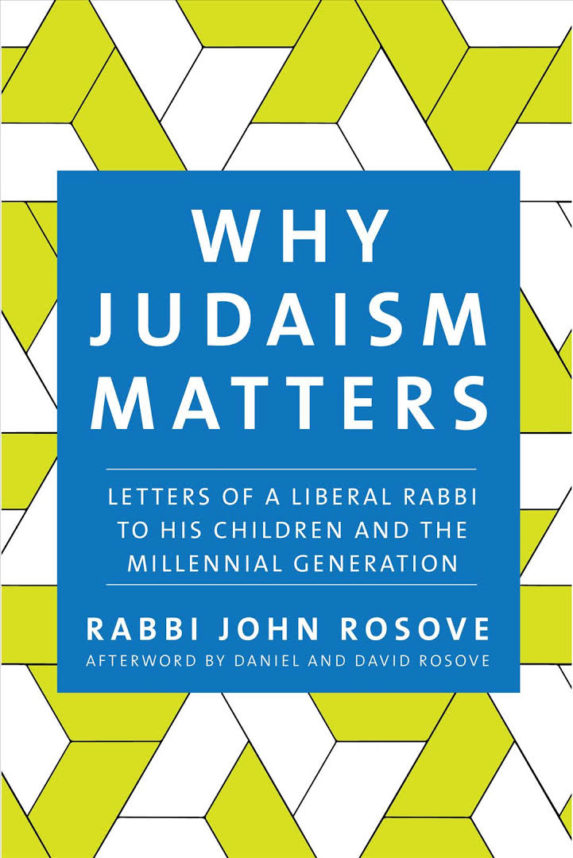
“Why Judaism Matters” – My New Book is Now Available on Amazon.com

24 Sunday Sep 2017

Posted by rabbijohnrosove in American Jewish Life, American Politics and Life, Book Recommendations, Ethics, Health and Well-Being, Holidays, Israel and Palestine, Israel/Zionism, Jewish History, Jewish Identity, Musings about God/Faith/Religious life, Social Justice

≈ 2 Comments

“Why Judaism Matter – Letters of a Liberal Rabbi to His Children and the Millennial Generation” with an Afterword by Daniel and David Rosove is now available for purchase on Amazon.com (publishing date – October 10). This book is a collection of thirteen letters offering a common sense guide and roadmap for a new generation of young men and women who find Jewish orthodoxy, tradition, issues, and beliefs impenetrable in 21st Century society. It is published by Jewish Lights Publishing, a division of Turner Publishing.

I have addressed this book of letters to millennials specifically, but this volume is also for their parents and grandparents, the younger generation of college-age Jews, and non-Jewish partners and spouses of Jews who are interested in the possibility of living meaningful and vibrant Jewish lives.

I invite you to purchase this book and share it with those you love.

Endorsements

“Rabbi John Rosove addresses his intellectual and well-reasoned investigation of faith to his own sons, which sets this book apart for its candor and its ability to penetrate not only the mind but also the heart.” – Matthew Weiner, creator of the AMC series Mad Men, and writer and producer on the HBO drama series The Sopranos. Matthew has earned nine Primetime Emmy Awards.

“John Rosove does what so many of us have struggled to do, and does it brilliantly: He makes the case for liberal Judaism to his children. As Rosove shows, liberal Judaism is choice-driven, messy, and always evolving, “traditional” in some ways and “radical” in others. It is also optimistic, spiritual, and progressive in both personal and political ethics. Without avoiding the hard stuff, such as intermarriage and Israel, Rabbi Rosove weaves all of these strands together to show the deep satisfactions of living and believing as a liberal Jew. All serious Jews, liberal or otherwise, should read this book.” – Rabbi Eric H. Yoffie, President Emeritus of the Union for Reform Judaism and a regular columnist for the Israeli daily newspaper Haaretz.

“Rabbi John Rosove has given a gift to all of us who care about engaging the next generation in Jewish life. The letters to his sons are really love-letters from countless voices of Jewish wisdom across history to all those young people who are seeking purpose in their lives. From wrestling with God, to advocating for peace and justice in Israel and at home, and living a life of purpose, this book is a compelling case for the joy of being Jewish.” – Rabbi Jonah Pesner, Director of the Religious Action Center of Reform Judaism in Washington, D.C.

“Rabbi John Rosove gets it. Here is a religious leader not afraid to tell it like it is, encapsulating for his audience the profound disaffection so many young Jews feel towards their heritage. But instead of letting them walk away, he makes a powerful case for the relevance of tradition in creating meaningful lives. In our technology-saturated, attention-absorbing age, Rosove offers religion-as-reprieve, his fresh vision of a thoroughly modern, politically-engaged and inclusive Judaism.” – Danielle Berrin, columnist and cover-story journalist for the Los Angeles Jewish Journal, commentator on CNN and MSNBC, and published work for The Guardian, British Esquire, and The Atlantic.

“Rabbi Rosove’s letters to his sons are full of Talmudic tales and practical parables, ancient wisdom with modern relevance, spiritual comfort, and intellectual provocation. Whether his subject is faith, love, intermarriage, success, Jewish continuity or the creation of a meaningful legacy, you’ll find yourself quoting lines from this beautiful book long after you’ve reached its final blessing.” – Letty Cottin Pogrebin, writer, speaker, social justice activist, author of eleven books including Debora, Gold, and Me: Being Female & Jewish in America, a founding editor of  Ms. Magazine, a regular columnist for Moment Magazine, and a contributor of op-eds in the New York Times, Washington Post, Boston Globe, Philadelphia Inquirer, Toronto Star, and LA Times, among other publications.

“If you’re a fellow Reform millennial, give yourself the gift of John’s insights. This book is written in a breezy, gentle, readable style that is welcoming without losing sharp insight. It was so enjoyable and refreshing to read and persuasive without ever being pushy. Rosove managed to do what only a truly worthy slice of kugel or chance viewing of Fiddler has done for me; reactivate my sense of wonder and gratitude about being Jewish. I’m a huge fan of WJM.” – Jen Spyra, staff comedy writer on The Late Show with Stephen Colbert (CBS), former senior writer for The Onion, actress, and stand-up comedian. Jen’s writing has appeared in The New Yorker, The Wall Street Journal, The New York Daily News, and The Daily Beast, and has been featured by The Laugh Factory Chicago’s Best Standup Show Case.

“Rabbi Rosove has written a wonderful book, a love letter to his children, and through them, to all our children. Prodigiously knowledgeable, exceedingly wise, and refreshingly honest, Rabbi Rosove has described why Judaism Matters. It should serve as a touching testament of faith, spanning the generations for generations to come.” – Rabbi Ammiel Hirsch, Senior Rabbi of Stephen Wise Free Synagogue in NYC, former Executive Director of the Association of Reform Zionists of America-World Union for Progressive Judaism, author of One People, Two Worlds: A Reform rabbi and an Orthodox rabbi explore the issues that divide them with Rabbi Yaakov Yosef Reinman.

“Rabbi Rosove has written a book of the utmost importance for our time. It is an imperative read for all those who struggle with the changing and evolving attitudes towards belonging, behavior and belief.  His analysis, stemming from deeply personal contemplation and decades of rabbinic experience, offers clear yet sophisticated approaches to tackling the challenges facing this generation and those to come. This book offers a treasure of wisdom through the lens of Jewish texts – both ancient and modern – which help to frame life’s major issues taking the reader from the particular to the universal. Israel is one of the most complicated of issues and he bridges the divide between Israel’s critics and staunch supporters and moves beyond the conversation of crisis for the millennial generation.” – Rabbi Joshua Weinberg, President of the Association of Reform Zionists of America

“John Rosove’s letters to his sons based on his life, philosophy, and rabbinic work address what it means to be a liberal and ethical Jew and a lover of Israel in an era when none are automatic. He writes in an unassuming personal style steeped in traditional texts as he confronts conflicts of faith and objectivity, Zionist pride and loving criticism of the Jewish state, traditional observance and religious innovation. He is never gratuitous and invites his readers into his family conversation because what he says is applicable to us all.” – Susan Freudenheim, Executive Director of Jewish World Watch,  journalist, former managing Editor of the Los Angeles Jewish Journal, and a former editor at the Los Angeles Times.

A Prayer for the Jewish New Year 5778

19 Tuesday Sep 2017

Posted by rabbijohnrosove in American Jewish Life, Ethics, Holidays, Inuyim - Prayer reflections and ruminations, Musings about God/Faith/Religious life, Poetry

≈ Leave a comment

RH fruits and symbols
May we hold lovingly in our thoughts / those who suffer from tyranny, subjection, cruelty, and injustice, / and work every day towards the alleviation of their suffering.
 
May we recognize our solidarity / with the stranger, outcast, downtrodden, abused, and deprived, / that no human being be treated as “other,” / that our common humanity weaves us together / in one fabric of mutuality, / one garment of destiny.
 
May we pursue the Biblical prophet’s vision of peace, / that we might live harmoniously with each other / and side by side, / respecting differences, / cherishing diversity, / with no one exploiting the weak, / each living without fear of the other, / each revering Divinity in every human soul.
 
May we struggle against institutional injustice, / free those from oppression and contempt, / act with purity of heart and mind, / despising none, defrauding none, hating none, insulting none / cherishing all, honoring every child of God, every creature of the earth.
 
May the Jewish people, the State of Israel, and all peoples in The Land / know peace in this New Year, / And may we nurture kindness and love everywhere.
 
Prayer composed by Rabbi John Rosove – Temple Israel of Hollywood, Los Angeles

Majesty of Calmness – A Must-Read during the High Holidays

18 Monday Sep 2017

Posted by rabbijohnrosove in American Jewish Life, Beauty in Nature, Book Recommendations, Ethics, Health and Well-Being, Holidays, Quote of the Day

≈ Leave a comment

Calm - Ocean

I recommend highly a little book first published in 1898 called “The Majesty of Calmness” by William George Jordan, an American editor, lecturer and essayist of the late 19th and early 20th century.

This 62-page treasure-trove of common-sense wisdom reminds me of the Biblical Book of Proverbs and the wisdom literature of the Hebrew Bible. It was written in an elegant prose that exists in classical works.

This series of seven short essays is particularly appropriate reading during the coming ten days of Repentance between Rosh Hashanah and Yom Kippur: “The Majesty of Calmness;” “Hurry, the Scourge of America;” “The Power of Personal Influence;” “The Dignity of Self-Reliance;” “Failure of Success;” “Doing our Best at All Times;” “The Royal Road to Happiness.”

I offer a few short passages from each of the essays that offer a taste of what you will find in this remarkable series of essays:

“Calmness is the rarest quality in human life. It is the poise of a great nature, in harmony with itself and its ideals. It is the moral atmosphere of a life self-centered, self-reliant, and self-controlled.” (p. 1)

“Nature is very un-American. Nature never hurries. Every phase of her working shows plan, calmness, reliability, and the absence of hurry…Hurry has ruined more Americans than has any other word in the vocabulary of life….In the race for wealth, people often sacrifice time, energy, health, home, happiness, and honor, –everything that money cannot buy, the very things that money can never bring back.” (pps. 8, 9, 10)

“Self-confidence, without self-reliance, is as useless as a cooking recipe, –without food. Self-confidence sees the possibilities of the individual; self-reliance realizes them. Self-confidence sees the angel in the unhewn block of marble; self-reliance carves it out for himself.” (p. 23)

“Many of our failures sweep us to greater heights of success than we ever hoped for in our wildest dreams. Life is a successive unfolding of success from failure…Failure is often the turning-point, the pivot of circumstance that swings us to higher levels…Failure is one of God’s educators.” (pp. 33, 35, 36)

“Living at one’s best is constant preparation for instant use. It can never make one over precise, self-conscious, affected, or priggish. Education, in its highest sense, is conscious training of mind or body to act unconsciously. It is conscious formation of mental habits, not mere acquisition of information.” (p. 46)

“Happiness is the greatest paradox in Nature. It can grow in any soil, live under any conditions. It defies environment. It comes from within: it is the revelation of the depths of the inner life as light and heat proclaim the sun from which they radiate. Happiness consists not of having, but of being; not of possessing, but of enjoying. It is the warm glow of a heart at peace with itself.” (p. 53)

“Majesty of Calmness” can be purchased on Amazon for $4.95. Do yourself a huge favor. Read it once, and then read it again.


This is the midnight hour

17 Sunday Sep 2017

Posted by rabbijohnrosove in American Jewish Life, Holidays, Inuyim - Prayer reflections and ruminations, Musings about God/Faith/Religious life, Poetry

≈ 2 Comments

At the midnight hour after Shabbat that precedes Rosh Hashanah, the Jewish community gathers as the Gates of Heaven begin to open to receive the petitions of forgiveness of the community.

Each year we change our Torah mantles to white symbolically revealing the deepest purpose of these High Holidays, to do Teshuvah, to turn away from an alienated life and to return to our loved ones, community, Torah, one’s own soul, and to God.

The moment is pregnant with possibility, as these verses suggest:

This is the midnight hour. / The Psalmist said: “At midnight I rose to acclaim you” (116:62). / We, who are his descendants, would follow this tradition. / For midnight belongs neither to today nor to tomorrow.

It is a moment alone in time. / It is an interval with a magic all its own. / As we grow weary with the weight of the late hour, / We become introspective, / Concerned with the nature of life; / Especially our own.

Time is fleeting. / Midnight becomes tomorrow. / A day is behind us / And the New Year beckons. / How shall we use our days? / What is the meaning of our lives, our goodness, our power? / Shall we use them only for ourselves / Or for the good of others? / This midnight service summons us / to the true purpose of life.  

Summer is passing. / The days grow shorter. / The sounds and colors of nature, / The stirring of the wind, / Speak to us of changes in the world, in life, / And in a human being’s course on earth.

Now is the time for turning. / The leaves are beginning to turn / From green to red and orange. 

The birds are beginning to turn / And are heading once more towards the south. / The animals are beginning to turn / To storing their food for the winter.

For leaves, birds, and animals / Turning comes instinctively. / But for us turning does not come so easily. 

It takes an act of will for us to make a turn. / It means breaking with old habits. / It means admitting that we have been wrong; / And this is never easy.

It means losing face; / It means starting all over again; / And this is always painful.

It means saying: I am sorry. / It means recognizing that we have the ability to change. / These things are terribly difficult to do.

But unless we turn, / We will be trapped forever in yesterday’s ways.

Author of above poem unknown.


Photographs by Rabbi Michelle Missaghieh

← Older posts
Newer posts →

Enter your email address to subscribe to this blog and receive notifications of new posts by email.

Join 366 other subscribers

Archive

  • March 2026 (2)
  • February 2026 (6)
  • January 2026 (8)
  • December 2025 (4)
  • November 2025 (6)
  • October 2025 (8)
  • September 2025 (3)
  • August 2025 (6)
  • July 2025 (4)
  • June 2025 (5)
  • May 2025 (4)
  • April 2025 (6)
  • March 2025 (8)
  • February 2025 (4)
  • January 2025 (8)
  • December 2024 (5)
  • November 2024 (5)
  • October 2024 (3)
  • September 2024 (7)
  • August 2024 (5)
  • July 2024 (7)
  • June 2024 (5)
  • May 2024 (5)
  • April 2024 (4)
  • March 2024 (8)
  • February 2024 (6)
  • January 2024 (5)
  • December 2023 (4)
  • November 2023 (4)
  • October 2023 (9)
  • September 2023 (8)
  • August 2023 (8)
  • July 2023 (10)
  • June 2023 (7)
  • May 2023 (6)
  • April 2023 (8)
  • March 2023 (5)
  • February 2023 (9)
  • January 2023 (8)
  • December 2022 (10)
  • November 2022 (5)
  • October 2022 (5)
  • September 2022 (10)
  • August 2022 (8)
  • July 2022 (8)
  • June 2022 (5)
  • May 2022 (6)
  • April 2022 (8)
  • March 2022 (11)
  • February 2022 (3)
  • January 2022 (7)
  • December 2021 (6)
  • November 2021 (9)
  • October 2021 (8)
  • September 2021 (6)
  • August 2021 (7)
  • July 2021 (7)
  • June 2021 (6)
  • May 2021 (11)
  • April 2021 (4)
  • March 2021 (9)
  • February 2021 (9)
  • January 2021 (14)
  • December 2020 (5)
  • November 2020 (12)
  • October 2020 (13)
  • September 2020 (17)
  • August 2020 (8)
  • July 2020 (8)
  • June 2020 (8)
  • May 2020 (8)
  • April 2020 (11)
  • March 2020 (13)
  • February 2020 (13)
  • January 2020 (15)
  • December 2019 (11)
  • November 2019 (9)
  • October 2019 (5)
  • September 2019 (10)
  • August 2019 (9)
  • July 2019 (8)
  • June 2019 (12)
  • May 2019 (9)
  • April 2019 (9)
  • March 2019 (16)
  • February 2019 (9)
  • January 2019 (19)
  • December 2018 (19)
  • November 2018 (9)
  • October 2018 (17)
  • September 2018 (12)
  • August 2018 (11)
  • July 2018 (10)
  • June 2018 (16)
  • May 2018 (15)
  • April 2018 (18)
  • March 2018 (8)
  • February 2018 (11)
  • January 2018 (10)
  • December 2017 (6)
  • November 2017 (12)
  • October 2017 (8)
  • September 2017 (17)
  • August 2017 (10)
  • July 2017 (10)
  • June 2017 (12)
  • May 2017 (11)
  • April 2017 (12)
  • March 2017 (10)
  • February 2017 (14)
  • January 2017 (22)
  • December 2016 (13)
  • November 2016 (12)
  • October 2016 (8)
  • September 2016 (6)
  • August 2016 (6)
  • July 2016 (10)
  • June 2016 (10)
  • May 2016 (11)
  • April 2016 (13)
  • March 2016 (10)
  • February 2016 (11)
  • January 2016 (9)
  • December 2015 (10)
  • November 2015 (12)
  • October 2015 (8)
  • September 2015 (7)
  • August 2015 (10)
  • July 2015 (7)
  • June 2015 (8)
  • May 2015 (10)
  • April 2015 (9)
  • March 2015 (12)
  • February 2015 (10)
  • January 2015 (12)
  • December 2014 (7)
  • November 2014 (13)
  • October 2014 (9)
  • September 2014 (8)
  • August 2014 (11)
  • July 2014 (10)
  • June 2014 (13)
  • May 2014 (9)
  • April 2014 (17)
  • March 2014 (9)
  • February 2014 (12)
  • January 2014 (15)
  • December 2013 (13)
  • November 2013 (16)
  • October 2013 (7)
  • September 2013 (8)
  • August 2013 (12)
  • July 2013 (8)
  • June 2013 (11)
  • May 2013 (11)
  • April 2013 (12)
  • March 2013 (11)
  • February 2013 (6)
  • January 2013 (9)
  • December 2012 (12)
  • November 2012 (11)
  • October 2012 (6)
  • September 2012 (11)
  • August 2012 (8)
  • July 2012 (11)
  • June 2012 (10)
  • May 2012 (11)
  • April 2012 (13)
  • March 2012 (10)
  • February 2012 (9)
  • January 2012 (14)
  • December 2011 (16)
  • November 2011 (23)
  • October 2011 (21)
  • September 2011 (19)
  • August 2011 (31)
  • July 2011 (8)

Categories

  • American Jewish Life (458)
  • American Politics and Life (417)
  • Art (30)
  • Beauty in Nature (24)
  • Book Recommendations (52)
  • Divrei Torah (159)
  • Ethics (490)
  • Film Reviews (6)
  • Health and Well-Being (156)
  • Holidays (136)
  • Human rights (57)
  • Inuyim – Prayer reflections and ruminations (95)
  • Israel and Palestine (358)
  • Israel/Zionism (502)
  • Jewish History (441)
  • Jewish Identity (372)
  • Jewish-Christian Relations (51)
  • Jewish-Islamic Relations (57)
  • Life Cycle (53)
  • Musings about God/Faith/Religious life (190)
  • Poetry (86)
  • Quote of the Day (101)
  • Social Justice (355)
  • Stories (74)
  • Tributes (30)
  • Uncategorized (835)
  • Women's Rights (152)

Blogroll

  • Americans for Peace Now
  • Association of Reform Zionists of America (ARZA)
  • Congregation Darchei Noam
  • Haaretz
  • J Street
  • Jerusalem Post
  • Jerusalem Report
  • Kehillat Mevesseret Zion
  • Temple Israel of Hollywood
  • The IRAC
  • The Jewish Daily Forward
  • The LA Jewish Journal
  • The RAC
  • URJ
  • World Union for Progressive Judaism

Blog at WordPress.com.

  • Subscribe Subscribed
    • Rabbi John Rosove's Blog
    • Join 366 other subscribers
    • Already have a WordPress.com account? Log in now.
    • Rabbi John Rosove's Blog
    • Subscribe Subscribed
    • Sign up
    • Log in
    • Report this content
    • View site in Reader
    • Manage subscriptions
    • Collapse this bar
 

Loading Comments...