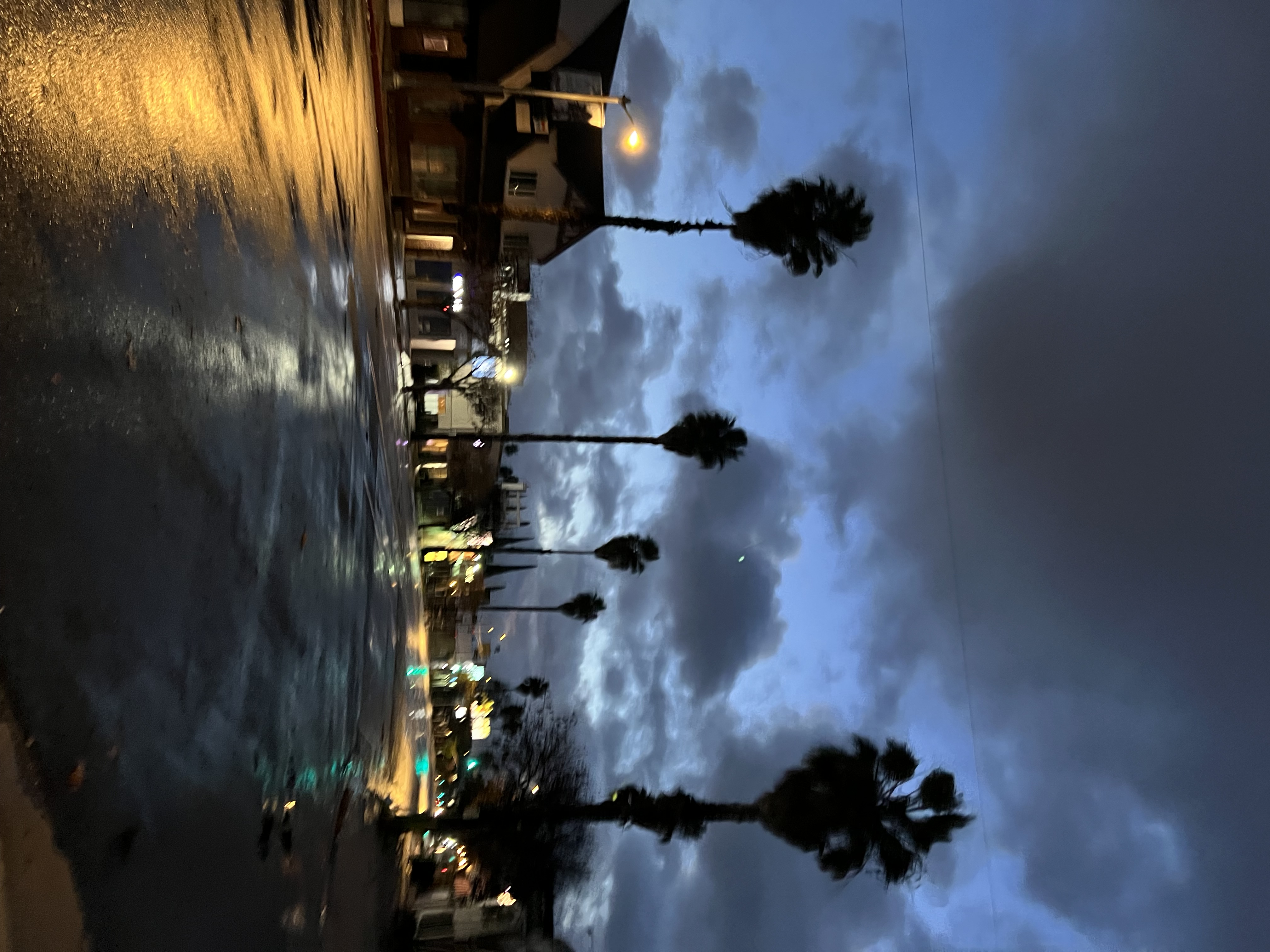
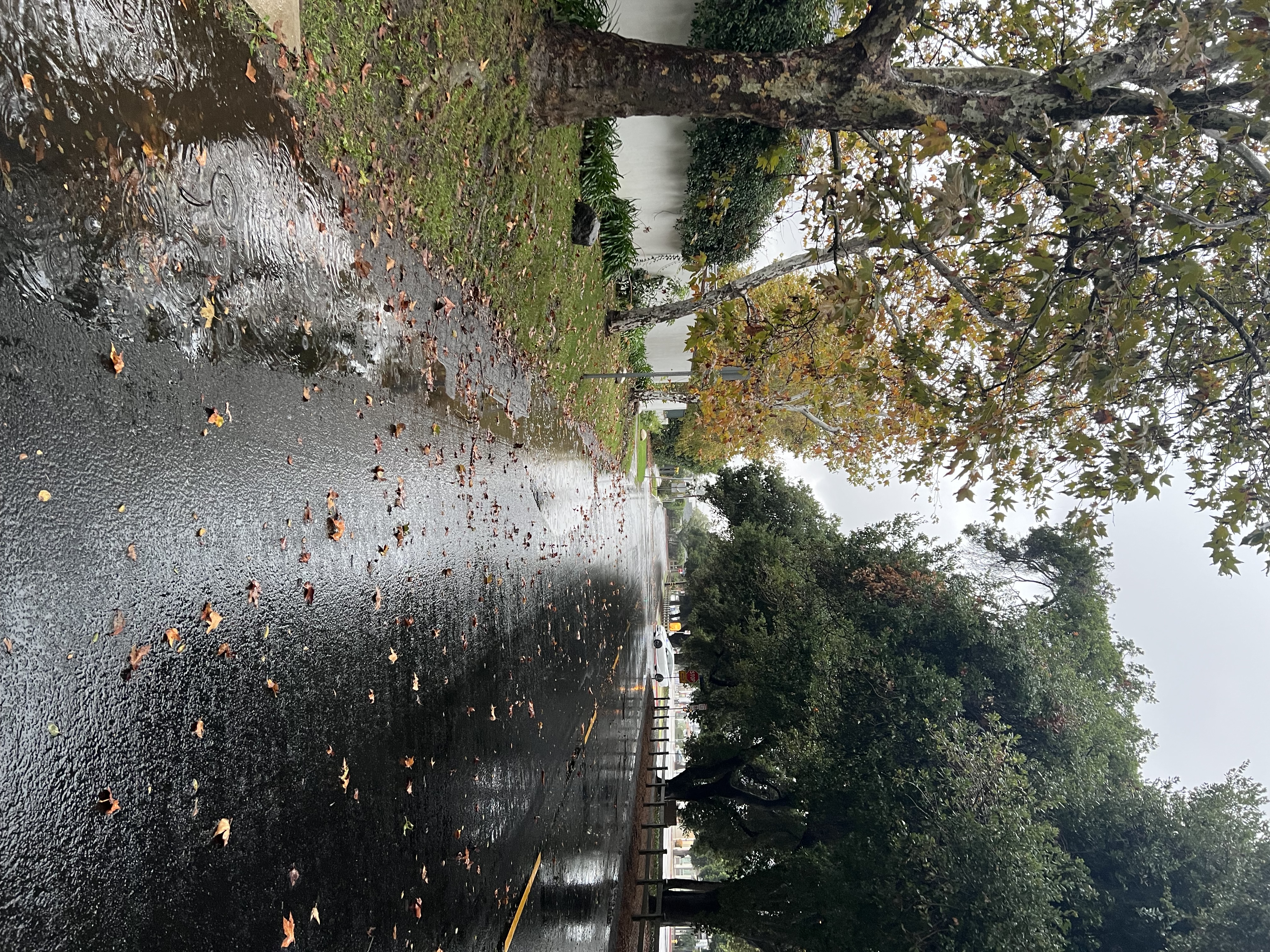
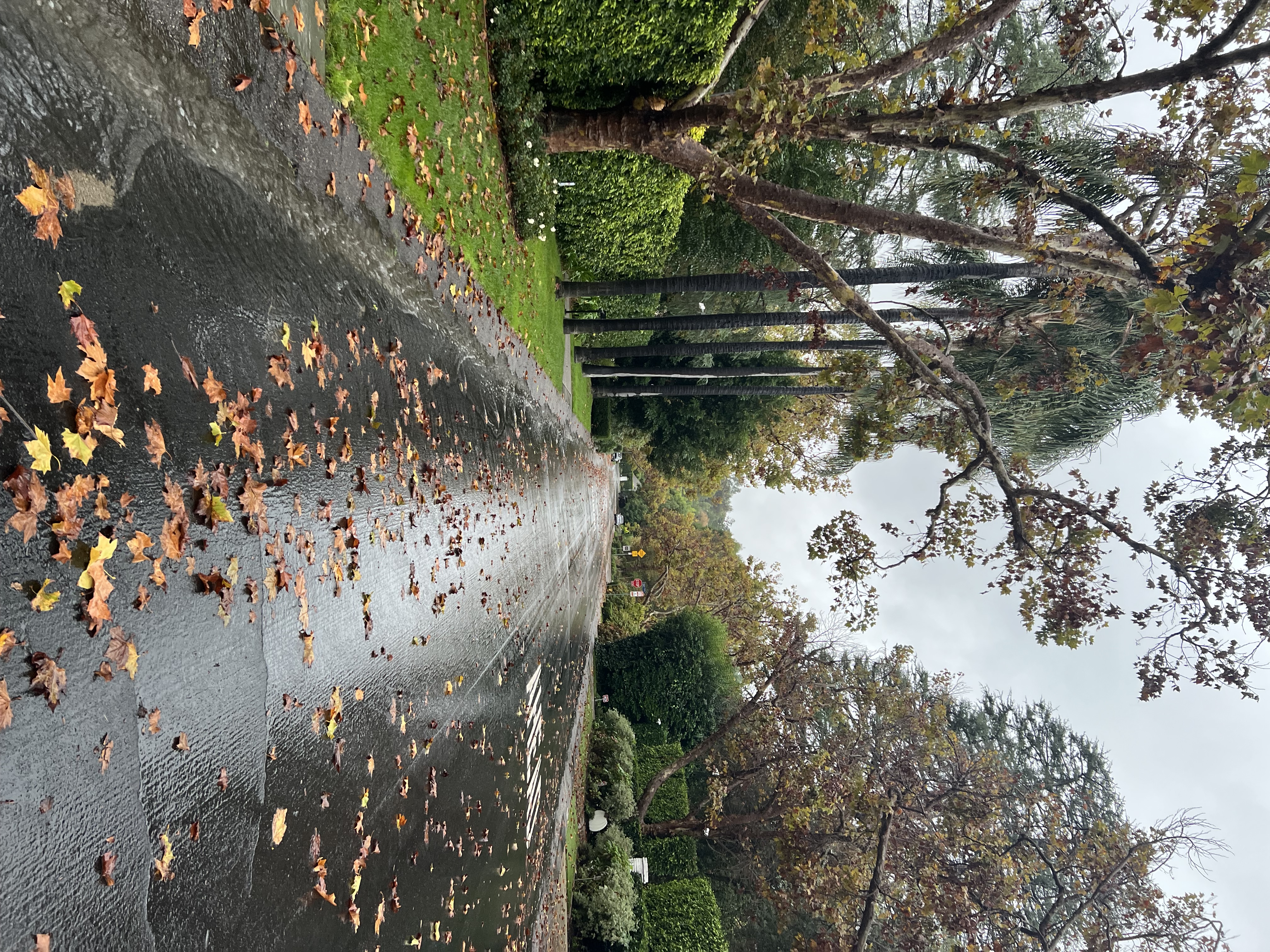
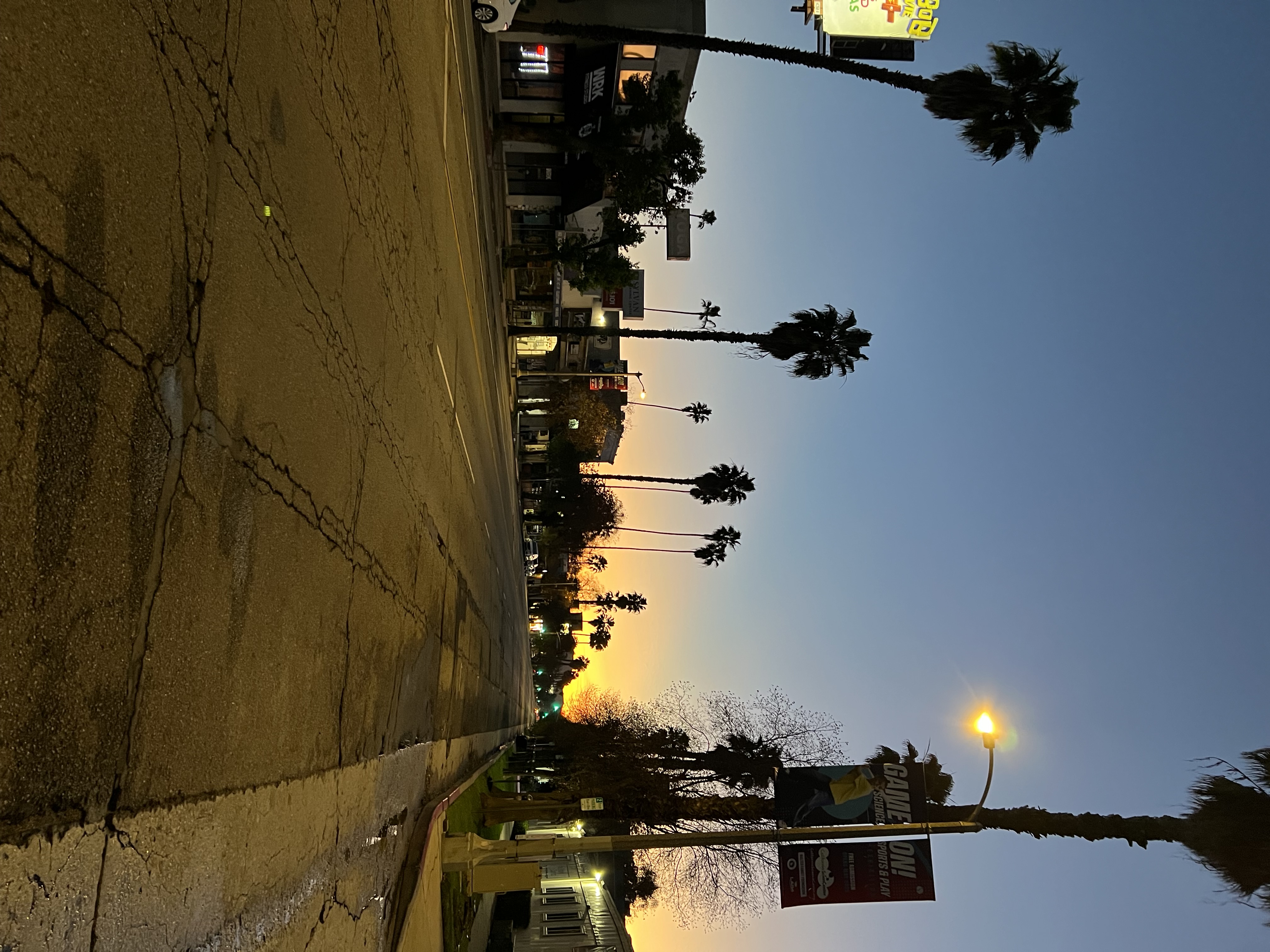
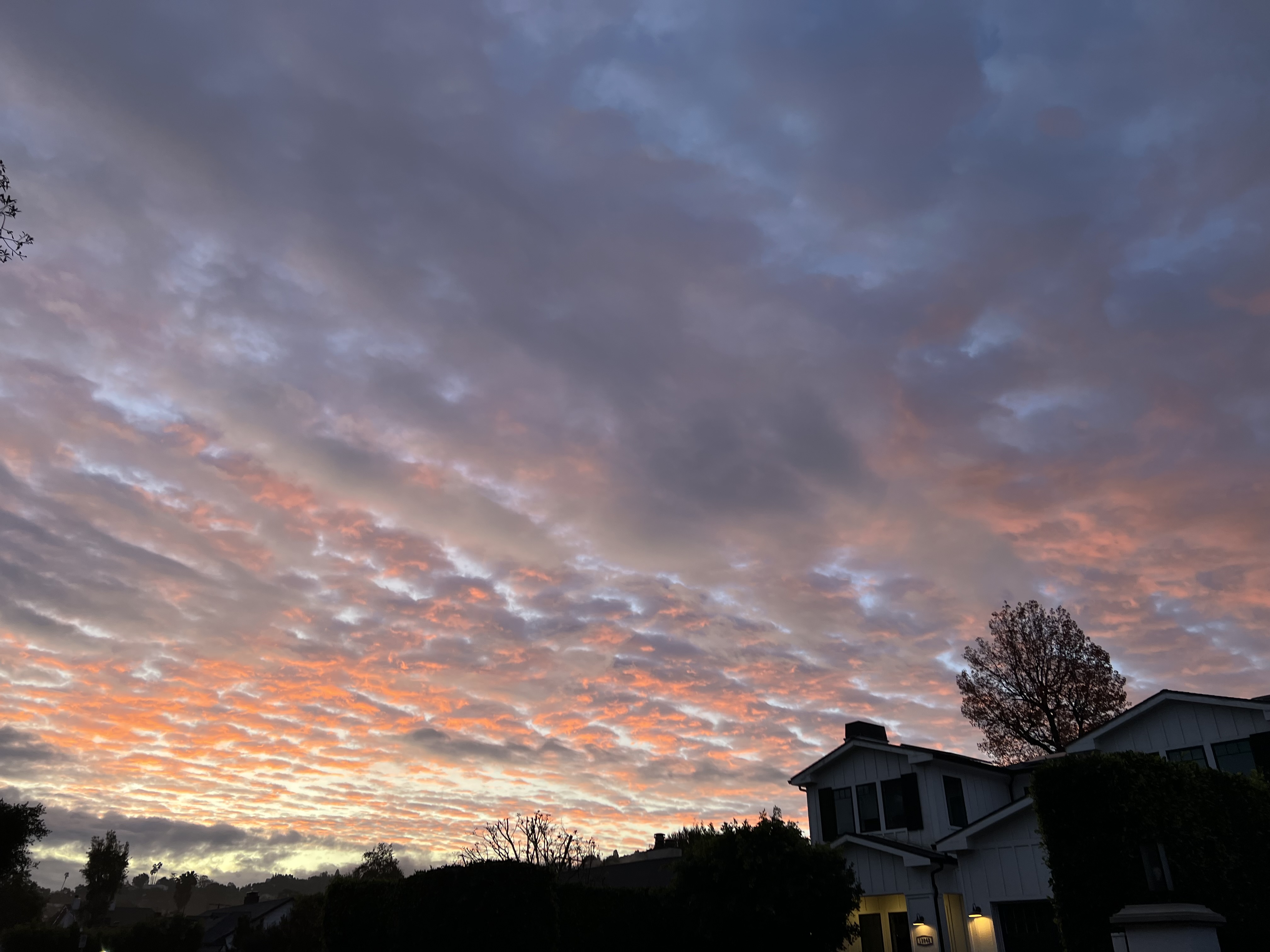
Early morning is my preferred time of day. I love walking the dark streets before most people have awakened. As I pass my neighbors’ homes with only a few scattered lights opened within, before our coyote neighbors begin their search for food, before the neighborhood dogs bark and disturb the pre-dawn quiet, and as the stars flicker their light from so very long ago, it is then that I feel the greatest sense of calm serenity. As the day emerges with the sun painting the clouds orange, magenta, and pink against the blue sky, I marvel as the colors change from moment to moment. The air is so still, quiet, and cool then, and when it rains on occasion and I step around the puddles and over the rivers streaming from the foothills, and there is no one outside except me, I feel wonderfully alive.
The following are images I have captured before, during, and after heavy rain has drenched my community, and other images too. I hope they communicate my experience in those early hours.
The American historian Heather Cox Richardson offers a characterization of Fascism in her “Letters From An American” substack. She writes that the events carried out by President Trump and key leaders in his administration during the past year make it “clear that officials in the Trump Administration have fully embraced the same fascism that underpinned the Nazi government that American soldiers were fighting 80 years ago.” (see her January 10, 2026 posting)
That is, obviously, a serious indictment. However, after reading the following with in mind the actions Trump and company have taken, Professor Richardson’s description of fascism as it relates to the MAGA movement is not an exaggeration.
If you have family and/or friends who support Donald Trump, for whatever reason, please consider sharing the following with them and, if they acknowledge what is happening in this country and consequently break away from the Trump camp, your effort would be worthwhile.
Professor Cox Richardson posted on January 9, 2026:
“Beginning in 1943, the War Department published a series of pamphlets for U.S. Army personnel in the European theater of World War II. Titled Army Talks, the series was designed “to help [the personnel] become better-informed men and women and therefore better soldiers.”
On March 24, 1945, the topic for the week was “FASCISM!”
“You are away from home, separated from your families, no longer at a civilian job or at school and many of you are risking your very lives,” the pamphlet explained, “because of a thing called fascism.” But, the publication asked, what is fascism? “Fascism is not the easiest thing to identify and analyze,” it said, “nor, once in power, is it easy to destroy. It is important for our future and that of the world that as many of us as possible understand the causes and practices of fascism, in order to combat it.”
Fascism, the U.S. government document explained, “is government by the few and for the few. The objective is seizure and control of the economic, political, social, and cultural life of the state.” “The people run democratic governments, but fascist governments run the people.”
“The basic principles of democracy stand in the way of their desires; hence—democracy must go! Anyone who is not a member of their inner gang has to do what he’s told. They permit no civil liberties, no equality before the law.” “Fascism treats women as mere breeders. ‘Children, kitchen, and the church,’ was the Nazi slogan for women,” the pamphlet said.
Fascists “make their own rules and change them when they choose…. They maintain themselves in power by use of force combined with propaganda based on primitive ideas of ‘blood’ and ‘race,’ by skillful manipulation of fear and hate, and by false promise of security. The propaganda glorifies war and insists it is smart and ‘realistic’ to be pitiless and violent.”
Fascists understood that “the fundamental principle of democracy—faith in the common sense of the common people—was the direct opposite of the fascist principle of rule by the elite few,” it explained, “[s]o they fought democracy…. They played political, religious, social, and economic groups against each other and seized power while these groups struggled.”
Americans should not be fooled into thinking that fascism could not come to America, the pamphlet warned; after all, “[w]e once laughed Hitler off as a harmless little clown with a funny mustache.” And indeed, the U.S. had experienced “sorry instances of mob sadism, lynchings, vigilantism, terror, and suppression of civil liberties. We have had our hooded gangs, Black Legions, Silver Shirts, and racial and religious bigots. All of them, in the name of Americanism, have used undemocratic methods and doctrines which…can be properly identified as ‘fascist.’”
The War Department thought it was important for Americans to understand the tactics fascists would use to take power in the United States. They would try to gain power “under the guise of ‘super-patriotism’ and ‘super-Americanism.’” And they would use three techniques:
First, they would pit religious, racial, and economic groups against one another to break down national unity. Part of that effort to divide and conquer would be a “well-planned ‘hate campaign’ against minority races, religions, and other groups.”
Second, they would deny any need for international cooperation, because that would fly in the face of their insistence that their supporters were better than everyone else. “In place of international cooperation, the fascists seek to substitute a perverted sort of ultra-nationalism which tells their people that they are the only people in the world who count. With this goes hatred and suspicion toward the people of all other nations.”
Third, fascists would insist that “the world has but two choices—either fascism or communism, and they label as ‘communists’ everyone who refuses to support them.”
It is “vitally important” to learn to spot native fascists, the government said, “even though they adopt names and slogans with popular appeal, drape themselves with the American flag, and attempt to carry out their program in the name of the democracy they are trying to destroy.”
The only way to stop the rise of fascism in the United States, the document said, “is by making our democracy work and by actively cooperating to preserve world peace and security.” In the midst of the insecurity of the modern world, the hatred at the root of fascism “fulfills a triple mission.” By dividing people, it weakens democracy. “By getting men to hate rather than to think,” it prevents them “from seeking the real cause and a democratic solution to the problem.” By falsely promising prosperity, it lures people to embrace its security.
“Fascism thrives on indifference and ignorance,” it warned. Freedom requires “being alert and on guard against the infringement not only of our own freedom but the freedom of every American. If we permit discrimination, prejudice, or hate to rob anyone of his democratic rights, our own freedom and all democracy is threatened.”
PS – Ezra Klein spoke with Masha Gessen, the Russian-born NY Times Opinion columnist on January 10 on The Ezra Klein Show on the theme of “Venezuela, Renee Good and Trump’s ‘Assault on Hope.’” It is worth hearing as it relates to the above.
Dan Rather said it as clearly as anyone can in his following Substack “Steady.” In the last 2 days, social media has been filled with the visual evidence that an ICE agent murdered Renee Good. The only way for us Americans to have any hope of stopping the outrageous policies of the Trump Administration’s ICE military force and the corrupt lying leadership of Trump including Kristi Noem and VP Vance, is to peacefully resist and say the names of the innocent victims out-loud-all-the-time-all-at-once.
RENEE GOOD – May her memory be a blessing and may she never be forgotten.
Here is Dan Rather
“This is not right. Not justifiable. Not who we are as Americans. Full stop.
The act of violence by a federal officer that killed an unarmed American is an unimaginable horror and a national atrocity.
Renee Good was murdered by an ICE agent on her way home from dropping off her first grader at school. Video from three different angles shows Good driving onto a street full of protesters and agents near her Minneapolis home. One can then see Good maneuvering her car at the command of several agents.
According to eyewitnesses, two agents were yelling at her simultaneously and at cross purposes to turn around, back up, stop, and get out of the car. She rolled down her window to hear and speak with them.
Moments before the shooting, she was inching her car forward. An agent, who was standing on the left side of the car, raised his gun and shot Good at point-blank range. A doctor in the crowd offered to help Good. The agent would not let him, saying, “I don’t care.”
Good was a poet and stay-at-home mom who was born and raised in Colorado. She has been described as a devoted Christian who was not politically active, according to her ex-husband’s father. Her social media accounts appear to bear this out.
Once again, the president and his lackeys are asking Americans not to believe what they see with their own eyes.
Rather than console the family or condemn the violence, he orchestrated a fiction to cover up ICE’s criminality, abuse of power, and the failures of his draconian deportation policies.
Trump claims the ICE agent acted in self-defense and DHS Secretary Kristi Noem called Good a domestic terrorist who weaponized her car to target the agents. While die-hard Trumpsters might gobble that up like it’s Thanksgiving dinner, the real story can be seen on the video taken by multiple bystanders.
ICE stokes fear and heightens tensions rather than de-escalating them. Since Trump took office last January, four people have been killed and five injured by ICE agents in 15 shootings. Though there is clear evidence that the agent who killed Good did not act in self-defense, it is unlikely even he will see the inside of a courtroom, never mind a prison cell.
The agent who killed Good was identified by the Minneapolis Star Tribune. He is an Iraq War veteran who has been with ICE since at least 2016. The agent was previously injured in a traffic incident while seizing an undocumented man who was later convicted of dragging the agent with his car. This doesn’t justify what happened. At all.
Stephen Miller, Trump’s immigration guru, who is not a lawyer, maintains ICE agents are untouchable. “You have federal immunity in the conduct of your duties. And anybody who lays a hand on you or tries to stop or obstruct you is committing a felony,” he said on Fox. This is patently false in America — always has been and always should be.
Though Minneapolis’s mayor and Minnesota’s governor vowed to seek justice for Good, Trump & Co. made sure they were unable to. The FBI announced on Thursday morning that it would be handling the investigation alone, boxing out the Minnesota Bureau of Criminal Apprehension (BCA). Historically, the agencies work together.
The BCA said in a statement that the U.S. attorney’s office “had reversed course: the investigation would now be led solely by the FBI, and the BCA would no longer have access to the case materials, scene evidence or investigative interviews necessary to complete a thorough and independent investigation.”
With no independent investigation and a Justice Department in the president’s pocket, the agent who killed Good may not even get a slap on the wrist.
Unless we demand it.
Renee Good’s death will not be in vain. It has already drawn needed attention to a rogue president and agency acting with impunity. She could be any mother, in any city, at any time. She could be any one of us. It is time to draw the line in the sand. And to say her name while doing it.”
This week, in synagogues around the world, Jews read the first chapters in the biblical book of Exodus. There we meet Moses and read about his birth to enslaved parents, his adoption into the palace and growth as a prince, his defense of an abused slave, his exile, his becoming a shepherd, and his encounter with God at the burning bush. There God commands Moses to go to the most powerful king on earth and demand the liberation of the enslaved Israelites. At first, Moses demurs believing he has no agency to stand before Pharaoh, but God reassures him and inspires in him the courage to do what must be done.
The narrative is infused with Ancient Near Eastern mythology that tells of a slave child becoming the redeemer of his people, but we have no archaeological evidence (except the Hebrew Bible) that Moses ever existed. Nevertheless, he would come to represent the model of prophetic leadership that took root in Judaism, Christianity, Islam, and western civilization.
One of the most important aspects of the Moses story is that, on God’s behalf, he destroyed the master-slave order of ancient Egypt and ushered in a new era in which every human being was to be regarded as a creation in the Divine Image and therefore worthy of ultimate dignity, respect, and freedom. (1)
Moses was singularly significant as God’s most intimate and important prophet regardless of the lack of historic evidence that he lived. Scholars have argued that even if no historic evidence outside of the biblical text exists, there had to be a figure like Moses who gave rise to the prophetic and legal tradition that he initiated and embodied.
Rabbi Abraham Joshua Heschel (1907-1972), arguably one of the greatest Jewish thinkers and social justice activists of the 20th century who lost his entire family in the Holocaust and who was a strong ally of Dr. Martin Luther King, characterized prophecy and the prophet’s nature in this way:
“Prophecy is the voice that God has lent to the silent agony, a voice to the plundered poor, to the profaned riches of this world. … God is raging in the prophets’ words.” (2)
“The prophet … feels fiercely. God has thrust a burden upon his soul, and he is bowed and stunned at [humankind]’s fierce greed. Frightful is the agony …; no human voice can convey its full terror. Prophecy … is a form of living, a crossing point of God and humankind.” (3)
“The prophet … employs notes one octave too high for our ears [and] experiences moments that defy our understanding. [The prophet] is … an assaulter of the mind [whose] words begin to burn where conscience ends.” (4)
Years ago, I wrote a poem about Moses and his encounter with God at the burning bush, and I edited it this past week because the story of Moses offers us still a preferred paradigm of moral and spiritual leadership that we need so badly in these times.
We walk in a daze / eyes sunk in creviced faces / fettered to worldly tasks / blind to rainbows.
I imagine Moses in Midian like that / brooding in exile / burdened by his people’s suffering / knowing each day their pain and stopped-up hearts.
A simple shepherd-prince Moses was / now staff in hand counting sheep / until one day / weaving through rocks amongst bramble bushes / he heard thorns popping.
Turning his head / his eyes opened / to see a bush burning / but not consumed by flames.
God had long before taken note of him / from his birth / but waited until this moment / to choose him as Prophet.
“Open to Me, My dove / My twin / My undefiled one.” (5)
Moses heard God’s voice / and beheld angels / his soul flowing in a sacred river / of Shekhinah light. (6)
‘Why me? / Why am I so privileged to behold such wonder? / Unworthy as I am.’
God said / “Moses – I choose you / because you are humble / the most humble of any human being on earth (7) / and your heart is burdened / because you know the world’s cruelty / and you are not cruel / ‘Nor do you stand idly by when others bleed.’ (8) / You are a tender of sheep / and you will lead my people / with the shepherd’s staff / and inspire them to open their stopped-up hearts to Me / without fear / with love.”
Trembling – Moses looked again / into the bush-flames / free from smoke and ash.
His eyes opened as in a dream / and he heard a soft-murmuring-sound (9) / the same that breath makes as it passes quietly / through lips.
MOSHE MOSHE!—HINEINI (10)
Two voices—One utterance.
He hid his face / for the more Moses heard / the brighter the light became / and he knew he must turn away or die. (11)
The Prophet’s thoughts were free / soaring / no longer of self / to this day there has not been a purer soul than Moses.
God said / “Come no closer / Remove your shoes” (12) / stand barefoot / I want your soul.
I am here with you / and in you / I am every thing / and no thing / and you are Me / I see that which is / and which is not / and I hear it all.
Take heed Moses / My shepherd-prince / “For My people‘s blood calls to Me from the ground” (13) / and the living are suffering a thousand deaths.
You must take them out / every last one / every crying child / every lashed man / every woman screaming.
And Moses know this / “With weeping they will come / and with compassion I will guide them.” (14)
The people’s exile began with tears of pain / and it will end with tears of joy.
I have recorded their story in a Book / “Black Fire on White Fire” (15) / letters on parchment / telling of slaves / seeing light / turning to Me / becoming a free people / and a nation.
The Book is My spirit / the Letters are My heart / “They are near to you that you do them” (16) / and teach them / and redeem My world / and free every human being / my cherished ones / all children of humankind / that the world not be consumed in flames.
This Book I give to you / O purest of souls / “that you may live / you and your generations to come.” (17)
Poem by Rabbi John L. Rosove
Notes:
Genesis 1:26.
Abraham Joshua Heschel, “Religion in a Free Society,” The Insecurity of Freedom: Essays on Human Existence (Farrar, Straus & Giroux, 1959), 11–12.
Abraham J. Heschel, The Prophets (New York: Harper & Row & The Jewish Publication Society of America, 1962), 5.
Introductory Note: Jennifer Rubin, formerly an op-ed writer at The Washington Post and now Editor-in-Chief of The Contrarian Substack is always worth reading. Here is her description of what to watch in 2026. I recommend subscribing Subscribe here . A disclaimer, Jen is a long-time friend. Let that, however, not dissuade you from reading what she and the other writers at The Contrarian write. She and her colleagues not only inform comprehensively, but their moral voice is clear and helpful as we confront the morass of events. Here is her piece published today – December 30, 2025:
“The 2026 midterms will be the most important of our lifetimes. The outcome will determine whether Donald Trump’s reign of terror continues unchecked, who will play critical roles in securing the 2028 presidential election, and which Democrats will be best positioned for the 2028 presidential race. Here are the most important—or most intriguing—races to watch.
Michigan Senate: Democrats Abdul El-Sayed (a progressive endorsed by Sen. Bernie Sanders); Rep. Haley Stevens (a pro-business moderate, but backed by the state AFL-CIO and Speaker Emerita Nancy Pelosi); and charismatic State Sen. Mallory McMorrow will compete in the Democratic primary, seeking to replace retiring Democrat and shutdown capitulator Sen. Gary Peters. Stevens and McMorrow are leading in polling. The winner will face former congressman Mike Rogers. In a blue wave election, Democrats should be able to hold the seat, but Michigan remains as closely divided as any state. McMorrow—social media savvy, with strong ties to pro-democracy resistance fighters—would push to replace Senate Leader Chuck Schumer (D-N.Y.). It is tempting to pigeon-hole Stevens as an establishment candidate, but she recently demonstrated her political moxie in introducing articles of impeachment against RFK, Jr. Stevens aligns with AIPAC on Israel; McMorrow’s approach is more nuanced.
Iowa Senate: Ordinarily not competitive, Iowa in a blue wave election could be in play, thanks to the retirement of Republican Sen. Joni “We are all going to die” Ernst and the horrid farm economy in the state. The Democratic field whittled down to three main intriguing contenders: State Rep. Josh Turek, Nathan Sage (businessman and veteran), and State Senator Josh Wahls. Turek has establishment backing but his personal disability story makes him a unique, compelling candidate; Sage and Wahls are insurgents, who have also pledged to remove Schumer. After the shutdown cave, Wahls stated: “We need a senator who works for Iowans, not for Chuck Schumer or Donald Trump or billionaires in big corporations.”
Texas Senate: This Democratic Senate primaries features two rising stars, Rep. Jasmine Crockett (D-Tex.), forty-four, and Texas state Rep. James Talarico, thirty-six. The winner will face Sen. John Cornyn (R-Tex.), a dull rubber stamp for radical policies and nominees of the sort he never used to support; Texas Attorney Gen. Ken Paxton, whoseethical travails, fondness for spurious, partisanlawsuits (including challenging the 2020 presidential outcome), anti-immigrantbias, and affinity for white supremacistrhetoric should make Texans cringe; or Rep. Wesley Hunt, whose entry splits traditional Republican voters, complicating Cornyn’s task. Crockett and Talarico are media-adept progressives. However, Crockett is fiery while Talarico’s cross-over message is rooted in faith. Crockett focuses relentlessly (and effectively) on Trump’s failings; Talarico (“Obama and Mr. Rogers,” said one voter) argues that America’s biggest divide is “top vs. bottom, not left vs. right.”
Ohio Senate: Again, Ohio would not normally be competitive (in part due to outrageous gerrymandering). However, former Senator and pro-union icon Sherrod Brown’s decision to run against JD Vance’s appointed replacement, Jon Husted (who invariably genuflects to Trump and has proven himself useless) means Democrats have a real shot. An October poll had Brown up by a point, fueling Democrats’ excitement in red Ohio.
Minnesota Senate: The Democratic primary winner will likely replace retiring Sen. Tina Smith (D-Minn.) Lt. Gov. Peggy Flanagan (endorsed by Sen. Elizabeth Warren) is more progressive than Rep. Angie Craig (D-Minn.), but both denounced the shutdown collapse and called for Schumer to be ousted. Craig’s pragmatism allows her to work across party lines, but she nevertheless tenaciously defends the safety net and slams Trump’s ruinous tariffs. Flanagan, forty-six, presents herself as a next generation Democrat. Whoever wins will be a first for Minnesota: Flanagan is Native American; Craig, married with four children, would be the state’s first openly LGBTQ+ Senator.
Maine Senate: Democrats relish the chance to dump perpetually “concerned” Sen. Susan Collins (R-Maine), who repeatedly betrays pro-choice and pro-democracy voters (e.g., voting to confirm Justice Brett Kavanaugh despite her “concerns” about his potential to assist in overturning Roe v. Wade, and, more recently, confirming Russell Vought, RFK, Jr., and Pam Bondi). Widely mocked for voting to acquit Trump in his impeachment because “he’s learned his lesson”, she also could have stopped the big, ugly bill from ever reaching the floor.
Democratic Gov. Janet Mills, seventy-seven, (backed by Schumer and Kentucky and Michigan Democratic governors) faces outsider and veteran Graham Platner, backed by Sen. Bernie Sanders (I-Vt.) in the primary. Scandals have plagued Platner—as Politico reported, he’ll have to answer to:
Platner apologized, citing past substance abuse and mental health issues. Remarkably, all that has not ended his run. Economically stressed, besieged voters seem to sympathize with his harrowing combat experience and battle with PTSD. Still, the latest poll had Mills up 10 points.
North Carolina Senate: North Carolina Democrats are ecstatic about their candidate, former Governor Roy Cooper. The centrist, congenial, successful ex-governor will compete against Trump puppet and former RNC chairman Michael Whatley. If this Democrat cannot beat this Republican in this cycle, Democrats aren’t likely to win a federal statewide race with much ease anytime soon.
Alabama Governor: If IQ or public accomplishment determined the winner, former Senator Doug Jones (D) would smoke former football coach Sen. Tommy Tuberville (R-Ala.), who many Democrats say is the dimmest bulb in the U.S. Senate—a particularly competitive field this term. Jones did pull off a stunning upset in 2017 against Roy Moore (hobbled by multiple, credible accusations of sexual misconduct, which he strenuously denied). Lightning will strike twice if voters decide their state could use a civil rights hero and competent, centrist Democrat rather than the winner of the Senate dunce cap.
California Governor: Rep. Eric Swalwell (D-Cal.) joined a crowded race, immediately surging to second place behind former congresswoman Katie Porter (whose “boss from hell” videos marred her appeal, contributing to a less favorable rating, though she still hovers roughly ten points above Swalwell). Although billionaire Tom Steyer, former L.A. mayor Antonio Villaraigosa, and former HHS secretary Xavier Becerra are also in the race, they trail Porter and the media-proficient, proven Trump-adversary of Swalwell. Democrats will compete in a nonpartisan primary alongside MAGA Republicans Chad Bianco, Riverside’s sheriff, and businessman/former British TV personality Steve Hilton. The top two will face off in November.
Ohio Governor: Few expected Ohio to have a competitive governor’s race. But two November polls and one in December showed likely GOP nominee Vivek Ramaswamy (a tech gadfly and MAGA extremist who quickly exited DOGE—or got dumped, depending on your view) statistically tied with the likely Democratic nominee Amy Acton (physician and former Ohio Department of Health Director). That suggests the playing field really has tilted—or Ramaswamy is truly off-putting, or both. Acton’s hard-scrabble upbringing in Youngstown, “overcoming abuse, hunger, and periods of homelessness,” according to her website) and background as a medical professional (she’s using “Dr.” in her campaign), populist, and working mom (with 6 kids) compares favorably to the profile of a rich tech-bro hostile to the safety net and the ACA. If the blue wave is strong enough, Ohio will have its first Democratic governor since 2011.
My friend, Erwin Chemerinsky, the Dean of the Berkeley Law School and a national expert on the US Constitution, wrote yesterday the following article that offers a master class on the Trump Administration’s assault on the United States Constitution, the rule of law, and our democracy.
The encounter between the biblical Joseph and his brothers twenty years after they sold him into slavery, an event that inspired me to write the poem below, is among the most emotionally dramatic and heartfelt meetings between brothers in all of scripture. The resolution of their conflict has important implications for us and for the numerous religious, cultural, ethnic, and national groups in America and around the world. In this era of polarization, inter-group and inter-religious distrust and tensions, the story of Joseph and his brothers can be regarded as a corrective healing template. See the book of Genesis, chapters 37 to 50.
Pope John XXIII (1881-1963) thought so much of the encounter between Joseph and his brothers that he quoted the text: “I am Joseph, your brother” (Heb. אני יוסף אחיכם – Ani Yosef Achichem) (Genesis 45:4) to a delegation of 130 American Jewish leaders associated with the United Jewish Appeal in the Vatican on October 17, 1960, five years before the Second Vatican Council published its revolutionary document Nostra Aetate(“In Our Time”or “In Our Age”) in 1965. That document augured the Catholic Church’s modern approach to non-Christian religions, particularly Judaism and Islam, but also to other Christian religious streams. The document emphasized our shared humanity, common values, and the importance of interfaith dialogue, and it affirmed Judaism’s, Christianity’s, and Islam’s shared spiritual roots in the biblical Abraham while rejecting historical condemnations of one religion or other religious streams.
The moral message in the Joseph stories and in Nostra Aetate is simple – the more commonality we feel with those who are unlike us, the more empathy we will experience and the greater will be the likelihood that we will reach out and act with a sense of shared responsibility in times of need, persecution, poverty, hate, bigotry, and a people’s powerlessness.
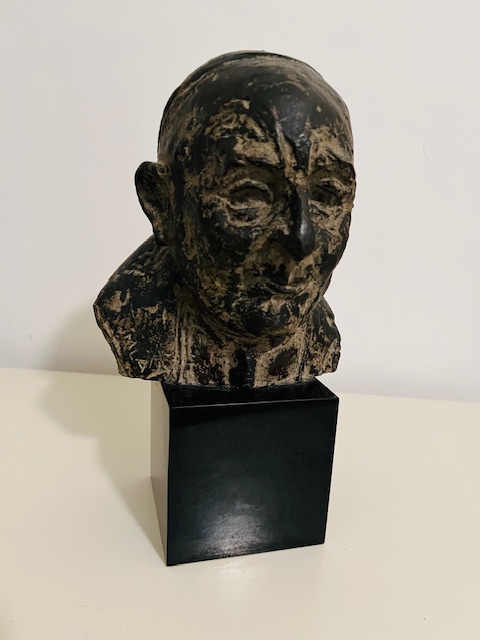
The bronze bust of Pope John XXIII pictured above was given by the Pope to my aunt and uncle – Dr. Max W. and Fay Bay – when they met with the Pontiff in the Vatican in the early 1960s. My uncle was the President of the Jewish Federation Council of Greater Los Angeles and my aunt was a beloved and respected leader in the Women’s Division of the United Jewish Appeal when they represented Los Angeles Jewry in a meeting with the Pope.
Fay and Max left the bust to me in their will, and I treasure it because it represents a new era in the relationship between the worldwide Catholic Church and the Jewish people, and it recalls my loving memories of my mother’s oldest sister (there were ten siblings) and her husband.
Here is my poem:
I can’t stop the dreams in the night / Even while awake I gaze the light / My mother died my father sighed / And wondered about my dreams.
Trusting a man along the way / I found my brothers lying in wait / To banish me from family and home / And send me far away.
They could not utter even my name / They cast me down and spat me away / They broke my father’s heart and claimed / That I had passed away.
My name was written in the stars / But I became a slave and was scarred / And as flesh in a woman’s lustful heart / Who also cast me away.
Her master incensed sent me to Sheol / But still a seer I glimpsed a glow / And blessings bubbled into my dreams / As I wondered about my way.
Alas I was given a royal reprieve / And brought to a place beside the King / I served him long and faithfully / And continued to dream my dreams.
My heart shut down over twenty odd years / My love poured into cold desert tears / I amassed power and instilled much fear / While serving at the pleasure of the King.
My brothers came their faces forlorn / Begging for bread before the throne / Thinking me Viceroy with scepter in hand / Not Joseph of their family clan.
My grandfather re-dug his father’s wells / Seeing my brothers the waters swelled / Into my steeped-up and hardened heart / I opened to love again.
I forgave them all and brought them near / Saved them from their desert fears / Settled them safely amongst their peers / As God intended over all those years.
I originally posted my poem “In The Black Night” on this blog on Friday, November 15, 2013 during the week in which Jews around the world read Parashat Vayishlach (Genesis 32:4-36:43) as part of the annual cycle of Torah readings. I re-read it this week in which again we read Vayishlach.
My poem addresses not only the biblical relationship between the fraternal twins Jacob and Esau from the perspective of Jacob, but also the relationship between competing political parties, peoples, and nationalities.
I offer it again now because it ought to be obvious how destructive and corrupting to human relationships are the impulses of ego, need, and ambition.
“In the black night / the river runs cold / slowly passing me by / over formerly sharp-edged stones / worn smooth by centuries of churning, / as if through earthy veins – / and I Jacob, alone, / shiver and wait / to meet my brother / and daylight.
Will there be war? / And will the angels carry my soul / up the rungs of the ladder / leaving my blood / to soak the earthy crust?
A presence!? / And I struggle yet again / as if in my mother’s womb / and in my dreams.
We played together as children once, / my brother Esau and me / as innocents, / and I confess tonight / how I wronged him / and wrenched from him his birthright / as this Being has done to me / between my thighs.
I was so young / driven by ego and need, / blinded by ambition, / my mother’s dreams / and my father’s silence.
I so craved to be first born / adored by my father, / to assume his place when he died / that my name be remembered / and define a people.
How Esau suffered and wailed / and I didn’t care. / Whatever his dreams / they were nothing to me – / my heart was hard – / his life be damned!
But, after all these years / I’ve learned that Esau and I / each alone is / a palga gufa – a half soul / without the other – / torn away / as two souls separated at creation / seeking reunification / in a sea of souls – / the yin missing the yang – / the dark and light never to touch – / the mind divorced from body – / the soul in exile – / without a beating bleating heart / to witness – / and no access to the thirty-two paths / to carry us together / up the ladder / and through the spheres.
It’s come to this! / To struggle again – / To live or die.
Tonight / I’m ready for death / or submission.
Compassionate One: / protect Esau and your servant – / my brother and me / as one – / and return us to each other.
El na r’fa na lanu! / Grant us peace and rest! / I’m very tired!”
Originally published in the CCAR Journal: Reform Jewish Quarterly, Spring, 2010, pages 113-115.
There are moments of decision that come to each of us when a moral choice must be made. Most of the time, those decisions have no great impact and we can make them easily without worrying about the risks such an action would carry for us or for the people near and dear to us. But there are other times in which our actions do have significant consequences and risks for us and our dear ones, and that our actions will define us for better or worse.
This blog was inspired (or better – provoked) by President Trump‘s and his administration’s ongoing efforts to bully large swaths of America’s citizenry and bend to his will government workers, the Justice department, politicians, educators, scientists, legal firms, universities, cultural, artistic, racial, and immigrant groups, and most recently six members of Congress – all respected veterans and former intelligence officials – who urged in a video disseminated widely that all members of the military not to obey unlawful orders, per the military code. President Trump’s irascible threat that they should be charged with treason and punished with execution is the most recent and stunning outrage.
Some have compared what is happening now in the United States to Germany in the 1930s when all democratic norms were destroyed in Hitler’s rapid and irrepressible march to dictatorship and the persecution and murder of Jews and others who resisted the Nazis. I don’t know if this claim is an accurate comparison or not. I have my doubts given the complexities of American democracy and the independence of federal, state, and local centers of authority that still exist, and given the noble actions of many judges at every level and of hundreds of attorneys who have filed law suits against Trump’s unconstitutional actions, though Trump is following the autocratic playbook closely, per Project 2025. I will leave the comparison to historians.
Without a doubt in my reading of history, however, the most extreme acts of moral courage, resistance and defiance against a murderous regime were taken by the many thousands of rescuers who hid or helped Jews during the Holocaust at great personal risk to themselves, their families and communities.
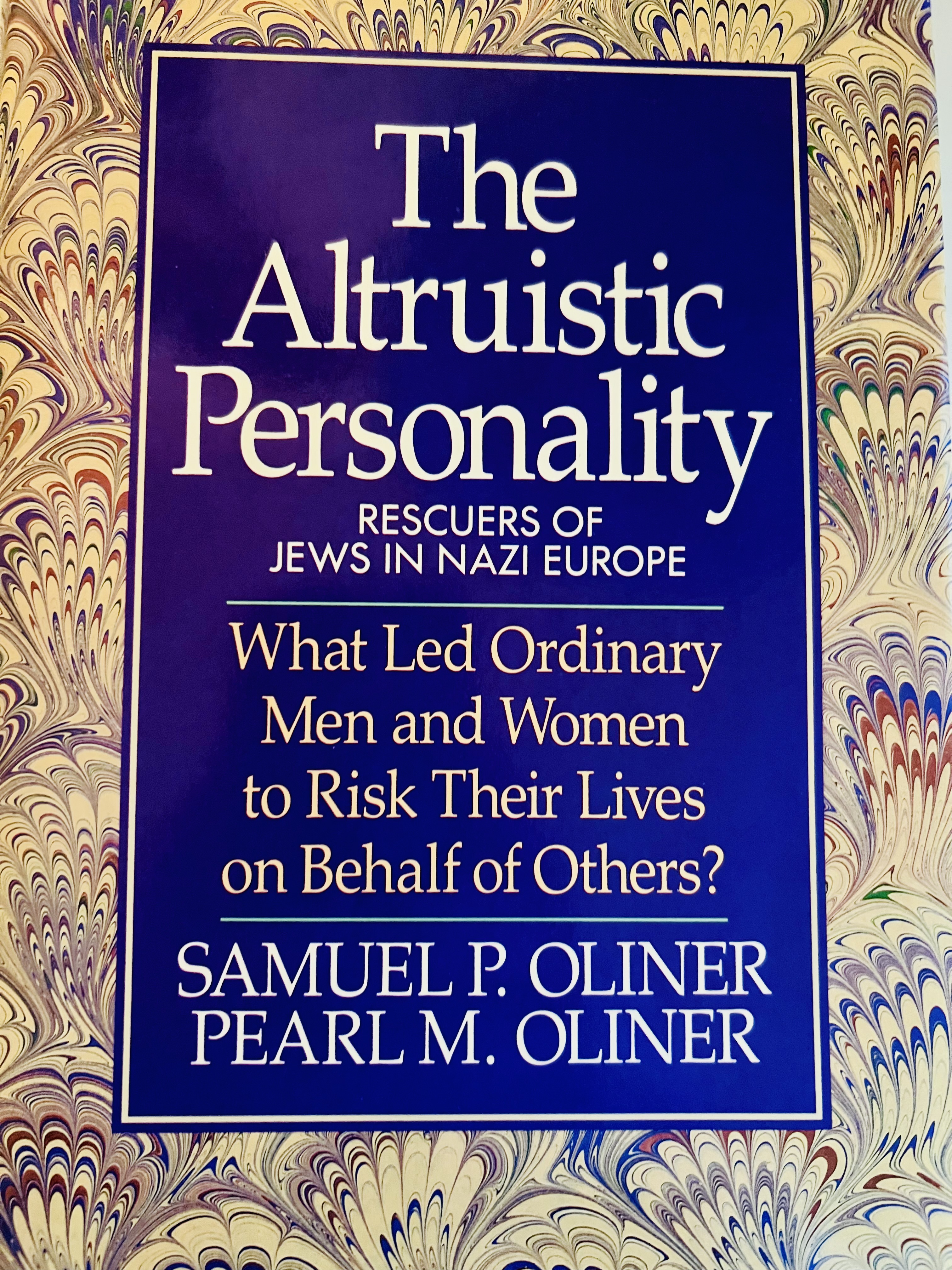
Years ago I read The Altruistic Personality: Rescuers of Jews in Nazi Europe – What Led Ordinary Men and Women to Risk Their Lives on Behalf of Others? by Samuel P. and Pearl M. Oliner with an Introduction by Rabbi Harold Schulweis (New York: The Free Press, 1988). Rabbi Schulweis, a moral giant in his generation, invited the Oliners to speak at his synagogue – Valley Beth Shalom in Los Angeles – and he invited the Board of Rabbis of Southern California to meet the authors and learn about their work.
It is written on the cover the following biographical notes about the authors and the purpose and content of the book:
“Samuel [Oliner] was ten years old when his entire family was murdered by the Nazis in Poland. Thanks to the help of a Polish Christian woman, he found a place to hide through the war – and survive. His experience left him with a profound, lifelong sense of wonder and a question that was the origin of this book.
In a time of extreme danger, what had led this woman, and a few thousand like her, to risk her own life and the lives of her family to help those who were marked for death – even total strangers – while others stood passively by?
To answer that complex and critically important question, Samuel and Pearl Oliner undertook the massive Altruistic Personality Project, which interviewed over 700 rescuers and nonrescuers living in Poland, France, Germany, the Netherlands, and Italy during the Nazi occupation.
Samuel (1930-2021) was a Professor of Sociology at Humboldt State University. Pearl (1931-2021) was a Professor of Education at Humboldt State University.
By comparing and contrasting rescuers and bystanders, [the Oliners] discovered that those who intervened were distinguished by certain common characteristics, including a deep-seated, wide-ranging empathy to others developed in their childhood homes, where moral and ethical values were not only strongly held, but acted upon by their parents. Unlike their neighbors who were concerned with their own survival and chose not to become involved, rescuers felt a more extensive concern and responsibility for the fate of the others and believed that what they did would make a difference…the Altruistic Personality explores the experiences and motivations of those uncommon individuals who aided Jews without compensation of any kind-and with full knowledge of the fatal consequences that would befall them if their actions were discovered.”
Altruism is based on a faith in a higher moral authority to which one is committed and the standards of which permeate one’s attitudes and behavior towards others, especially those outside one’s personal cultural, religious, ethnic, and national communities, and regardless of one’s personal self-interest and safety. This faith and moral commitment can come from one’s religious faith, parents, family, and other community groups to which a person belonged.
The Oliners learned in their research that rescuers did not consider themselves to be moral heroes. In their interviews these uncommon individuals explained that they could not do other than what they did and be able to live with themselves, regardless of the great risks involved. Rescuers felt instinctively and intuitively the difference between moral right and wrong and acted always according to their deeply held moral values nurtured and emphasized since childhood. They present to us a powerful model of quiet defiance and resistance.
The following are selected passages from this book:
“I did nothing unusual; anyone would have done the same thing in my place.” A Dutchman [said] who sheltered a Jewish family for two years.” (p. 113)
“Rescuers did differ from others in their interpretation of religious teaching and religious commitment, which emphasized the common humanity of all people and therefore [rescuers] supported efforts to help Jews.” (p. 156)
“I found it incomprehensible and inadmissible that for religious reasons or as a result of a religious choice, Jews would be persecuted. It’s like saving somebody who is drowning. You don’t ask them what God they pray to. You just go and save them.” (p. 166)
“…the language of care dominated [for most rescuers]: Pity, compassion, concern, affection made up the vocabulary of 76 percent of rescuers…”(p. 168)
“Rescuers described their early family relationships in general and their relationships with their mothers in particular as closer significantly more often than did non-rescuers. Rescuers also felt significantly closer to their fathers than did bystanders. From such family relationships, more rescuers learned the satisfactions accruing from personal bonds with others.” (p. 173)
“What distinguished rescuers from non-rescuers was their tendency to be moved by pain. Sadness and helplessness aroused their empathy. More frequently than others, rescuers were likely to say ‘I can’t feel good if others around me feel sad,’ ‘seeing people cry upsets me,’ ‘I get very upset when I see an animal in pain,’ ‘It upsets me to see helpless people,’ and ‘I get angry when I see someone hurt.’” (p. 174)
“…parents [in disciplining their children] of rescuers depended significantly less on physical punishment and significantly more on reasoning.” (p. 179)
“Involvement, commitment, care, and responsibility are the hallmarks of extensive persons [or ‘expansive persons’ – An extensive/expansive person is often friendly, outgoing, talkative, or generous by nature.] Disassociation, detachment, and exclusiveness are the hallmarks of constricted persons. Rescuers were marked by extensivity [or expansiveness], whereas non-rescuers and bystanders in particular, were marked by constrictedness, by an ego that perceived most of the world beyond [his/her] own boundaries as peripheral.” (p. 186)
“Constricted people experience the external world as largely peripheral except insofar as it may be instrumentally useful. More centered on themselves and their own needs, they pay scant attention to others… contractedness begins in early life. Family attachments are weak, and discipline relies heavily on physical punishment, the latter often routine and gratuitous. Reasoning and explaining [of parents to their children when a child does wrong] are infrequent [for the contracted personality]. Family values center on the self and social convention; relationships with others are guarded and generally viewed as commodity exchanges. Stereotypes regarding outsiders are common.” (p. 251)
“Moral courage is thus the conspicuous characteristic only of the independent, autonomous, ego-integrated liberal.” (p. 256)
Again, I am not making a direct comparison between what is taking place today in the United States with Germany in the 1930s. We Americans are, nevertheless, being challenged morally in ways most of us alive today have not experienced or imagined possible ever in our lifetimes. Our political leaders as well as university presidents and their boards, law firms, entertainment companies, journalists and the media, scientists and the men and women serving in the armed forces systematically are being morally challenged by a President whose clear intent is for Americans to bend the knee to his autocratic will.
The book may explain one important reason why so many Americans continue to support President Trump, though a Gallup poll released yesterday shows that Trump’s approval rating has sunk to a historic low of 36 percent with disapproval at 60 percent, and that the MAGA coalition is fracturing.
The book, though published in 1988, is still available and I recommend it highly.
Gratitude (Hebrew – הכרת הטוב – literally, “recognition of/knowing the good”) is not to be regarded as a quid pro quo – rather, as an attitude of the heart towards others who are kind and generous.
I offer a few choice quotations on this most important of virtues.
“I can no other answer make but thanks, / and thanks, / and thanks, / and ever thanks.” -William Shakespeare
“Cultivate the habit of being grateful for every good thing that comes to you, and to give thanks continuously. And because all things have contributed to your advancement, you should include all things in your gratitude.” -Ralph Waldo Emerson
“When a Jew breaks a leg, he should thank God that he did not break both; and when he breaks both legs, he should thank God that he didn’t break his neck.” -Yiddish proverb
“In the time to come all prayers of petition will be annulled, but the prayer of gratitude will not be annulled.” –Midrash Rabbah Vayikra 9:7
“A chasid once was asked: ‘What is stealing?’ He thought for a moment and then replied, ‘A person steals when s/he enjoys the benefits of the earth without giving thanks to God.‘” -Cited in Bechol Levavcha by Rabbi Harvey Fields
“How strange we are in the world, and how presumptuous our doings! Only one response can maintain us: gratefulness for witnessing the wonder, for the gift of our unearned right to serve, to adore, and to fulfill. It is gratefulness which makes the soul great.” -Rabbi Abraham Joshua Heschel







 Rabbi John Rosove's Blog