• About

Rabbi John Rosove's Blog

Rabbi John Rosove's Blog

Category Archives: Book Recommendations

The Fox Hunt – A gripping tale

13 Sunday Oct 2019

Posted by rabbijohnrosove in Book Recommendations, Human rights, Jewish-Islamic Relations

≈ Leave a comment

The Fox Hunt – A Memoir of Yemen and my Odyssey to America (Harper Collins: New York, 2018) reads like an action novel based in the fundamentalist and extremist Muslim world. It tells the odyssey of a young Yemeni Muslim man, Mohammed Al Samawi, who dared to challenge the template of anti-Christian and anti-Jewish attitudes in which he was raised and risked his life to escape his beloved country of birth in the midst of its murderous civil war in 2015.

To read my entire review, see my blog at the Times of Israel – https://blogs.timesofisrael.com/the-fox-hunt-a-gripping-tale/

A Matter of Character

07 Sunday Jul 2019

Posted by rabbijohnrosove in American Politics and Life, Book Recommendations, Ethics, Health and Well-Being, Human rights, Quote of the Day, Women's Rights

≈ 2 Comments

In his book Tyrant – Shakespeare on Politics, Stephen Greenblatt (John Cogan University Professor of the Humanities at Harvard University) probes the nature of tyranny in the works of Shakespeare. Greenblatt focuses particularly on the character of Richard III.

I offer one passage but recommend the entire short volume (189 pages):

“Shakespeare’s Richard III brilliantly develops the personality features of the aspiring tyrant already sketched in the Henry VI trilogy: the limitless self-regard, the law-breaking, the pleasure in inflicting pain, the compulsive desire to dominate. He is pathologically narcissistic and supremely arrogant. He has a grotesque sense of entitlement, never doubting that he can do whatever he chooses. He loves to bark orders and to watch underlings scurry to carry them out. He expects absolute loyalty, but he is incapable of gratitude. The feelings of others mean nothing to him. He has no natural grace, no sense of shared humanity, no decency.

He is not merely indifferent to the law; he hates it and takes pleasure in breaking it. He hates it because it gets in his way and because it stands for a notion of the public good that he holds in contempt. He divides the world into winners and losers. The winners arouse his regard insofar as he can use them for his own ends; the losers arouse only his scorn. The public good is something only losers like to talk about. What he likes to talk about is winning.

He has always had wealth; he was born into it and makes ample use of it. But though he enjoys having what money can get him, it is not what most excites him. What excites him is the joy of domination. He is a bully. Easily enraged, he strikes out at anyone who stands in his way. He enjoys seeing others cringe, tremble, or wince with pain. He is gifted at detecting weakness and deft at mockery and insult. These skills attract followers who are drawn to the same cruel delight, even if they cannot have it to his unmatched degree. Though they know that he is dangerous, the followers help him advance to his goal, which is the possession of supreme power.

His possession of power includes the domination of women, but he despises them far more than desires them. Sexual conquest excites him, but only for the endlessly reiterated proof that he can have anything he likes. He knows that those he grabs hate him. For that matter, once he has succeeded in seizing the control that so attracts him, in politics as in sex, he knows that virtually everyone hates him. At first that knowledge energizes him, making him feverishly alert to rivals and conspiracies. But it soon begins to eat away at him and exhaust him.

Sooner or later, he is brought down. He dies unloved and un-lamented. He leaves behind only wreckage. It would have been better had Richard III never been born.” (pages 53-54)

Though Greenblatt published this study of tyranny in 2018 in the midst of the Trump era, it is the character of Richard III – after all – that he describes in his brilliant short work. Before his death, Philip Roth endorsed the book with these words: “Brilliant, beautifully organized, exceedingly readable.”

And remarkably current!


Hanukah Gift – “Why Judaism Matters” Available on Amazon.com

22 Thursday Nov 2018

Posted by rabbijohnrosove in American Jewish Life, Book Recommendations, Divrei Torah, Ethics, Holidays, Israel and Palestine, Israel/Zionism, Jewish Identity, Life Cycle, Musings about God/Faith/Religious life, Social Justice, Stories, Uncategorized, Women's Rights

≈ Leave a comment

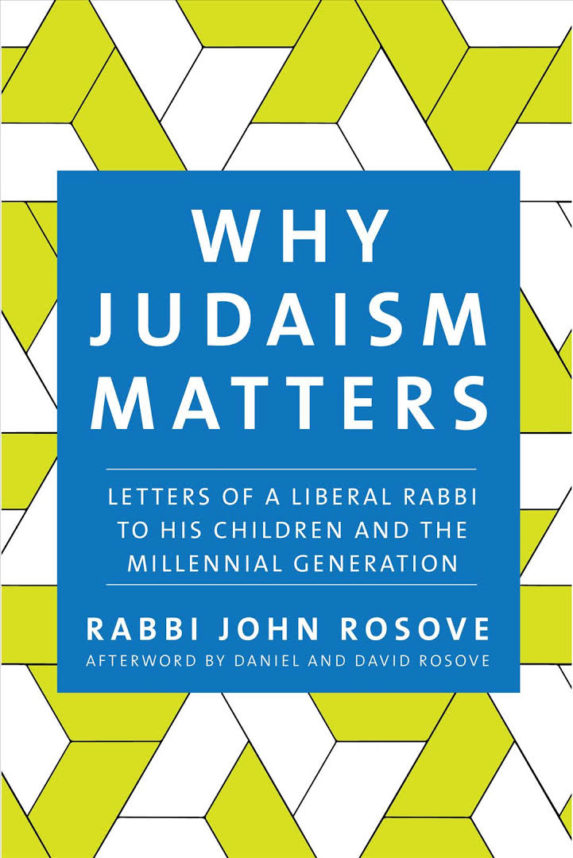
Book cover

This is a Hanukah gift that I recommend. See endorsements below and the  more than 20 five star endorsements posted on Amazon.

To purchase the book, go to Amazon.com.

“Why Judaism Matters – Letters of a Liberal Rabbi to His Children and the Millennial Generation” with an Afterword by Daniel and David Rosove is a collection of thirteen letters offering a common sense guide and roadmap for a new generation of young men and women who find Jewish orthodoxy, tradition, issues, and beliefs impenetrable in 21st Century society. It is published by Jewish Lights Publishing, a division of Turner Publishing.

I have addressed this book of letters to millennials specifically, but this volume is also for their parents and grandparents, the younger generation of college-age Jews, high school students, and non-Jewish partners and spouses of Jews who are interested in the possibility of living meaningful and vibrant Jewish lives.

I invite you to purchase this book and multiples of it and share it with those you love.

Endorsements

 “John Rosove does what so many of us have struggled to do, and does it brilliantly: He makes the case for liberal Judaism to his children. As Rosove shows, liberal Judaism is choice-driven, messy, and always evolving, “traditional” in some ways and “radical” in others. It is also optimistic, spiritual, and progressive in both personal and political ethics. Without avoiding the hard stuff, such as intermarriage and Israel, Rabbi Rosove weaves all of these strands together to show the deep satisfactions of living and believing as a liberal Jew. All serious Jews, liberal or otherwise, should read this book.” – Rabbi Eric H. Yoffie, President Emeritus of the Union for Reform Judaism and a regular columnist for the Israeli daily newspaper Haaretz.

“Rabbi John Rosove gets it. Here is a religious leader not afraid to tell it like it is, encapsulating for his audience the profound disaffection so many young Jews feel towards their heritage. But instead of letting them walk away, he makes a powerful case for the relevance of tradition in creating meaningful lives. In our technology-saturated, attention-absorbing age, Rosove offers religion-as-reprieve, his fresh vision of a thoroughly modern, politically-engaged and inclusive Judaism.” – Danielle Berrin, former columnist and cover-story journalist for the Los Angeles Jewish Journal, commentator on CNN and MSNBC, and published work for The Guardian, British Esquire, and The Atlantic.

“Rabbi John Rosove addresses his intellectual and well-reasoned investigation of faith to his own sons, which sets this book apart for its candor and its ability to penetrate not only the mind but also the heart.” – Matthew Weiner, creator of the AMC series Mad Men, the current Amazon Prime series  The Romanoffs, and was a writer and producer on the HBO drama series The Sopranos. Matthew has earned nine Primetime Emmy Awards.

“Rabbi Rosove’s letters to his sons are full of Talmudic tales and practical parables, ancient wisdom with modern relevance, spiritual comfort, and intellectual provocation. Whether his subject is faith, love, intermarriage, success, Jewish continuity or the creation of a meaningful legacy, you’ll find yourself quoting lines from this beautiful book long after you’ve reached its final blessing.” – Letty Cottin Pogrebin, writer, speaker, social justice activist, author of eleven books including Debora, Gold, and Me: Being Female & Jewish in America, a founding editor of  Ms. Magazine, a regular columnist for Moment Magazine, and a contributor of op-eds in the New York Times, Washington Post, Boston Globe, Philadelphia Inquirer, Toronto Star, and LA Times, among other publications.

“Rabbi John Rosove has given a gift to all of us who care about engaging the next generation in Jewish life. The letters to his sons are really love-letters from countless voices of Jewish wisdom across history to all those young people who are seeking purpose in their lives. From wrestling with God, to advocating for peace and justice in Israel and at home, and living a life of purpose, this book is a compelling case for the joy of being Jewish.” – Rabbi Jonah Pesner, Director of the Religious Action Center of Reform Judaism in Washington, D.C.

 “If you’re a fellow Reform millennial, give yourself the gift of John’s insights. This book is written in a breezy, gentle, readable style that is welcoming without losing sharp insight. It was so enjoyable and refreshing to read and persuasive without ever being pushy. Rosove managed to do what only a truly worthy slice of kugel or chance viewing of Fiddler has done for me; reactivate my sense of wonder and gratitude about being Jewish. I’m a huge fan of WJM.” – Jen Spyra, staff comedy writer on The Late Show with Stephen Colbert (CBS), former senior writer for the Onion, actress, and stand-up comedian. Jen’s writing has appeared in The New Yorker, The Wall Street Journal, The New York Daily News, and The Daily Beast, and has been featured by The Laugh Factory Chicago’s Best Standup Show Case.

“Rabbi Rosove has written a wonderful book, a love letter to his children, and through them, to all our children. Prodigiously knowledgeable, exceedingly wise, and refreshingly honest, Rabbi Rosove has described why Judaism Matters. It should serve as a touching testament of faith, spanning the generations for generations to come.” – Rabbi Ammiel Hirsch, Senior Rabbi of Stephen Wise Free Synagogue in NYC, former Executive Director of the Association of Reform Zionists of America-World Union for Progressive Judaism, author of One People, Two Worlds: A Reform rabbi and an Orthodox rabbi explore the issues that divide them with Rabbi Yaakov Yosef Reinman.

“Rabbi Rosove has written a book of the utmost importance for our time. It is an imperative read for all those who struggle with the changing and evolving attitudes towards belonging, behavior and belief.  His analysis, stemming from deeply personal contemplation and decades of rabbinic experience, offers clear yet sophisticated approaches to tackling the challenges facing this generation and those to come. This book offers a treasure of wisdom through the lens of Jewish texts – both ancient and modern – which help to frame life’s major issues taking the reader from the particular to the universal. Israel is one of the most complicated of issues and he bridges the divide between Israel’s critics and staunch supporters and moves beyond the conversation of crisis for the millennial generation.” – Rabbi Joshua Weinberg, President of the Association of Reform Zionists of America

“John Rosove’s letters to his sons based on his life, philosophy, and rabbinic work address what it means to be a liberal and ethical Jew and a lover of Israel in an era when none are automatic. He writes in an unassuming personal style steeped in traditional texts as he confronts conflicts of faith and objectivity, Zionist pride and loving criticism of the Jewish state, traditional observance and religious innovation. He is never gratuitous and invites his readers into his family conversation because what he says is applicable to us all.” – Susan Freudenheim, Executive Director of Jewish World Watch,  journalist, former managing Editor of the Los Angeles Jewish Journal, and a former editor at the Los Angeles Times.


“The Chosen Wars – How Judaism Became an American Religion” by Steven R. Weisman – A Review

08 Monday Oct 2018

Posted by rabbijohnrosove in American Jewish Life, Book Recommendations, Ethics, Jewish History, Jewish Identity, Social Justice

≈ Leave a comment

Steven R. Weisman does the American Jewish community and anyone interested in who we are and how we came to be who we are a deep favor. His history of the American Jewish experience (publ. 2018 – 266 pages) is a wonderful read. He covers the beginning of our history in the new world when Jews first arrived on American shores in New Amsterdam in 1654, spends much time on the dynamic 19th century, and brings it all into the present.

Weisman’s readable narrative is comprehensive. His nuanced discussion of events and trends as they reflect the influences of the American experience on our community gives insight into how we evolved from before the American Revolution through the Civil War into the industrial age and twentieth century as we strove to be at once American and Jewish.

He describes how we acclimated to the new world in every generation without losing a sense of Jewish meaning. He discusses radical and conservative religious, ideological, and practical responses to the myriad of challenges Jews encountered coming from Central Europe, Germany, Russia, and Sefardic lands over a period of two centuries.

Weisman discusses at some length the emergence of the American Reform movement, the founding of the Conservative movement, and how orthodoxy struggled to survive and then staked its ground as immigrant waves from Eastern Europe arrived during the twentieth century.

The title of the book (“The Chosen Wars”) is Weisman’s thesis. So often, there is a tendency to look back with nostalgia on our history and smooth the edges of controversy. To do so, however, is to mischaracterize history itself and especially Jewish history. He shows that we Jews were and continue to be argumentative and rarely unified even as we have aspired for unity.

He writes in the epilogue:

“Judaism’s flourishing in America was not foreordained or inevitable. Neither was it free from conflict and animosity. On the contrary, the disputes among Jews in America were emotional and personal. They were also very American…The Jews shaped their experience in America, and they were shaped by the America they found. The push and pull for Jews followed a historic tension.”

Steven R. Weisman is vice president for publications and communications at the Peterson Institute for International Economics. He previously served as a correspondent, editor and editorial board member of The New York Times. He is the author of “The Great Tax Wars: How the Income Tax Transformed America.”

I recommend this volume highly. If you want deeper understanding about who we are as an American Jewish community, how we got here, and what contemporary challenges we face, this book will not only frame it all for you but inspire you with the hope that, indeed, we are NOT the ever-dying people.

Why Judaism Matters – A review in the Jewish Press of Northern California

16 Friday Feb 2018

Posted by rabbijohnrosove in American Jewish Life, Book Recommendations, Divrei Torah, Ethics, Israel/Zionism, Jewish History, Jewish Identity, Musings about God/Faith/Religious life, Social Justice

≈ Leave a comment

This appeared this week – fyi

https://www.jweekly.com/2018/02/15/liberal-rabbi-tells-jewish-millennials-judaism-matter/

“Why Judaism Matters – Letters of a Liberal Rabbi to His children and the Millennial Generation” – Reading and Book Signing – November 27 at 7 PM – Chevaliers Bookstore, Los Angeles

19 Sunday Nov 2017

Posted by rabbijohnrosove in American Jewish Life, American Politics and Life, Book Recommendations, Divrei Torah, Ethics, Health and Well-Being, Holidays, Israel and Palestine, Israel/Zionism, Jewish History, Jewish Identity, Life Cycle, Musings about God/Faith/Religious life, Social Justice, Stories, Uncategorized

≈ Leave a comment

Book cover

Chevaliers Books is the oldest independent book store in Los Angeles and is located at 126 N Larchmont Blvd, Los Angeles, CA 90004 in Hancock Park.

I would love to see you there!

“Why Judaism Matter – Letters of a Liberal Rabbi to His Children and the Millennial Generation” with an Afterword by Daniel and David Rosove is now available for purchase on Amazon.com (publishing date – October 10). This book is a collection of thirteen letters offering a common sense guide and roadmap for a new generation of young men and women who find Jewish orthodoxy, tradition, issues, and beliefs impenetrable in 21st Century society. It is published by Jewish Lights Publishing, a division of Turner Publishing.

Endorsements

“Rabbi Rosove’s letters to his sons are full of Talmudic tales and practical parables, ancient wisdom with modern relevance, spiritual comfort, and intellectual provocation. Whether his subject is faith, love, intermarriage, success, Jewish continuity or the creation of a meaningful legacy, you’ll find yourself quoting lines from this beautiful book long after you’ve reached its final blessing.” – Letty Cottin Pogrebin, writer, speaker, social justice activist, author of eleven books including Debora, Gold, and Me: Being Female & Jewish in America, a founding editor of  Ms. Magazine, a regular columnist for Moment Magazine, and a contributor of op-eds in the New York Times, Washington Post, Boston Globe, Philadelphia Inquirer, Toronto Star, and LA Times, among other publications.

 “John Rosove does what so many of us have struggled to do, and does it brilliantly: He makes the case for liberal Judaism to his children. As Rosove shows, liberal Judaism is choice-driven, messy, and always evolving, “traditional” in some ways and “radical” in others. It is also optimistic, spiritual, and progressive in both personal and political ethics. Without avoiding the hard stuff, such as intermarriage and Israel, Rabbi Rosove weaves all of these strands together to show the deep satisfactions of living and believing as a liberal Jew. All serious Jews, liberal or otherwise, should read this book.” – Rabbi Eric H. Yoffie, President Emeritus of the Union for Reform Judaism and a regular columnist for the Israeli daily newspaper Haaretz.

“Rabbi John Rosove has given a gift to all of us who care about engaging the next generation in Jewish life. The letters to his sons are really love-letters from countless voices of Jewish wisdom across history to all those young people who are seeking purpose in their lives. From wrestling with God, to advocating for peace and justice in Israel and at home, and living a life of purpose, this book is a compelling case for the joy of being Jewish.” – Rabbi Jonah Pesner, Director of the Religious Action Center of Reform Judaism in Washington, D.C.

“Rabbi John Rosove gets it. Here is a religious leader not afraid to tell it like it is, encapsulating for his audience the profound disaffection so many young Jews feel towards their heritage. But instead of letting them walk away, he makes a powerful case for the relevance of tradition in creating meaningful lives. In our technology-saturated, attention-absorbing age, Rosove offers religion-as-reprieve, his fresh vision of a thoroughly modern, politically-engaged and inclusive Judaism.” – Danielle Berrin, columnist and cover-story journalist for the Los Angeles Jewish Journal, commentator on CNN and MSNBC, and published work for The Guardian, British Esquire, and The Atlantic.

 “If you’re a fellow Reform millennial, give yourself the gift of John’s insights. This book is written in a breezy, gentle, readable style that is welcoming without losing sharp insight. It was so enjoyable and refreshing to read and persuasive without ever being pushy. Rosove managed to do what only a truly worthy slice of kugel or chance viewing of Fiddler has done for me; reactivate my sense of wonder and gratitude about being Jewish. I’m a huge fan of WJM.” – Jen Spyra, staff comedy writer on The Late Show with Stephen Colbert (CBS), former senior writer for The Onion, actress, and stand-up comedian. Jen’s writing has appeared in The New Yorker, The Wall Street Journal, The New York Daily News, and The Daily Beast, and has been featured by The Laugh Factory Chicago’s Best Standup Show Case.

“Rabbi Rosove has written a wonderful book, a love letter to his children, and through them, to all our children. Prodigiously knowledgeable, exceedingly wise, and refreshingly honest, Rabbi Rosove has described why Judaism Matters. It should serve as a touching testament of faith, spanning the generations for generations to come.” – Rabbi Ammiel Hirsch, Senior Rabbi of Stephen Wise Free Synagogue in NYC, former Executive Director of the Association of Reform Zionists of America-World Union for Progressive Judaism, author of One People, Two Worlds: A Reform rabbi and an Orthodox rabbi explore the issues that divide them with Rabbi Yaakov Yosef Reinman.

“Rabbi Rosove has written a book of the utmost importance for our time. It is an imperative read for all those who struggle with the changing and evolving attitudes towards belonging, behavior and belief.  His analysis, stemming from deeply personal contemplation and decades of rabbinic experience, offers clear yet sophisticated approaches to tackling the challenges facing this generation and those to come. This book offers a treasure of wisdom through the lens of Jewish texts – both ancient and modern – which help to frame life’s major issues taking the reader from the particular to the universal. Israel is one of the most complicated of issues and he bridges the divide between Israel’s critics and staunch supporters and moves beyond the conversation of crisis for the millennial generation.” – Rabbi Joshua Weinberg, President of the Association of Reform Zionists of America

“John Rosove’s letters to his sons based on his life, philosophy, and rabbinic work address what it means to be a liberal and ethical Jew and a lover of Israel in an era when none are automatic. He writes in an unassuming personal style steeped in traditional texts as he confronts conflicts of faith and objectivity, Zionist pride and loving criticism of the Jewish state, traditional observance and religious innovation. He is never gratuitous and invites his readers into his family conversation because what he says is applicable to us all.” – Susan Freudenheim, Executive Director of Jewish World Watch,  journalist, former managing Editor of the Los Angeles Jewish Journal, and a former editor at the Los Angeles Times.
See 11 Reader 5 Star Reviews at Amazon.com

“Why Judaism Matters” – My New Book is Now Available on Amazon.com

24 Sunday Sep 2017

Posted by rabbijohnrosove in American Jewish Life, American Politics and Life, Book Recommendations, Ethics, Health and Well-Being, Holidays, Israel and Palestine, Israel/Zionism, Jewish History, Jewish Identity, Musings about God/Faith/Religious life, Social Justice

≈ 2 Comments

“Why Judaism Matter – Letters of a Liberal Rabbi to His Children and the Millennial Generation” with an Afterword by Daniel and David Rosove is now available for purchase on Amazon.com (publishing date – October 10). This book is a collection of thirteen letters offering a common sense guide and roadmap for a new generation of young men and women who find Jewish orthodoxy, tradition, issues, and beliefs impenetrable in 21st Century society. It is published by Jewish Lights Publishing, a division of Turner Publishing.

I have addressed this book of letters to millennials specifically, but this volume is also for their parents and grandparents, the younger generation of college-age Jews, and non-Jewish partners and spouses of Jews who are interested in the possibility of living meaningful and vibrant Jewish lives.

I invite you to purchase this book and share it with those you love.

Endorsements

“Rabbi John Rosove addresses his intellectual and well-reasoned investigation of faith to his own sons, which sets this book apart for its candor and its ability to penetrate not only the mind but also the heart.” – Matthew Weiner, creator of the AMC series Mad Men, and writer and producer on the HBO drama series The Sopranos. Matthew has earned nine Primetime Emmy Awards.

“John Rosove does what so many of us have struggled to do, and does it brilliantly: He makes the case for liberal Judaism to his children. As Rosove shows, liberal Judaism is choice-driven, messy, and always evolving, “traditional” in some ways and “radical” in others. It is also optimistic, spiritual, and progressive in both personal and political ethics. Without avoiding the hard stuff, such as intermarriage and Israel, Rabbi Rosove weaves all of these strands together to show the deep satisfactions of living and believing as a liberal Jew. All serious Jews, liberal or otherwise, should read this book.” – Rabbi Eric H. Yoffie, President Emeritus of the Union for Reform Judaism and a regular columnist for the Israeli daily newspaper Haaretz.

“Rabbi John Rosove has given a gift to all of us who care about engaging the next generation in Jewish life. The letters to his sons are really love-letters from countless voices of Jewish wisdom across history to all those young people who are seeking purpose in their lives. From wrestling with God, to advocating for peace and justice in Israel and at home, and living a life of purpose, this book is a compelling case for the joy of being Jewish.” – Rabbi Jonah Pesner, Director of the Religious Action Center of Reform Judaism in Washington, D.C.

“Rabbi John Rosove gets it. Here is a religious leader not afraid to tell it like it is, encapsulating for his audience the profound disaffection so many young Jews feel towards their heritage. But instead of letting them walk away, he makes a powerful case for the relevance of tradition in creating meaningful lives. In our technology-saturated, attention-absorbing age, Rosove offers religion-as-reprieve, his fresh vision of a thoroughly modern, politically-engaged and inclusive Judaism.” – Danielle Berrin, columnist and cover-story journalist for the Los Angeles Jewish Journal, commentator on CNN and MSNBC, and published work for The Guardian, British Esquire, and The Atlantic.

“Rabbi Rosove’s letters to his sons are full of Talmudic tales and practical parables, ancient wisdom with modern relevance, spiritual comfort, and intellectual provocation. Whether his subject is faith, love, intermarriage, success, Jewish continuity or the creation of a meaningful legacy, you’ll find yourself quoting lines from this beautiful book long after you’ve reached its final blessing.” – Letty Cottin Pogrebin, writer, speaker, social justice activist, author of eleven books including Debora, Gold, and Me: Being Female & Jewish in America, a founding editor of  Ms. Magazine, a regular columnist for Moment Magazine, and a contributor of op-eds in the New York Times, Washington Post, Boston Globe, Philadelphia Inquirer, Toronto Star, and LA Times, among other publications.

“If you’re a fellow Reform millennial, give yourself the gift of John’s insights. This book is written in a breezy, gentle, readable style that is welcoming without losing sharp insight. It was so enjoyable and refreshing to read and persuasive without ever being pushy. Rosove managed to do what only a truly worthy slice of kugel or chance viewing of Fiddler has done for me; reactivate my sense of wonder and gratitude about being Jewish. I’m a huge fan of WJM.” – Jen Spyra, staff comedy writer on The Late Show with Stephen Colbert (CBS), former senior writer for The Onion, actress, and stand-up comedian. Jen’s writing has appeared in The New Yorker, The Wall Street Journal, The New York Daily News, and The Daily Beast, and has been featured by The Laugh Factory Chicago’s Best Standup Show Case.

“Rabbi Rosove has written a wonderful book, a love letter to his children, and through them, to all our children. Prodigiously knowledgeable, exceedingly wise, and refreshingly honest, Rabbi Rosove has described why Judaism Matters. It should serve as a touching testament of faith, spanning the generations for generations to come.” – Rabbi Ammiel Hirsch, Senior Rabbi of Stephen Wise Free Synagogue in NYC, former Executive Director of the Association of Reform Zionists of America-World Union for Progressive Judaism, author of One People, Two Worlds: A Reform rabbi and an Orthodox rabbi explore the issues that divide them with Rabbi Yaakov Yosef Reinman.

“Rabbi Rosove has written a book of the utmost importance for our time. It is an imperative read for all those who struggle with the changing and evolving attitudes towards belonging, behavior and belief.  His analysis, stemming from deeply personal contemplation and decades of rabbinic experience, offers clear yet sophisticated approaches to tackling the challenges facing this generation and those to come. This book offers a treasure of wisdom through the lens of Jewish texts – both ancient and modern – which help to frame life’s major issues taking the reader from the particular to the universal. Israel is one of the most complicated of issues and he bridges the divide between Israel’s critics and staunch supporters and moves beyond the conversation of crisis for the millennial generation.” – Rabbi Joshua Weinberg, President of the Association of Reform Zionists of America

“John Rosove’s letters to his sons based on his life, philosophy, and rabbinic work address what it means to be a liberal and ethical Jew and a lover of Israel in an era when none are automatic. He writes in an unassuming personal style steeped in traditional texts as he confronts conflicts of faith and objectivity, Zionist pride and loving criticism of the Jewish state, traditional observance and religious innovation. He is never gratuitous and invites his readers into his family conversation because what he says is applicable to us all.” – Susan Freudenheim, Executive Director of Jewish World Watch,  journalist, former managing Editor of the Los Angeles Jewish Journal, and a former editor at the Los Angeles Times.

Majesty of Calmness – A Must-Read during the High Holidays

18 Monday Sep 2017

Posted by rabbijohnrosove in American Jewish Life, Beauty in Nature, Book Recommendations, Ethics, Health and Well-Being, Holidays, Quote of the Day

≈ Leave a comment

Calm - Ocean

I recommend highly a little book first published in 1898 called “The Majesty of Calmness” by William George Jordan, an American editor, lecturer and essayist of the late 19th and early 20th century.

This 62-page treasure-trove of common-sense wisdom reminds me of the Biblical Book of Proverbs and the wisdom literature of the Hebrew Bible. It was written in an elegant prose that exists in classical works.

This series of seven short essays is particularly appropriate reading during the coming ten days of Repentance between Rosh Hashanah and Yom Kippur: “The Majesty of Calmness;” “Hurry, the Scourge of America;” “The Power of Personal Influence;” “The Dignity of Self-Reliance;” “Failure of Success;” “Doing our Best at All Times;” “The Royal Road to Happiness.”

I offer a few short passages from each of the essays that offer a taste of what you will find in this remarkable series of essays:

“Calmness is the rarest quality in human life. It is the poise of a great nature, in harmony with itself and its ideals. It is the moral atmosphere of a life self-centered, self-reliant, and self-controlled.” (p. 1)

“Nature is very un-American. Nature never hurries. Every phase of her working shows plan, calmness, reliability, and the absence of hurry…Hurry has ruined more Americans than has any other word in the vocabulary of life….In the race for wealth, people often sacrifice time, energy, health, home, happiness, and honor, –everything that money cannot buy, the very things that money can never bring back.” (pps. 8, 9, 10)

“Self-confidence, without self-reliance, is as useless as a cooking recipe, –without food. Self-confidence sees the possibilities of the individual; self-reliance realizes them. Self-confidence sees the angel in the unhewn block of marble; self-reliance carves it out for himself.” (p. 23)

“Many of our failures sweep us to greater heights of success than we ever hoped for in our wildest dreams. Life is a successive unfolding of success from failure…Failure is often the turning-point, the pivot of circumstance that swings us to higher levels…Failure is one of God’s educators.” (pp. 33, 35, 36)

“Living at one’s best is constant preparation for instant use. It can never make one over precise, self-conscious, affected, or priggish. Education, in its highest sense, is conscious training of mind or body to act unconsciously. It is conscious formation of mental habits, not mere acquisition of information.” (p. 46)

“Happiness is the greatest paradox in Nature. It can grow in any soil, live under any conditions. It defies environment. It comes from within: it is the revelation of the depths of the inner life as light and heat proclaim the sun from which they radiate. Happiness consists not of having, but of being; not of possessing, but of enjoying. It is the warm glow of a heart at peace with itself.” (p. 53)

“Majesty of Calmness” can be purchased on Amazon for $4.95. Do yourself a huge favor. Read it once, and then read it again.


My Top Ten Jewish Books

11 Friday Aug 2017

Posted by rabbijohnrosove in American Jewish Life, Book Recommendations, Divrei Torah, Ethics, Israel/Zionism, Jewish History, Jewish Identity, Musings about God/Faith/Religious life

≈ 3 Comments

When people ask me what books I think offer the best understanding of what Jews believe and care most about, I’m often stymied because there are so many.

Nevertheless, as an exercise, I tried this week to make a list of my top ten. All of these have moved me, informed me, changed me, and taught me wisdom, inspired me, and given me insight not only into the Jewish heart, mind, and soul, but into what it means to be a human being and a mensch.

Here are my top ten:

  • The Five Books of Moses – The Hebrew Bible is the foundational text in Judaism. Among the best modern commentaries that I’ve found is Etz Hayim: Torah and Commentary, edited by Rabbi David L. Lieber and published by the Conservative movement.
  • Covenant & Conversation – Numbers: The Wilderness Years by Rabbi Jonathan Sacks is a brilliant commentary and exploration into the fourth of the five books of Moses. Rabbi Sacks brings the Biblical past into the present and shows how the Book of Numbers is among the world’s most important literary works.
  • A History of the Jews by Paul Johnson – There are many fine Jewish histories. I chose Johnson’s because it is both descriptive and inspirational. For example, he wrote: “No people has ever insisted more firmly than the Jews that history has a purpose and humanity a destiny … The Jews, therefore, stand right at the center of the perennial attempt to give human life the dignity of a purpose.”
  • Pirkei Avot – Sayings of the Sages – An ethical tractate stuck in the middle of a 2nd century legal code, this series of teachings and maxims is a guide to behavior, attitudes, civility, honor, integrity, faith, aspiration, kindness, peace, humility, generosity, patience, fairness, and the proper use of speech. Of the many commentaries, my favorite is one that comes out of the Orthodox world – Pirkei Avot: Ethics of the Fathers – The Sages’ Guide to Living published by Artscroll.
  • Sefer Ha-Hinukh – Book of Education is attributed to the 13th century Rabbi Aaron ha-Levi of Barcelona (in 5 volumes). This work explains each of the Torah’s 613 commandments in order of appearance. Intended most likely as a text for students to learn the purpose of the commandments and how to live in line with the spirit and values of Torah, it is a superb introduction to Biblical law.
  • Opening The Tanya, Learning the Tanya, and Understanding the Tanya (3 volumes) was written by Rabbi Shneur Zalman of Liadi, the founder of Chabad Lubavitch Chassidism. This three volume text with commentary by Rabbi Adin Steinsaltz explores the complexities, doubts, and drives at the core of the struggle between the Godly and animal souls. Though more than two centuries old, the teachings here are as relevant today as they were when they were written at the end of the eighteenth century.
  • Between God and Man – An Interpretation of Judaism is a selection of writings by Rabbi Abraham Joshua Heschel, among the greatest Jewish scholars, thinkers, theologians, social activists, teachers, and leaders of the 20th century. Rabbi Heschel is a poet of the soul and this work opens the heart, mind, and soul to the relationship between humankind and God as few great thinkers can do.
  • One People, Two Worlds: A Reform Rabbi and an Orthodox Rabbi Explore the Issues That Divide Them is by Rabbi Ammiel Hirsch (Reform) and Rabbi Yosef Reinman (Haredi Orthodox). These two rabbis entered into an 18-month email correspondence after being introduced by a mutual friend on the fundamental principles of Jewish faith and practice. What resulted is “an honest, intelligent, no-holds-barred discussion of virtually every hot-button issue on which Reform and Orthodox Jews differ, among them the existence of a Supreme Being, the origins and authenticity of the Bible and the Oral Law, the role of women, assimilation, the value of secular culture, and Israel.” (the publisher) This dialogue is unprecedented. In the end these two rabbis from very different religious streams found that they not only liked each other but respected each other as well.
  • Not in God’s Name – Confronting Religious Violence by Rabbi Jonathan Sacks explores how religious extremism and violence in Jewish, Christian, and Muslim communities worldwide are corruptions of our respective religious texts and our shared monotheistic tradition.
  • Fragile Dialogue: The New Voices of Liberal Zionism, edited by Rabbis Stanley Davids, Larry Englander, and Hara Person and published by the Central Conference of American Rabbis, includes the reflections of close to forty teachers and thinkers who struggle with a variety of approaches to liberal Zionism that are emerging in the 21st century. Israel has become one of the most polarizing forces in the North American Jewish community resulting in a serious challenge to Jewish unity and the alienation of many Jews from the State of Israel and the Jewish people. This work is an attempt to address those tensions within modern Jewish life and bring clarity to the conversation (to be published in early Fall, 2017).

People often ask me where to begin. It really doesn’t matter. Just begin where you are most interested and allow your heart, mind and soul to carry you forward.


“Why Judaism Matters” Pre-Order My Book to be published September 26

01 Thursday Jun 2017

Posted by rabbijohnrosove in American Jewish Life, American Politics and Life, Book Recommendations, Divrei Torah, Ethics, Health and Well-Being, Inuyim - Prayer reflections and ruminations, Israel and Palestine, Israel/Zionism, Jewish History, Jewish Identity, Musings about God/Faith/Religious life, Social Justice

≈ 1 Comment

My book “Why Judaism Matters – Letters of a Liberal Rabbi to His Children and the Millennial Generation” is a common sense guide and road map for a generation of young men and women who find Jewish orthodoxy, tradition, issues, and beliefs impenetrable in 21st Century society. By illustrating how the tenets of Judaism still apply in our modern world, I offer direction not only to my own sons but to the sons and daughters of Reform Jews everywhere. My sons, Daniel and David, have written the Afterword. The book will be published on September 26 by Jewish Lights Publishing (a division of Turner Publishing).

Why Judaism Matters -Letters of a Liberal Rabbi to his Children and the Millennial Generation

Rabbi John Rosove

6 x 9, 240 pp, Paperback, 978-1-68336-705-5

http://www.jewishlights.com/page/product/978-1-68336-705-5

Why Judaism Matters: Letters of a Liberal Rabbi to his Children and the Millennial Generation – Kindle edition by Rabbi John Rosove.

← Older posts
Newer posts →

Enter your email address to subscribe to this blog and receive notifications of new posts by email.

Join 366 other subscribers

Archive

  • January 2026 (2)
  • December 2025 (4)
  • November 2025 (6)
  • October 2025 (8)
  • September 2025 (3)
  • August 2025 (6)
  • July 2025 (4)
  • June 2025 (5)
  • May 2025 (4)
  • April 2025 (6)
  • March 2025 (8)
  • February 2025 (4)
  • January 2025 (8)
  • December 2024 (5)
  • November 2024 (5)
  • October 2024 (3)
  • September 2024 (7)
  • August 2024 (5)
  • July 2024 (7)
  • June 2024 (5)
  • May 2024 (5)
  • April 2024 (4)
  • March 2024 (8)
  • February 2024 (6)
  • January 2024 (5)
  • December 2023 (4)
  • November 2023 (4)
  • October 2023 (9)
  • September 2023 (8)
  • August 2023 (8)
  • July 2023 (10)
  • June 2023 (7)
  • May 2023 (6)
  • April 2023 (8)
  • March 2023 (5)
  • February 2023 (9)
  • January 2023 (8)
  • December 2022 (10)
  • November 2022 (5)
  • October 2022 (5)
  • September 2022 (10)
  • August 2022 (8)
  • July 2022 (8)
  • June 2022 (5)
  • May 2022 (6)
  • April 2022 (8)
  • March 2022 (11)
  • February 2022 (3)
  • January 2022 (7)
  • December 2021 (6)
  • November 2021 (9)
  • October 2021 (8)
  • September 2021 (6)
  • August 2021 (7)
  • July 2021 (7)
  • June 2021 (6)
  • May 2021 (11)
  • April 2021 (4)
  • March 2021 (9)
  • February 2021 (9)
  • January 2021 (14)
  • December 2020 (5)
  • November 2020 (12)
  • October 2020 (13)
  • September 2020 (17)
  • August 2020 (8)
  • July 2020 (8)
  • June 2020 (8)
  • May 2020 (8)
  • April 2020 (11)
  • March 2020 (13)
  • February 2020 (13)
  • January 2020 (15)
  • December 2019 (11)
  • November 2019 (9)
  • October 2019 (5)
  • September 2019 (10)
  • August 2019 (9)
  • July 2019 (8)
  • June 2019 (12)
  • May 2019 (9)
  • April 2019 (9)
  • March 2019 (16)
  • February 2019 (9)
  • January 2019 (19)
  • December 2018 (19)
  • November 2018 (9)
  • October 2018 (17)
  • September 2018 (12)
  • August 2018 (11)
  • July 2018 (10)
  • June 2018 (16)
  • May 2018 (15)
  • April 2018 (18)
  • March 2018 (8)
  • February 2018 (11)
  • January 2018 (10)
  • December 2017 (6)
  • November 2017 (12)
  • October 2017 (8)
  • September 2017 (17)
  • August 2017 (10)
  • July 2017 (10)
  • June 2017 (12)
  • May 2017 (11)
  • April 2017 (12)
  • March 2017 (10)
  • February 2017 (14)
  • January 2017 (22)
  • December 2016 (13)
  • November 2016 (12)
  • October 2016 (8)
  • September 2016 (6)
  • August 2016 (6)
  • July 2016 (10)
  • June 2016 (10)
  • May 2016 (11)
  • April 2016 (13)
  • March 2016 (10)
  • February 2016 (11)
  • January 2016 (9)
  • December 2015 (10)
  • November 2015 (12)
  • October 2015 (8)
  • September 2015 (7)
  • August 2015 (10)
  • July 2015 (7)
  • June 2015 (8)
  • May 2015 (10)
  • April 2015 (9)
  • March 2015 (12)
  • February 2015 (10)
  • January 2015 (12)
  • December 2014 (7)
  • November 2014 (13)
  • October 2014 (9)
  • September 2014 (8)
  • August 2014 (11)
  • July 2014 (10)
  • June 2014 (13)
  • May 2014 (9)
  • April 2014 (17)
  • March 2014 (9)
  • February 2014 (12)
  • January 2014 (15)
  • December 2013 (13)
  • November 2013 (16)
  • October 2013 (7)
  • September 2013 (8)
  • August 2013 (12)
  • July 2013 (8)
  • June 2013 (11)
  • May 2013 (11)
  • April 2013 (12)
  • March 2013 (11)
  • February 2013 (6)
  • January 2013 (9)
  • December 2012 (12)
  • November 2012 (11)
  • October 2012 (6)
  • September 2012 (11)
  • August 2012 (8)
  • July 2012 (11)
  • June 2012 (10)
  • May 2012 (11)
  • April 2012 (13)
  • March 2012 (10)
  • February 2012 (9)
  • January 2012 (14)
  • December 2011 (16)
  • November 2011 (23)
  • October 2011 (21)
  • September 2011 (19)
  • August 2011 (31)
  • July 2011 (8)

Categories

  • American Jewish Life (458)
  • American Politics and Life (417)
  • Art (30)
  • Beauty in Nature (24)
  • Book Recommendations (52)
  • Divrei Torah (159)
  • Ethics (490)
  • Film Reviews (6)
  • Health and Well-Being (156)
  • Holidays (136)
  • Human rights (57)
  • Inuyim – Prayer reflections and ruminations (95)
  • Israel and Palestine (358)
  • Israel/Zionism (502)
  • Jewish History (441)
  • Jewish Identity (372)
  • Jewish-Christian Relations (51)
  • Jewish-Islamic Relations (57)
  • Life Cycle (53)
  • Musings about God/Faith/Religious life (190)
  • Poetry (86)
  • Quote of the Day (101)
  • Social Justice (355)
  • Stories (74)
  • Tributes (30)
  • Uncategorized (821)
  • Women's Rights (152)

Blogroll

  • Americans for Peace Now
  • Association of Reform Zionists of America (ARZA)
  • Congregation Darchei Noam
  • Haaretz
  • J Street
  • Jerusalem Post
  • Jerusalem Report
  • Kehillat Mevesseret Zion
  • Temple Israel of Hollywood
  • The IRAC
  • The Jewish Daily Forward
  • The LA Jewish Journal
  • The RAC
  • URJ
  • World Union for Progressive Judaism

Blog at WordPress.com.

  • Subscribe Subscribed
    • Rabbi John Rosove's Blog
    • Join 366 other subscribers
    • Already have a WordPress.com account? Log in now.
    • Rabbi John Rosove's Blog
    • Subscribe Subscribed
    • Sign up
    • Log in
    • Report this content
    • View site in Reader
    • Manage subscriptions
    • Collapse this bar
 

Loading Comments...