• About

Rabbi John Rosove's Blog

Rabbi John Rosove's Blog

Category Archives: Health and Well-Being

“Why Judaism Matters” – My New Book is Now Available on Amazon.com

24 Sunday Sep 2017

Posted by rabbijohnrosove in American Jewish Life, American Politics and Life, Book Recommendations, Ethics, Health and Well-Being, Holidays, Israel and Palestine, Israel/Zionism, Jewish History, Jewish Identity, Musings about God/Faith/Religious life, Social Justice

≈ 2 Comments

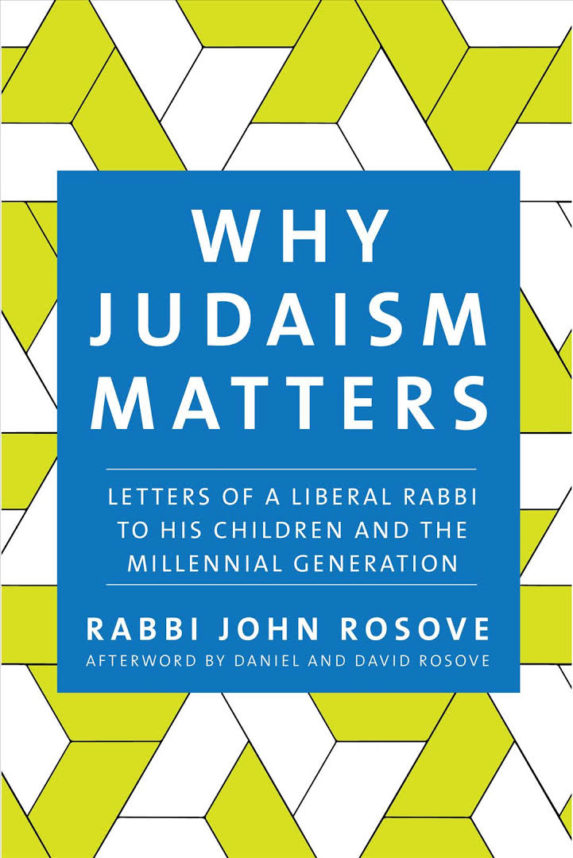
“Why Judaism Matter – Letters of a Liberal Rabbi to His Children and the Millennial Generation” with an Afterword by Daniel and David Rosove is now available for purchase on Amazon.com (publishing date – October 10). This book is a collection of thirteen letters offering a common sense guide and roadmap for a new generation of young men and women who find Jewish orthodoxy, tradition, issues, and beliefs impenetrable in 21st Century society. It is published by Jewish Lights Publishing, a division of Turner Publishing.

I have addressed this book of letters to millennials specifically, but this volume is also for their parents and grandparents, the younger generation of college-age Jews, and non-Jewish partners and spouses of Jews who are interested in the possibility of living meaningful and vibrant Jewish lives.

I invite you to purchase this book and share it with those you love.

Endorsements

“Rabbi John Rosove addresses his intellectual and well-reasoned investigation of faith to his own sons, which sets this book apart for its candor and its ability to penetrate not only the mind but also the heart.” – Matthew Weiner, creator of the AMC series Mad Men, and writer and producer on the HBO drama series The Sopranos. Matthew has earned nine Primetime Emmy Awards.

“John Rosove does what so many of us have struggled to do, and does it brilliantly: He makes the case for liberal Judaism to his children. As Rosove shows, liberal Judaism is choice-driven, messy, and always evolving, “traditional” in some ways and “radical” in others. It is also optimistic, spiritual, and progressive in both personal and political ethics. Without avoiding the hard stuff, such as intermarriage and Israel, Rabbi Rosove weaves all of these strands together to show the deep satisfactions of living and believing as a liberal Jew. All serious Jews, liberal or otherwise, should read this book.” – Rabbi Eric H. Yoffie, President Emeritus of the Union for Reform Judaism and a regular columnist for the Israeli daily newspaper Haaretz.

“Rabbi John Rosove has given a gift to all of us who care about engaging the next generation in Jewish life. The letters to his sons are really love-letters from countless voices of Jewish wisdom across history to all those young people who are seeking purpose in their lives. From wrestling with God, to advocating for peace and justice in Israel and at home, and living a life of purpose, this book is a compelling case for the joy of being Jewish.” – Rabbi Jonah Pesner, Director of the Religious Action Center of Reform Judaism in Washington, D.C.

“Rabbi John Rosove gets it. Here is a religious leader not afraid to tell it like it is, encapsulating for his audience the profound disaffection so many young Jews feel towards their heritage. But instead of letting them walk away, he makes a powerful case for the relevance of tradition in creating meaningful lives. In our technology-saturated, attention-absorbing age, Rosove offers religion-as-reprieve, his fresh vision of a thoroughly modern, politically-engaged and inclusive Judaism.” – Danielle Berrin, columnist and cover-story journalist for the Los Angeles Jewish Journal, commentator on CNN and MSNBC, and published work for The Guardian, British Esquire, and The Atlantic.

“Rabbi Rosove’s letters to his sons are full of Talmudic tales and practical parables, ancient wisdom with modern relevance, spiritual comfort, and intellectual provocation. Whether his subject is faith, love, intermarriage, success, Jewish continuity or the creation of a meaningful legacy, you’ll find yourself quoting lines from this beautiful book long after you’ve reached its final blessing.” – Letty Cottin Pogrebin, writer, speaker, social justice activist, author of eleven books including Debora, Gold, and Me: Being Female & Jewish in America, a founding editor of  Ms. Magazine, a regular columnist for Moment Magazine, and a contributor of op-eds in the New York Times, Washington Post, Boston Globe, Philadelphia Inquirer, Toronto Star, and LA Times, among other publications.

“If you’re a fellow Reform millennial, give yourself the gift of John’s insights. This book is written in a breezy, gentle, readable style that is welcoming without losing sharp insight. It was so enjoyable and refreshing to read and persuasive without ever being pushy. Rosove managed to do what only a truly worthy slice of kugel or chance viewing of Fiddler has done for me; reactivate my sense of wonder and gratitude about being Jewish. I’m a huge fan of WJM.” – Jen Spyra, staff comedy writer on The Late Show with Stephen Colbert (CBS), former senior writer for The Onion, actress, and stand-up comedian. Jen’s writing has appeared in The New Yorker, The Wall Street Journal, The New York Daily News, and The Daily Beast, and has been featured by The Laugh Factory Chicago’s Best Standup Show Case.

“Rabbi Rosove has written a wonderful book, a love letter to his children, and through them, to all our children. Prodigiously knowledgeable, exceedingly wise, and refreshingly honest, Rabbi Rosove has described why Judaism Matters. It should serve as a touching testament of faith, spanning the generations for generations to come.” – Rabbi Ammiel Hirsch, Senior Rabbi of Stephen Wise Free Synagogue in NYC, former Executive Director of the Association of Reform Zionists of America-World Union for Progressive Judaism, author of One People, Two Worlds: A Reform rabbi and an Orthodox rabbi explore the issues that divide them with Rabbi Yaakov Yosef Reinman.

“Rabbi Rosove has written a book of the utmost importance for our time. It is an imperative read for all those who struggle with the changing and evolving attitudes towards belonging, behavior and belief.  His analysis, stemming from deeply personal contemplation and decades of rabbinic experience, offers clear yet sophisticated approaches to tackling the challenges facing this generation and those to come. This book offers a treasure of wisdom through the lens of Jewish texts – both ancient and modern – which help to frame life’s major issues taking the reader from the particular to the universal. Israel is one of the most complicated of issues and he bridges the divide between Israel’s critics and staunch supporters and moves beyond the conversation of crisis for the millennial generation.” – Rabbi Joshua Weinberg, President of the Association of Reform Zionists of America

“John Rosove’s letters to his sons based on his life, philosophy, and rabbinic work address what it means to be a liberal and ethical Jew and a lover of Israel in an era when none are automatic. He writes in an unassuming personal style steeped in traditional texts as he confronts conflicts of faith and objectivity, Zionist pride and loving criticism of the Jewish state, traditional observance and religious innovation. He is never gratuitous and invites his readers into his family conversation because what he says is applicable to us all.” – Susan Freudenheim, Executive Director of Jewish World Watch,  journalist, former managing Editor of the Los Angeles Jewish Journal, and a former editor at the Los Angeles Times.

Majesty of Calmness – A Must-Read during the High Holidays

18 Monday Sep 2017

Posted by rabbijohnrosove in American Jewish Life, Beauty in Nature, Book Recommendations, Ethics, Health and Well-Being, Holidays, Quote of the Day

≈ Leave a comment

Calm - Ocean

I recommend highly a little book first published in 1898 called “The Majesty of Calmness” by William George Jordan, an American editor, lecturer and essayist of the late 19th and early 20th century.

This 62-page treasure-trove of common-sense wisdom reminds me of the Biblical Book of Proverbs and the wisdom literature of the Hebrew Bible. It was written in an elegant prose that exists in classical works.

This series of seven short essays is particularly appropriate reading during the coming ten days of Repentance between Rosh Hashanah and Yom Kippur: “The Majesty of Calmness;” “Hurry, the Scourge of America;” “The Power of Personal Influence;” “The Dignity of Self-Reliance;” “Failure of Success;” “Doing our Best at All Times;” “The Royal Road to Happiness.”

I offer a few short passages from each of the essays that offer a taste of what you will find in this remarkable series of essays:

“Calmness is the rarest quality in human life. It is the poise of a great nature, in harmony with itself and its ideals. It is the moral atmosphere of a life self-centered, self-reliant, and self-controlled.” (p. 1)

“Nature is very un-American. Nature never hurries. Every phase of her working shows plan, calmness, reliability, and the absence of hurry…Hurry has ruined more Americans than has any other word in the vocabulary of life….In the race for wealth, people often sacrifice time, energy, health, home, happiness, and honor, –everything that money cannot buy, the very things that money can never bring back.” (pps. 8, 9, 10)

“Self-confidence, without self-reliance, is as useless as a cooking recipe, –without food. Self-confidence sees the possibilities of the individual; self-reliance realizes them. Self-confidence sees the angel in the unhewn block of marble; self-reliance carves it out for himself.” (p. 23)

“Many of our failures sweep us to greater heights of success than we ever hoped for in our wildest dreams. Life is a successive unfolding of success from failure…Failure is often the turning-point, the pivot of circumstance that swings us to higher levels…Failure is one of God’s educators.” (pp. 33, 35, 36)

“Living at one’s best is constant preparation for instant use. It can never make one over precise, self-conscious, affected, or priggish. Education, in its highest sense, is conscious training of mind or body to act unconsciously. It is conscious formation of mental habits, not mere acquisition of information.” (p. 46)

“Happiness is the greatest paradox in Nature. It can grow in any soil, live under any conditions. It defies environment. It comes from within: it is the revelation of the depths of the inner life as light and heat proclaim the sun from which they radiate. Happiness consists not of having, but of being; not of possessing, but of enjoying. It is the warm glow of a heart at peace with itself.” (p. 53)

“Majesty of Calmness” can be purchased on Amazon for $4.95. Do yourself a huge favor. Read it once, and then read it again.


A Yemenite Jew who doesn’t want to get out of bed

14 Thursday Sep 2017

Posted by rabbijohnrosove in American Jewish Life, Divrei Torah, Ethics, Health and Well-Being, Holidays, Stories

≈ 1 Comment

At this season we Jews ask ourselves the most basic of questions:
 
Where am I? What’s the state of my inner life, my relationships with the people I love, with Judaism and tradition, and with God? How through habit and a lack of will have I strayed from a healthy, integrated, loving, and generous life?
The Torah this week (Parashat Nitzavim) reminds us that “This mitzvah that I command you this day is not too hard for you, nor too remote…” (Deuteronomy 30:11)
 
A wonderful Midrash from Yemen shines a light on what is common to everyone:
 
“They say to a person: ‘Go to a certain town and learn Torah there.’ But the person answers: ‘I am afraid of the lions that I will encounter on the way.’
 
So they say: ‘You can go and learn in another town that is closer.’ But the person replies: ‘I am afraid of the thieves.’
So they suggest: ‘There is a sage in your own city. God and learn from him.’
 
But the person replies: ‘What if I find the door locked, and I have to return to where I am?’
 
So they say: ‘There is a teacher sitting and teaching right here in the chair next to you.’ But the person replies: ‘You know what? What I really want to do is go back to sleep!’ That is what Scripture refers to when it says in Proverbs 26:14: ‘The door is turning upon its hinges, and the lazy is still upon his bed.’” -Yalkut Midreshei Teiman
 
Do we recognize ourselves in this Midrash? Though the mitzvah refers to learning Torah its application is far broader. The protagonist lists one hundred and one ways why he can’t learn or find a teacher, mentor or guide to help him grow and change.
 
Are we not like the Jew in the story?
 
Like him, so often we just don’t want to get out of bed nor confront our shortcomings, inadequacies, and failures of will.
 
Like the Jew in the story, so often we’re accustomed to doing things the way we always have done them, even if they’re dysfunctional and self-destructive, and even if they’re the source and cause of our alienation from others and unhappy relationships.
 
Like the Jew in the story, so often we find reasons to avoid change.
 
Like the Jew in the story, so often we’re stubborn. Though there’s comfort in routine, a routine may keep us stuck in the past when we should be living our lives forward.
 
As Chassidic wisdom teaches, if you want to go east but are going west, all you have to do is turn around and take that first step.
 
This is the season of turning, and though changing direction may require an extreme act of will before taking that first step, once we do it, the second step is easier to take and the third easier still.
 
Shabbat Shalom.
Painting by Reuben Reubens


Overcoming Despair and Beginning Again

11 Monday Sep 2017

Posted by rabbijohnrosove in Ethics, Health and Well-Being, Holidays, Inuyim - Prayer reflections and ruminations, Jewish Identity, Musings about God/Faith/Religious life

≈ 2 Comments

The central theme of the High Holidays is teshuvah, a restorative process that brings us back to ourselves, to our families and friends, to our community, to humanity, to the natural world, to Torah, and to God. Teshuvah demonstrates the power of hope, that who we are today need not be who we become tomorrow.

Teshuvah is a step-by-step process of turning and re-engaging with our inclinations, the yetzer hara-the evil urge that’s propelled by desire, lust, and self-centered needs and our yetzer tov-the good inclination that is inspired by humility, gratitude, generosity, and kindness.

The beginning in the teshuvah process is, however, despair, hopelessness, and sadness, the feeling that we’re stuck and can’t change the nature, character, and direction our lives have taken us.

Judaism rejects pessimism, cynicism, and everything that impedes personal transformation and a hopeful future.

In the story of Jonah, to be read as final scriptural portion on the afternoon of Yom Kippur, we read the tale of the prophet’s descent into despair and what’s required for him to change direction and restore a hopeful self.

Jonah is an unrealized prophet who runs away from himself, from civilization, and from God. Every verb used in his journey is the language of descent (yod-resh-daled). He flees down to the sea. He boards a ship and goes down into its dark interior. He lies down and falls into a deep sleep. He is thrown overboard down into the waters. A great fish swallows him and he finds himself down in its belly where he remains in utter darkness for three days and nights until his despair forces him, at last, to choose to live and not to die. Then he cries out to God to save him.

God responds and the great fish vomits Jonah out onto dry land. Jonah agrees this time to do God’s bidding and preach to the Ninevites to repent from their evil ways. The town’s people put on sack cloth and ashes and promise to change.

Jonah, however, still believes that change is impossible and the Ninevites are destined to failure. God chastises Jonah for his pessimism and lack of faith, for his self-centered concern for himself and not the well-being of others.

Teshuvah is difficult and challenging. It’s a dramatic break from the past, our refusal to remain stuck. It’s for the strong of mind, heart and soul, for those willing to work hard and transcend their suffering and fear of failure, to get up every time, to own without defense and excuse what we do and what we’ve become, to acknowledge all of it, to apologize to ourselves and to others without conditions that we are responsible and at fault, and to recommit to our struggle step-by-step, patiently, one day at a time, one hour at a time, one moment at a time to turn our lives around.

When successful, teshuvah is restorative and utopian, for it enables us to return to our best selves, to the place of soul, to the garden of oneness.

Rabbi Joseph Soloveitchik wrote that in teshuvah we’re able even to transcend time: “The future has overcome the past.”

Originally published – September 13, 2015


The Time for Forgiveness is Now!

03 Sunday Sep 2017

Posted by rabbijohnrosove in American Jewish Life, Ethics, Health and Well-Being, Holidays, Musings about God/Faith/Religious life, Stories

≈ 1 Comment

Forgiveness (i.e. forgiving others and forgiving ourselves) may be the most difficult challenge we ever have to face. However, we often make it more difficult than it needs to be because we misunderstand what forgiveness is and is meant to do.

Forgiving others doesn’t mean excusing their bad behavior or forgetting that they wronged us. Even if people who hurt us don’t apologize to us and even if they continue to justify what they did that is contrary to what we believe actually happened, we ought to forgive them not for their sake but for ours. Forgiveness means “letting go” of resentments because these negative and toxic feelings are damaging to us.

Having noted this, the ideal goal of forgiveness is to reconcile and reestablish some kind of relationship with the offending “other.” Let me be quick to say, however, that reconciliation isn’t always possible if, for example, the person who harmed us or we harmed is deceased, nor is it always desirable if the “other” is so incorrigible, narcissistic, and damaged that we have no desire for reconciliation.

Here, however, is one positive example of what forgiveness can do.

A woman in her 70s hadn’t spoken with her sister in forty years. Out of the blue one day her sister called to tell her that she was dying and wanted to see her. They met, her sister apologized for the wrong that caused the breach so long before, and asked for forgiveness. They wept together and reconciled. After her sister died the woman felt a heavy burden lifted from her heart, and the love she once felt for her sister returned.

There is no time like the present (in this season of Elul before Rosh Hashanah in particular) to summon the courage, take the risk, and seek forgiveness from those we’ve wronged even if the event occurred many years ago. Hopefully, those who wronged us will do the same. There is no expiration date nor is there a statute of limitations on forgiveness.

Michael McCullough extends the principles of forgiveness to groups, communities, and nations:

“The forgiveness instinct … can change the world. Groups can be helped to forgive other groups, communities can be helped to forgive other communities, …and nations can even be helped to forgive other nations. Leaders… can offer apologies on behalf of their people to groups with whom they’ve been in conflict. They can also offer … remorse and empathy for the suffering of another group, and they can provide compensation to groups of people whom they’ve harmed – just as individuals can. When they engage in such gestures, it is often to great effect.” (Beyond Revenge – The Evolution of the Forgiveness Instinct, [Jossey-Bass, San Francisco, 2008] p. 181-2)

Think of the power of Pope John Paul II’s apology to the Jewish people for Christendom’s participation in the Holocaust, the Japanese apology for war atrocities it committed against China and Korea, the United States’ apology to Japanese Americans interred in concentration camps during World War II, and the Irish Republican Army’s apology for the deaths of noncombatants during the war in northern Ireland.

Imagine Prime Minister Netanyahu on behalf of Israel and President Abbas on behalf of the Palestinians taking a similar step and apologizing to the other for the pain and suffering each people caused non-combatants on the other side. If this were to happen, if either took the initiative, I believe that a peaceful resolution of the Israeli-Palestinian conflict is possible.

Longfellow wrote: “If we could read the secret history of our enemies, we should find in each person’s life sorrow and suffering enough to disarm all hostility.”

Note: Selichot (the Holiday in which Judaism teaches that the Gates of Heaven begin to open to receive the petitionary prayers of the community) this year falls on Saturday night, September 16. Those who live in Los Angeles and are unaffiliated are welcome to join us at Temple Israel of Hollywood. We’ll convene for learning with the Rabbis at 8:30 pm considering all aspects of forgiveness, followed by a presentation by Theater Dybbuk on the theme of forgiveness, and then we’ll join together in the mystical service of Selichot in which we will change the Torah mantles on all our sifrei Torah to white. Come dressed in white.  

L’shanah tovah.


Why Forgive?

30 Wednesday Aug 2017

Posted by rabbijohnrosove in American Jewish Life, Ethics, Health and Well-Being, Holidays, Inuyim - Prayer reflections and ruminations

≈ 1 Comment

forgiveness-001

During the thirty days before Rosh Hashanah we Jews begin the process of returning (Teshuvah) to the people from whom we’ve become alienated, to the Jewish community, to Torah, to one’s own soul, to a balanced relationship with nature, and to God. Part of that journey requires the act forgiveness in all its dimensions. Forgiving those who have hurt us is not easy.

I’ve come to the conclusion that our forgiving others and forgiving ourselves for past wrongs means letting go of hurt, anger, resentment, jealousy, envy, and hate, and thereby becoming free. If we are successful, the ensuing relationship we develop with the “other” will necessarily be different than it was. In many cases, the change that takes place in us requires letting go not only of the toxic relationship that caused us so much pain and hardship but any future relationship with the “other.”

On Saturday night, September 16, the Jewish world enters into a midnight service called “Selichot” (“forgiveness”) when tradition teaches that the gates of heaven begin to open to receive our prayers and supplications. Selichot is the opening service of the High Holiday season and it occurs on Saturday night just before Rosh Hashanah. It is a powerful service if we take the need for forgiveness seriously.

I have compiled a list of quotations from world literature that offer wisdom and insight into the purpose and benefits of forgiveness. I present it to you as a gift.

“Forgiveness sets you free!” – Mother Teresa

“The weak can never forgive. Forgiveness is the attribute of the strong.” – Mohandas “Mahatma” Gandhi

“I can forgive, but I cannot forget” is only another way of saying, ‘I will not forgive.’ Forgiveness ought to be like a canceled note — torn in two, and burned up, so that it never can be shown against one.” – Henry Ward Beecher

“A wise person will make haste to forgive, because s/he knows the true value of time, and will not suffer it to pass away in unnecessary pain.” – Samuel Johnson

“Those who cannot forgive others break the bridge over which they themselves must pass.” – Confucius

“To forgive someone does not mean you excuse their behavior or that they were bad. To forgive means getting rid of your resentment, so that it does not complicate your own life.” – Rabbi Abraham J Twerski

“The primary aspect of forgiveness is not as an act of kindness toward the offender, but as a gift to oneself, to free one of the burdens of harboring resentment, which can have negative effects, both physically and emotionally.” – Rabbi Abraham J Twerski

“Forgiveness isn’t about pardoning the one who has hurt us. We simply decide to move on.” – Rabbi Edwin Goldberg

“If we could read the secret history of our enemies, we should find in each person’s life sorrow and suffering enough to disarm all hostility.” – Henry Wadsworth Longfellow

“The day the child realizes that all adults are imperfect, s/he becomes an adolescent; the day s/he forgives them, s/he becomes an adult; the day s/he forgives her/himself, s/he becomes wise.” – Alden Nowlan

“Ribono shel olam! I hereby forgive everyone who has angered or provoked me or sinned against me, whether against me physically, financially, or against my dignity, or against anything belonging to me, whether it was done under duress, or intentionally, or inadvertently or willfully, whether it was verbal, or by deed, or by thought, whether it was in this existence or in a previous existence, everyone, and may no person ever be punished because of me.” – Jewish bedtime prayer

L’shanah tovah!

Have Smartphones Destroyed a Generation?

15 Tuesday Aug 2017

Posted by rabbijohnrosove in American Politics and Life, Health and Well-Being

≈ 2 Comments

This is a must-read article for anyone who cares about our kids and the impact that Smart Phones are having on those born after 2000.
 
Jean M. Twenge writes this important piece in the September 2017 edition of The Atlantic. She is a professor of psychology at San Diego State University and the author of Generation Me and iGen.
 
“Psychologically, however, they are more vulnerable than Millennials were: Rates of teen depression and suicide have skyrocketed since 2011. It’s not an exaggeration to describe iGen as being on the brink of the worst mental-health crisis in decades. Much of this deterioration can be traced to their phones.
 
…the twin rise of the smartphone and social media has caused an earthquake of a magnitude we’ve not seen in a very long time, if ever. There is compelling evidence that the devices we’ve placed in young people’s hands are having profound effects on their lives—and making them seriously unhappy.”
 
https://www.theatlantic.com/magazine/archive/2017/09/has-the-smartphone-destroyed-a-generation/534198/
 

When Mortality Stares Back at Us

09 Sunday Jul 2017

Posted by rabbijohnrosove in Health and Well-Being, Life Cycle

≈ 3 Comments

A good friend, a few years older than me, told me this week that he just received a heart stent to open one of his 90% occluded arteries. His doctors explained that without the stent he risked suffering a massive and likely fatal heart attack at any time.

He appeared vulnerable and in shock and confessed that he felt both terrified and grateful: “My mortality stared me in the face.”

Relieved, I responded: “Thankfully, you have yet to write more chapters of your life!”

Eight years ago following cancer surgery and radiation therapy (I’m fine now), I learned two important truths. The first is that healing physically from surgery and treatment is the easier part of a post-traumatic and life threatening event, but it is very different than the emotional and spiritual healing that’s also required. The latter takes much longer and necessitates far more introspection and inner emotional, psychological, and spiritual struggle to adjust to the new reality of our lives.

Most young people don’t think much about the end of life, but as we age we realize that there are fewer years ahead of us than there are behind us. When we suffer an event as my friend did this past week, we necessarily become excruciatingly aware of our life circumstances.

Thankfully, advances in medicine have extended life expectancy substantially, and there is little doubt that my friend has been given a reprieve by the angel of death.

Twenty years ago after his father died, he told me that he had read all 150 Psalms and had found great comfort and perspective in its verse.

Tradition attributes the authorship of the Psalms to King David as an old man who had lived a full, dramatic, challenging, and often heart-breaking life.

When my friend told me about his experience reading the Psalms, I said that perhaps I ought to teach them in my community. He liked the idea but thought I was too young and though I’d experienced much in my own life already and witnessed much in the lives of the people in my community, the Psalms, he reflected, required a person of age to teach them as they ought to be taught. He believed that no young person could adequately understand them.

I put aside the idea and wonder now if I’m ready.


Call Fence-Sitting Senators to Vote “Nay” on the Senate “Health Care Bill”

23 Friday Jun 2017

Posted by rabbijohnrosove in American Politics and Life, Ethics, Health and Well-Being, Social Justice, Women's Rights

≈ 1 Comment

[Edit]

“It was once said that the moral test of government is how that government treats those who are in the dawn of life, the children; those who are in the twilight of life, the elderly; and those who are in the shadows of life, the sick, the needy and the handicapped.” (Former Senator and Vice President of the United States, Hubert H. Humphrey)

So – the question is this! Does the Senate’s health care reform bill released yesterday pass this moral test?

Our own Reform movement sharply criticized this Republican Senate bill because it would repeal and replace major parts of the Affordable Care Act, make severe cuts to Medicaid, get rid of the legal requirement that most Americans have health coverage, and remove federal tax credits to aid Americans in paying for health insurance.

The Religious Action Center of Reform Judaism in Washington, D.C. has called this measure “deeply harmful” and yesterday, the RAC made the following statement:

“The Senate bill revealed this morning is a major undermining of American health care that will hurt Americans most in need: the elderly, the poor, children and people with disabilities…Jewish tradition’s emphasis on caring for the sick and lifting up those in need inspires us to call on Senators to reject the Better Care Reconciliation Act of 2017.”

Here are some of the specifics in the bill’s provisions:

  • It enables insurance companies to charge five times the cost of insurance to people over fifty;
  • It denies coverage for maternity care, mental health care, and substance abuse to millions of Americans;
  • It dramatically cuts treatments for those who have opioid disorders;
  • It defunds Planned Parenthood on which 2.4 million people depend for their health care;
  • It has dramatic cuts to Medicare effective over time;
  • The following categories of people will be affected: 49% of all births – 64% for all nursing home residents – 30% of adults with disabilities – 40% of all poor – 39% of all children – 76% of poor children – 60% of all children with disabilities

This bill is an attack on the weakest Americans in order to give massive tax cuts for the top 1% of the wealthiest of Americans – consequently, it does indeed fail Hubert Humphrey’s moral test of government.

The Congressional Budget Office (CBO) will issue a cost analysis at the beginning of the week, but Senate Majority Leader Mitchell has insisted that there be a vote before the Fourth of July Congressional recess. For a bill that affects one-sixth of the American economy and impacts negatively the lives of more than 20 million Americans, he refuses to allow time for debate, discussion, or analysis of this bill.

The Affordable Care Act of 2010 took one year to pass with massive amounts of House and Senate discussion and more than 200 amendments. Senator Mitch McConnell thinks that Americans and the Senate have discussed health care enough and it’s time to fulfill the President’s and the Republican promise to repeal and replace Obamacare, though a great majority of the American people don’t want it replaced.

This is not democracy, nor is it reflective of the humane tradition of America.

What ought we to do?

We have a weekend to have our voices be heard and we should make them heard by calling the ten fence-sitting Senators who have not as yet signed onto this Senate bill (per Families USA).

We ought to flood their Washington DC offices with calls and emails to demand that they vote no on this Senate bill.

The ten include Senator Susan Collins (R. Maine), Senator Lisa Murkowski (R. Alaska), Senator Bill Cassidy (R. Louisiana), Senator Jeff Flake (R. AZ), Senator Cory Gardner (R. Colorado), Senator Rob Portman (R. Ohio), Senator Ted Cruz (R. Texas), Senator Rand Paul (R. Kentucky), Senator Mike Lee (R. Utah), and Senator Ben Sasse (R. Nebraska).

We Jews are inspired by the example set over many centuries in Jewish tradition which instructs communities to provide health care to their inhabitants. In RAMBAM’s Mishneh Torah (Hilchot De’ot IV: 23) it’s written:

כל עיר שאין בה עשרה דברים האלו אין תלמיד חכם רשאי לדור בתוכה ואלו הן

רופא

“A Torah Sage is not permitted to live in a community which does not have the following: a doctor.”

Please make those calls!


“Why Judaism Matters” Pre-Order My Book to be published September 26

01 Thursday Jun 2017

Posted by rabbijohnrosove in American Jewish Life, American Politics and Life, Book Recommendations, Divrei Torah, Ethics, Health and Well-Being, Inuyim - Prayer reflections and ruminations, Israel and Palestine, Israel/Zionism, Jewish History, Jewish Identity, Musings about God/Faith/Religious life, Social Justice

≈ 1 Comment

My book “Why Judaism Matters – Letters of a Liberal Rabbi to His Children and the Millennial Generation” is a common sense guide and road map for a generation of young men and women who find Jewish orthodoxy, tradition, issues, and beliefs impenetrable in 21st Century society. By illustrating how the tenets of Judaism still apply in our modern world, I offer direction not only to my own sons but to the sons and daughters of Reform Jews everywhere. My sons, Daniel and David, have written the Afterword. The book will be published on September 26 by Jewish Lights Publishing (a division of Turner Publishing).

Why Judaism Matters -Letters of a Liberal Rabbi to his Children and the Millennial Generation

Rabbi John Rosove

6 x 9, 240 pp, Paperback, 978-1-68336-705-5

http://www.jewishlights.com/page/product/978-1-68336-705-5

Why Judaism Matters: Letters of a Liberal Rabbi to his Children and the Millennial Generation – Kindle edition by Rabbi John Rosove.

← Older posts
Newer posts →

Enter your email address to subscribe to this blog and receive notifications of new posts by email.

Join 366 other subscribers

Archive

  • March 2026 (2)
  • February 2026 (6)
  • January 2026 (8)
  • December 2025 (4)
  • November 2025 (6)
  • October 2025 (8)
  • September 2025 (3)
  • August 2025 (6)
  • July 2025 (4)
  • June 2025 (5)
  • May 2025 (4)
  • April 2025 (6)
  • March 2025 (8)
  • February 2025 (4)
  • January 2025 (8)
  • December 2024 (5)
  • November 2024 (5)
  • October 2024 (3)
  • September 2024 (7)
  • August 2024 (5)
  • July 2024 (7)
  • June 2024 (5)
  • May 2024 (5)
  • April 2024 (4)
  • March 2024 (8)
  • February 2024 (6)
  • January 2024 (5)
  • December 2023 (4)
  • November 2023 (4)
  • October 2023 (9)
  • September 2023 (8)
  • August 2023 (8)
  • July 2023 (10)
  • June 2023 (7)
  • May 2023 (6)
  • April 2023 (8)
  • March 2023 (5)
  • February 2023 (9)
  • January 2023 (8)
  • December 2022 (10)
  • November 2022 (5)
  • October 2022 (5)
  • September 2022 (10)
  • August 2022 (8)
  • July 2022 (8)
  • June 2022 (5)
  • May 2022 (6)
  • April 2022 (8)
  • March 2022 (11)
  • February 2022 (3)
  • January 2022 (7)
  • December 2021 (6)
  • November 2021 (9)
  • October 2021 (8)
  • September 2021 (6)
  • August 2021 (7)
  • July 2021 (7)
  • June 2021 (6)
  • May 2021 (11)
  • April 2021 (4)
  • March 2021 (9)
  • February 2021 (9)
  • January 2021 (14)
  • December 2020 (5)
  • November 2020 (12)
  • October 2020 (13)
  • September 2020 (17)
  • August 2020 (8)
  • July 2020 (8)
  • June 2020 (8)
  • May 2020 (8)
  • April 2020 (11)
  • March 2020 (13)
  • February 2020 (13)
  • January 2020 (15)
  • December 2019 (11)
  • November 2019 (9)
  • October 2019 (5)
  • September 2019 (10)
  • August 2019 (9)
  • July 2019 (8)
  • June 2019 (12)
  • May 2019 (9)
  • April 2019 (9)
  • March 2019 (16)
  • February 2019 (9)
  • January 2019 (19)
  • December 2018 (19)
  • November 2018 (9)
  • October 2018 (17)
  • September 2018 (12)
  • August 2018 (11)
  • July 2018 (10)
  • June 2018 (16)
  • May 2018 (15)
  • April 2018 (18)
  • March 2018 (8)
  • February 2018 (11)
  • January 2018 (10)
  • December 2017 (6)
  • November 2017 (12)
  • October 2017 (8)
  • September 2017 (17)
  • August 2017 (10)
  • July 2017 (10)
  • June 2017 (12)
  • May 2017 (11)
  • April 2017 (12)
  • March 2017 (10)
  • February 2017 (14)
  • January 2017 (22)
  • December 2016 (13)
  • November 2016 (12)
  • October 2016 (8)
  • September 2016 (6)
  • August 2016 (6)
  • July 2016 (10)
  • June 2016 (10)
  • May 2016 (11)
  • April 2016 (13)
  • March 2016 (10)
  • February 2016 (11)
  • January 2016 (9)
  • December 2015 (10)
  • November 2015 (12)
  • October 2015 (8)
  • September 2015 (7)
  • August 2015 (10)
  • July 2015 (7)
  • June 2015 (8)
  • May 2015 (10)
  • April 2015 (9)
  • March 2015 (12)
  • February 2015 (10)
  • January 2015 (12)
  • December 2014 (7)
  • November 2014 (13)
  • October 2014 (9)
  • September 2014 (8)
  • August 2014 (11)
  • July 2014 (10)
  • June 2014 (13)
  • May 2014 (9)
  • April 2014 (17)
  • March 2014 (9)
  • February 2014 (12)
  • January 2014 (15)
  • December 2013 (13)
  • November 2013 (16)
  • October 2013 (7)
  • September 2013 (8)
  • August 2013 (12)
  • July 2013 (8)
  • June 2013 (11)
  • May 2013 (11)
  • April 2013 (12)
  • March 2013 (11)
  • February 2013 (6)
  • January 2013 (9)
  • December 2012 (12)
  • November 2012 (11)
  • October 2012 (6)
  • September 2012 (11)
  • August 2012 (8)
  • July 2012 (11)
  • June 2012 (10)
  • May 2012 (11)
  • April 2012 (13)
  • March 2012 (10)
  • February 2012 (9)
  • January 2012 (14)
  • December 2011 (16)
  • November 2011 (23)
  • October 2011 (21)
  • September 2011 (19)
  • August 2011 (31)
  • July 2011 (8)

Categories

  • American Jewish Life (458)
  • American Politics and Life (417)
  • Art (30)
  • Beauty in Nature (24)
  • Book Recommendations (52)
  • Divrei Torah (159)
  • Ethics (490)
  • Film Reviews (6)
  • Health and Well-Being (156)
  • Holidays (136)
  • Human rights (57)
  • Inuyim – Prayer reflections and ruminations (95)
  • Israel and Palestine (358)
  • Israel/Zionism (502)
  • Jewish History (441)
  • Jewish Identity (372)
  • Jewish-Christian Relations (51)
  • Jewish-Islamic Relations (57)
  • Life Cycle (53)
  • Musings about God/Faith/Religious life (190)
  • Poetry (86)
  • Quote of the Day (101)
  • Social Justice (355)
  • Stories (74)
  • Tributes (30)
  • Uncategorized (835)
  • Women's Rights (152)

Blogroll

  • Americans for Peace Now
  • Association of Reform Zionists of America (ARZA)
  • Congregation Darchei Noam
  • Haaretz
  • J Street
  • Jerusalem Post
  • Jerusalem Report
  • Kehillat Mevesseret Zion
  • Temple Israel of Hollywood
  • The IRAC
  • The Jewish Daily Forward
  • The LA Jewish Journal
  • The RAC
  • URJ
  • World Union for Progressive Judaism

Blog at WordPress.com.

  • Subscribe Subscribed
    • Rabbi John Rosove's Blog
    • Join 366 other subscribers
    • Already have a WordPress.com account? Log in now.
    • Rabbi John Rosove's Blog
    • Subscribe Subscribed
    • Sign up
    • Log in
    • Report this content
    • View site in Reader
    • Manage subscriptions
    • Collapse this bar
 

Loading Comments...