• About

Rabbi John Rosove's Blog

Rabbi John Rosove's Blog

Category Archives: Israel/Zionism

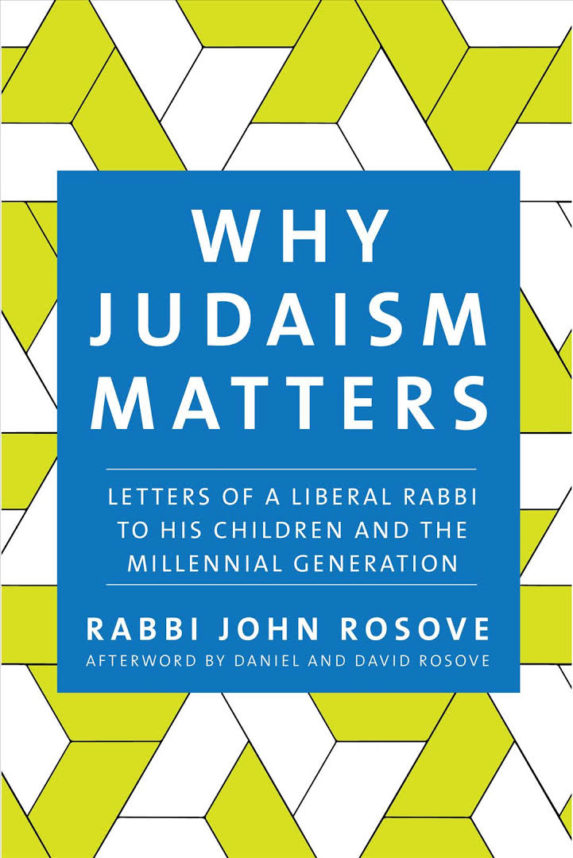
“Why Judaism Matters – Letters of a Liberal Rabbi to His children and the Millennial Generation” – Reading and Book Signing – November 27 at 7 PM – Chevaliers Bookstore, Los Angeles

19 Sunday Nov 2017

Posted by rabbijohnrosove in American Jewish Life, American Politics and Life, Book Recommendations, Divrei Torah, Ethics, Health and Well-Being, Holidays, Israel and Palestine, Israel/Zionism, Jewish History, Jewish Identity, Life Cycle, Musings about God/Faith/Religious life, Social Justice, Stories, Uncategorized

≈ Leave a comment

Book cover

Chevaliers Books is the oldest independent book store in Los Angeles and is located at 126 N Larchmont Blvd, Los Angeles, CA 90004 in Hancock Park.

I would love to see you there!

“Why Judaism Matter – Letters of a Liberal Rabbi to His Children and the Millennial Generation” with an Afterword by Daniel and David Rosove is now available for purchase on Amazon.com (publishing date – October 10). This book is a collection of thirteen letters offering a common sense guide and roadmap for a new generation of young men and women who find Jewish orthodoxy, tradition, issues, and beliefs impenetrable in 21st Century society. It is published by Jewish Lights Publishing, a division of Turner Publishing.

Endorsements

“Rabbi Rosove’s letters to his sons are full of Talmudic tales and practical parables, ancient wisdom with modern relevance, spiritual comfort, and intellectual provocation. Whether his subject is faith, love, intermarriage, success, Jewish continuity or the creation of a meaningful legacy, you’ll find yourself quoting lines from this beautiful book long after you’ve reached its final blessing.” – Letty Cottin Pogrebin, writer, speaker, social justice activist, author of eleven books including Debora, Gold, and Me: Being Female & Jewish in America, a founding editor of  Ms. Magazine, a regular columnist for Moment Magazine, and a contributor of op-eds in the New York Times, Washington Post, Boston Globe, Philadelphia Inquirer, Toronto Star, and LA Times, among other publications.

 “John Rosove does what so many of us have struggled to do, and does it brilliantly: He makes the case for liberal Judaism to his children. As Rosove shows, liberal Judaism is choice-driven, messy, and always evolving, “traditional” in some ways and “radical” in others. It is also optimistic, spiritual, and progressive in both personal and political ethics. Without avoiding the hard stuff, such as intermarriage and Israel, Rabbi Rosove weaves all of these strands together to show the deep satisfactions of living and believing as a liberal Jew. All serious Jews, liberal or otherwise, should read this book.” – Rabbi Eric H. Yoffie, President Emeritus of the Union for Reform Judaism and a regular columnist for the Israeli daily newspaper Haaretz.

“Rabbi John Rosove has given a gift to all of us who care about engaging the next generation in Jewish life. The letters to his sons are really love-letters from countless voices of Jewish wisdom across history to all those young people who are seeking purpose in their lives. From wrestling with God, to advocating for peace and justice in Israel and at home, and living a life of purpose, this book is a compelling case for the joy of being Jewish.” – Rabbi Jonah Pesner, Director of the Religious Action Center of Reform Judaism in Washington, D.C.

“Rabbi John Rosove gets it. Here is a religious leader not afraid to tell it like it is, encapsulating for his audience the profound disaffection so many young Jews feel towards their heritage. But instead of letting them walk away, he makes a powerful case for the relevance of tradition in creating meaningful lives. In our technology-saturated, attention-absorbing age, Rosove offers religion-as-reprieve, his fresh vision of a thoroughly modern, politically-engaged and inclusive Judaism.” – Danielle Berrin, columnist and cover-story journalist for the Los Angeles Jewish Journal, commentator on CNN and MSNBC, and published work for The Guardian, British Esquire, and The Atlantic.

 “If you’re a fellow Reform millennial, give yourself the gift of John’s insights. This book is written in a breezy, gentle, readable style that is welcoming without losing sharp insight. It was so enjoyable and refreshing to read and persuasive without ever being pushy. Rosove managed to do what only a truly worthy slice of kugel or chance viewing of Fiddler has done for me; reactivate my sense of wonder and gratitude about being Jewish. I’m a huge fan of WJM.” – Jen Spyra, staff comedy writer on The Late Show with Stephen Colbert (CBS), former senior writer for The Onion, actress, and stand-up comedian. Jen’s writing has appeared in The New Yorker, The Wall Street Journal, The New York Daily News, and The Daily Beast, and has been featured by The Laugh Factory Chicago’s Best Standup Show Case.

“Rabbi Rosove has written a wonderful book, a love letter to his children, and through them, to all our children. Prodigiously knowledgeable, exceedingly wise, and refreshingly honest, Rabbi Rosove has described why Judaism Matters. It should serve as a touching testament of faith, spanning the generations for generations to come.” – Rabbi Ammiel Hirsch, Senior Rabbi of Stephen Wise Free Synagogue in NYC, former Executive Director of the Association of Reform Zionists of America-World Union for Progressive Judaism, author of One People, Two Worlds: A Reform rabbi and an Orthodox rabbi explore the issues that divide them with Rabbi Yaakov Yosef Reinman.

“Rabbi Rosove has written a book of the utmost importance for our time. It is an imperative read for all those who struggle with the changing and evolving attitudes towards belonging, behavior and belief.  His analysis, stemming from deeply personal contemplation and decades of rabbinic experience, offers clear yet sophisticated approaches to tackling the challenges facing this generation and those to come. This book offers a treasure of wisdom through the lens of Jewish texts – both ancient and modern – which help to frame life’s major issues taking the reader from the particular to the universal. Israel is one of the most complicated of issues and he bridges the divide between Israel’s critics and staunch supporters and moves beyond the conversation of crisis for the millennial generation.” – Rabbi Joshua Weinberg, President of the Association of Reform Zionists of America

“John Rosove’s letters to his sons based on his life, philosophy, and rabbinic work address what it means to be a liberal and ethical Jew and a lover of Israel in an era when none are automatic. He writes in an unassuming personal style steeped in traditional texts as he confronts conflicts of faith and objectivity, Zionist pride and loving criticism of the Jewish state, traditional observance and religious innovation. He is never gratuitous and invites his readers into his family conversation because what he says is applicable to us all.” – Susan Freudenheim, Executive Director of Jewish World Watch,  journalist, former managing Editor of the Los Angeles Jewish Journal, and a former editor at the Los Angeles Times.

See 11 Reader 5 Star Reviews at Amazon.com
The Kotel Agreement and the Conversion Law – A Report from Jerusalem

05 Sunday Nov 2017

Posted by rabbijohnrosove in American Jewish Life, Israel and Palestine, Israel/Zionism, Jewish History, Jewish Identity, Social Justice, Women's Rights

≈ 2 Comments

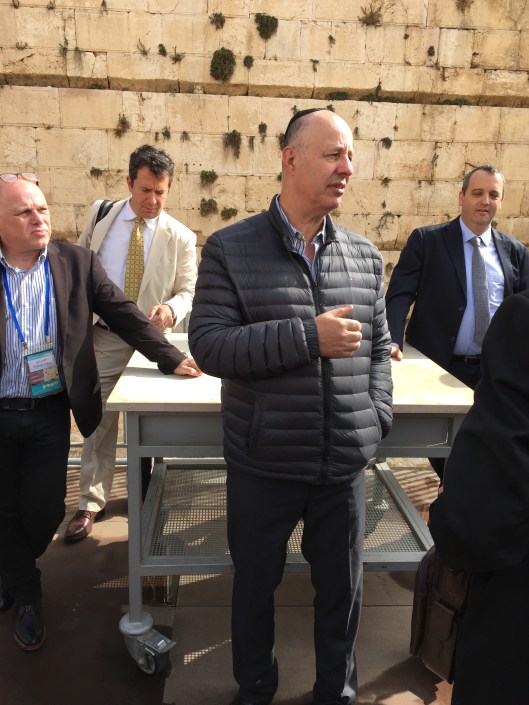
Tzachi Hanegbi at Kotel - November 2017

Tzachi Hanegbi above. Rabbi Gilad Kariv, Executive Director of the Israel Movement for Progressive Judaism is standing behind Minister Hanegbi and to his left. My photo.

I just returned from meetings of the Board of Governors of the Jewish Agency for Israel (BOG of JAFI) and the Zionist Council of the World Zionist Organization (Vaad HaPoel of the WZO) that met this past week in Jerusalem. (See historical notes below about these two national institutions of the Jewish people).

Two items were prominent on the agenda of JAFI – The Kotel Agreement compromise reached by the government of Israel in January 2016 (19 months ago) and the Conversion Law introduced before the Knesset by the ultra-Orthodox religious parties.

Re: the Kotel Agreement compromise – This agreement was reached after nearly four years of negotiations. If implemented the agreement would create an egalitarian prayer space in the southern Kotel plaza that would be equal in size and accessibility with the traditional Kotel plaza. Whereas the traditional Kotel plaza would continue to be controlled and supervised by the ultra-Orthodox Administrator of the Wall, the new southern Kotel plaza would be controlled and supervised by the Reform and Conservative movements, the Jewish Federations of North America, and the Women of the Wall. There would be a common entrance and both the traditional and southern plazas would be visible from that entrance. The new southern Kotel plaza would include egalitarian mixed-gender prayer.

Prime Minister Netanyahu had asked Natan Sharansky in 2013 to find a compromise agreement that would calm the tensions that had developed as a consequence of the monthly prayer minyanim observed by Women of the Wall in the back of the women’s section for the last 25 years, and would address the concerns of many Israelis that the entire Kotel plaza had been turned into an ultra-Orthodox synagogue. Non-religious ceremonies had once been conducted in the plaza by the State of Israel including the induction of soldiers into the IDF. Whereas the plaza represented the modern State of Israel as a national heritage site, it had been taken over by the most extreme religious forces in the state.

Natan Sharansky and the committee representing all interested parties (including the ultra-Orthodox Administrator of the Wall) succeeded in reaching a compromise. Should the agreement then be implemented as intended, it would have marked a victory for religious pluralism and democracy as stated in Israel’s Declaration of Independence.

However, on June 25, 2017, the Prime Minister abandoned the agreement when the ultra-Orthodox religious parties in his ruling government coalition threatened to leave the government should the compromise agreement be implemented. This action infuriated Natan Sharansky, the Board of Governors of the Jewish Agency for Israel that Sharansky now chaired, and the leadership of non-Orthodox Jews in Israel and around the world.

Also on June 25, 2017, the ultra-Orthodox parties submitted a bill to the Knesset that would restrict authority over all conversions in Israel to the ultra-Orthodox Chief Rabbinate. This means that 350,000 Israeli citizens who are not Jewish according to traditional Halacha (“Jewish law” defines a Jew as someone born of a Jewish mother) must convert according to the most rigid and strict standards as determined by the Israeli Chief Rabbinate. The 350,000 Israelis are primarily immigrants and children of immigrants from the former Soviet Union who either do not have a Jewish mother or who are spouses and family of Jews who would like to convert to Judaism but who would prefer to study with Reform or Conservative Rabbis and to live their Jewish lives according to Reform and/or Conservative standards and practices. Many would also choose to live their Jewish lives as does the vast majority of Israelis who practice Jewish tradition on Shabbat and the Holidays but are not Orthodox.

These non-Jewish Israelis, by the way, serve in the Israeli Defense Forces, speak Hebrew, pay taxes, and in every way identify as Israeli citizens. Many have been living in Israel for decades. But, they cannot marry in Israel unless they convert to Judaism. The Conversion Bill would make it far more difficult for them to ever convert. The ultra-Orthodox rabbinate converts only a few hundred individuals each year. If this bill were to pass it would take 1167 years to convert all 350,000 Israeli citizens. The Reform and Conservative movements in Israel are willing and able to convert thousands of individuals who seek to live their lives as Jews.

The Conversion Bill also rejects for purposes of Aliyah under the Law of Return any Jew converted in Diaspora communities by rabbis not approved by the Chief Rabbinate. This means that no Reform and Conservative rabbis, no modern Orthodox rabbis, and even many Haredi rabbis are not approved by the chief rabbinate as authentically Jewish.

The Kotel Agreement and the Conversion Law dominated our meetings of the Board of Governors of the Jewish Agency this past week.

In response to the outrage of the members of JAFI, Prime Minister Netanyahu asked his close political and personal ally, Minister of Regional Cooperation Tzachi Hanegbi (see photo above), to meet with us and explain the government’s position. The American Reform movement led by Rabbi Rick Jacobs, the Israeli Reform movement led by Rabbi Gilad Kariv, and the American Conservative movement led by Rabbi Steven Wernick expressed to Minister Hanegbi emphatically our demand that the original Kotel agreement be implemented immediately and that the Conversion Law be withdrawn from consideration permanently. PM Netanyahu had tabled the Conversion Law for six months and that period expires at the end of December.

In the same week when we celebrated the hundredth anniversary of the signing of the Balfour Declaration (November 2, 1917) in which the British government declared its support for the establishment of a national home for the Jewish people in the land of Israel, it was shocking to confront the reactionary response of the Netanyahu government concerning the Kotel and Conversion Law.

These issues in and of themselves are important, but they are only the tip of the iceberg. The wider and deeper issue at stake is whether Israel will remain religiously pluralistic and democratic.

By his actions, the Prime Minister has created a serious rift between the government of the State of Israel and the Jewish Diaspora, so much so that for the first time in history an Israeli Prime Minister was not invited to address the Jewish Agency Board of Governors. For the first time in my memory as well, the Prime Minister will not attend nor address by video the General Assembly (GA) of Jewish Federations, the most important American Jewish body taking place next week in Los Angeles.

We of the Board of Governors of the Jewish Agency convened at the Kotel last week in a demonstration of our support for the original Kotel agreement. It is important to note that there are those in the JAFI BOG leadership who would take whatever we can get from the government now and continue to fight for the implementation of the rest of the original compromise agreement. There are others including our Reform movement leaders who argue that the negotiated agreement reached in June, 2016 is already a compromise and should be implemented without changes.

At the Kotel, after Minister Hanegbi tried to reassure us of the Prime Minister’s good intentions on behalf of the entirety of the Jewish people, I asked him an obvious question:

“It seems to much of world Jewry that Prime Minister Netanyahu is more concerned with holding his position as Prime Minister and keeping his governing coalition together than he is concerned with the best interests of klal Yisrael, the entirety of the Jewish people. How do you respond to this widely held belief?”

Minister Hanegbi said that this was not true, that the Prime Minister has political challenges to consider, and that he still believes that a compromise is achievable.

No one I know standing there at the holiest site in Judaism believed that PM Netanyahu would become a “profile of courage” and risk his government on this issue or, for that matter, on any issue. But, I for one would be thrilled if he did so and would earn my deepest respect.

What is the take-away for us as progressive Zionists?

First, it is our duty as Diaspora Jews to continue to support the State of Israel as the national home of the entire Jewish people and not walk away from her. We need Israel and Israel needs us.We need to learn the history of the state of Israel if we don’t already know it, and stay engaged with her.

Second, it is our obligation as progressive Jews and Zionists to align ourselves with progressive democratic forces in Israel that advocate for religious pluralism, democracy, and human rights. After all, that is the vision expressed in Israel’s Declaration of Independence.

The following day, the 120 members of the Jewish Agency Board of Governors went to the Knesset and met individually in groups of four with thirty-four MKs. Our message was simple – We asked the government to implement the original Kotel Agreement and to reject the Conversion Law.

After our individual hour-long discussions, we met in a large Knesset Conference room and many MKs spoke to us including members of Likud, the Zionist Union, Kulanu, Yesh Atid, Bayit Hayehudi, Yisrael Beiteinu, and Meretz.

To a person, each supported our agenda and said so forthrightly and without equivocation. We did not meet, however, with any members of the extremist ultra-Orthodox parties or the Arab List.

Historical Notes:

JAFI and the WZO are two of the three national institutions of the Jewish people. The third is Keren Kayemet L’Yisrael (i.e. KK’L – or JNF).

Theodor Herzl, the Father of Zionism, founded the WZO in 1897 in Basel, Switzerland. It is called “the Parliament of the Jewish people” and includes representatives from every major Israeli political party and all world Zionist organizations.

David Ben Gurion founded the Jewish Agency for Israel in 1935 and served as its first Chair. He was also the chair of the WZO before the state was founded. Today, Natan Sharansky serves as chairman of the Jewish Agency Executive.

JAFI’s purpose is to “inspire Jews throughout the world to connect with their people, heritage, and land, and empower them to build a thriving Jewish future and a strong Israel.”

The WZO’s purpose “… aims at establishing for the Jewish people a legally assured home in Palestine.” Today, the WZO includes the World Zionist Unions, international Zionist federations, and international organizations that define themselves as Zionist, such as WIZO, Hadassah, B’nai Brith, Maccabi, the International Sephardic Federation, the three religious streams of world Judaism (Orthodox, Conservative, Reform), a delegation from the Commonwealth of Independent States (i.e. the former Soviet Union), the World Union of Jewish Students (WUJS), and more.

Both national institutions bring the State of Israel and the Jewish Diaspora together to debate the great issues facing the Jewish people, to promote the Jewish people’s general welfare, and to fund programs and projects that support world Zionism and the connections of world Jewry to the State of Israel.

Additional note: I serve as the national Chair of the Association of Reform Zionists of America (ARZA), the largest American Zionist organization representing 1.5 million American Reform Jews. ARZA’s President, Rabbi Josh Weinberg and other members of our ARZA national board were present in Jerusalem for these meetings, along with the leaders of Israel’s Reform movement, the Israel Movement for Progressive Judasim, the international Reform movement called ARZENU whose President is Rabbi Lea Muelstein from Great Britain, and Rabbi Daniel Freelander, President of the World Union for Progressive Judaism and his top leadership from Canada and around the world.

An Evening with the Israeli Ambassador to the United States

24 Tuesday Oct 2017

Posted by rabbijohnrosove in American Jewish Life, American Politics and Life, Israel and Palestine, Israel/Zionism, Jewish History, Jewish Identity

≈ Leave a comment

 Prossor - Grundwerg - Rosove

Right to left – Ambassador Ron Dermer, Israeli Consul General Sam Grundwerg, and me. (Photo by Rabbi Stanley Davids)

Israeli Ambassador to the United States Ron Dermer is an impressive, intelligent, and well-spoken advocate for Israel and the American-Israel partnership.

In meeting him last evening at Stephen S. Wise Temple I was impressed by his rhetorical skills, intelligence, optimism, and comprehensive presentation that touted all the positives about the State of Israel. Among other things, he noted that Israel is now regarded as the 8th most powerful nation in the world according to US News and World Report (https://www.usnews.com/news/best-countries/power-full-list). Its world leadership in start-ups are second only to the United States. Its ongoing positive diplomatic efforts with large nations around the world along with its strong economy, military, intelligence services, innovative technology, and Jewish values represent the fulfillment of one hundred generations since the destruction of Jerusalem by Rome.

The several hundred in attendance were overwhelmingly friendly and the Ambassador was gracious and felt clearly at home.

He began his talk by arguing why the Iran Agreement must be renegotiated. He saw us walking towards “a cliff” because he said that at the end of the term of the agreement, he claimed that there will be nothing stopping Iran from gaining a nuclear bomb.

Despite his dark assessment, others in the Israeli intelligence and military community believe that this agreement, while imperfect, is effective and must remain in place and that Iran is abiding by what it signed.

I refer you to an article that addresses his fears about what happens after the 15-year term of the agreement and what restrictions and safeguards will remain in place. Though no one, me included, trusts Iran, without this agreement Iran would be within months of the development of nuclear capability. The agreement did in fact result in the destruction of much of Iran’s nuclear capacity.

The Ambassador supported President Trump’s desire to renegotiate this deal which would blow the deal apart altogether and undermine international trust in the United States by our allies.

For a deeper explanation read “The world can’t afford a nuclear Iran. Keep the current deal” –  by Ernest Moniz, one of America’s chief negotiators:

https://www.bostonglobe.com/opinion/2017/10/04/the-world-can-afford-nuclear-iran-keep-current-deal/9d7JW61RDyRwQWQNoT2HCP/story.html

Ambassador Dermer noted that the single most existential threat to Israel is the spreading influence of Iran throughout the Middle East. It has armed Hezbollah in the north, has a growing relationship with Hamas in Gaza, and is attempting to take over Yemen so as to threaten Saudi Arabia. Ambassador Dermer said that when Arab countries and Israel are on the same page, one has to take notice. He is right. I had no disagreement with him on the threat against Israel, but I do disagree with his assessment of dangers of the Iran Agreement.

I was pleased to hear the Ambassador thank President Obama for signing a ten-year security agreement with Israel.

There were two other existential threats to the people and state of Israel that Mr. Dermer did not mention. Though he noted in passing the Israeli-Palestinian conflict that must be addressed, he said nothing about the corrosive effect of Israel’s occupation of the West Bank on both Palestinians living under the Israeli military administration there and upon Israeli soldiers who serve as occupiers. And he said nothing about the growing ultra-Orthodox stranglehold on the ruling governing coalition.

Before the meeting, with his childhood friend Consul General Sam Grundwerg, I told Mr. Dermer in my role representing the Association of Reform Zionists of America (ARZA) that the liberal American Jewish community has lost trust in Prime Minister Netanyahu primarily because he cancelled the Kotel agreement that he has advocated for the passage of the Conversion Law that would disenfranchise all Diaspora Jewry from the State of Israel.

I told him that we liberal American Zionists need Israel and I asked him to communicate our love of Israel and our concerns about his government’s direction to the Prime Minister. He said he would do so, but sadly, I have no expectation that Prime Minister Netanyahu will do anything that threatens his own government’s survivability, including standing up to the anti-democratic hegemonic intentions of the ultra-Orthodox political parties in his coalition.

This week I will be traveling to Israel to participate in meetings of the Board of Governors of the Jewish Agency for Israel and the Vaad HaPoel of the World Zionist Organization. The main challenge in our meetings with the WZO is to fight back the attempts of Israel’s right-wing parties to change the WZO constitution that would weaken Diaspora Zionism with Israel.

I will write from Israel, so stay tuned.


Israeli Paratroopers who freed Jerusalem meet resistence at the Kotel

20 Friday Oct 2017

Posted by rabbijohnrosove in Holidays, Israel/Zionism, Jewish History, Jewish Identity, Social Justice, Women's Rights

≈ Leave a comment

See the ARZA Facebook page or my Facebook Page below showing Israeli paratroopers who liberated Jerusalem striving to enter the Kotel plaza to share with Women of the Wall in their Rosh Hodesh Chesvhan celebration. These soldiers who risked their lives 50 years ago met with resistance provoked by the Haredim, one of the great ironies of modern Israeli history.
Facebook – www.facebook.com/RabbiJohnLRosove

“Netanyahu Refuses to Talk to Us. But We American Jews Won’t Be Silenced” by Rabbi Rick Jacobs – Haaretz – September 24, 2017

26 Tuesday Sep 2017

Posted by rabbijohnrosove in American Jewish Life, Israel/Zionism, Jewish History, Jewish Identity

≈ Leave a comment

wrickjacobs-121913-1423654474

“While Netanyahu cuts us Reform Jews out, he payrolls those who spew hatred towards us. But we won’t give up on Israel, equality or democracy. And we will continue to demand our rights”  (Rabbi Rick Jacobs)

In my memory, the non-Orthodox American Jewish community and the Prime Minister of Israel have never been in a greater crisis of trust. This is not good for the Jewish people, said Rabbi Rick Jacobs, the President of the Union for Reform Jews representing 1.5 million American Jews. Rabbi Jacobs is right and he says so eloquently and forthrightly in an open letter printed in Haaretz this week. (see link below)

As the chairman of the national board of the Association of Reform Zionists of America,  the largest Zionist movement in the United States, I stand proudly with Rabbi Jacobs in his call to Prime Minister Netanyahu to heal this terrible breach between the Israeli government and the non-Orthodox American Jewish community.

We American Reform Jews can no more walk away from Israel  than we can walk away from our own country when our own political leadership fails us.

Read Rabbi Jacob’s powerful letter here – http://www.haaretz.com/opinion/1.813840


“Why Judaism Matters” – My New Book is Now Available on Amazon.com

24 Sunday Sep 2017

Posted by rabbijohnrosove in American Jewish Life, American Politics and Life, Book Recommendations, Ethics, Health and Well-Being, Holidays, Israel and Palestine, Israel/Zionism, Jewish History, Jewish Identity, Musings about God/Faith/Religious life, Social Justice

≈ 2 Comments

“Why Judaism Matter – Letters of a Liberal Rabbi to His Children and the Millennial Generation” with an Afterword by Daniel and David Rosove is now available for purchase on Amazon.com (publishing date – October 10). This book is a collection of thirteen letters offering a common sense guide and roadmap for a new generation of young men and women who find Jewish orthodoxy, tradition, issues, and beliefs impenetrable in 21st Century society. It is published by Jewish Lights Publishing, a division of Turner Publishing.

I have addressed this book of letters to millennials specifically, but this volume is also for their parents and grandparents, the younger generation of college-age Jews, and non-Jewish partners and spouses of Jews who are interested in the possibility of living meaningful and vibrant Jewish lives.

I invite you to purchase this book and share it with those you love.

Endorsements

“Rabbi John Rosove addresses his intellectual and well-reasoned investigation of faith to his own sons, which sets this book apart for its candor and its ability to penetrate not only the mind but also the heart.” – Matthew Weiner, creator of the AMC series Mad Men, and writer and producer on the HBO drama series The Sopranos. Matthew has earned nine Primetime Emmy Awards.

“John Rosove does what so many of us have struggled to do, and does it brilliantly: He makes the case for liberal Judaism to his children. As Rosove shows, liberal Judaism is choice-driven, messy, and always evolving, “traditional” in some ways and “radical” in others. It is also optimistic, spiritual, and progressive in both personal and political ethics. Without avoiding the hard stuff, such as intermarriage and Israel, Rabbi Rosove weaves all of these strands together to show the deep satisfactions of living and believing as a liberal Jew. All serious Jews, liberal or otherwise, should read this book.” – Rabbi Eric H. Yoffie, President Emeritus of the Union for Reform Judaism and a regular columnist for the Israeli daily newspaper Haaretz.

“Rabbi John Rosove has given a gift to all of us who care about engaging the next generation in Jewish life. The letters to his sons are really love-letters from countless voices of Jewish wisdom across history to all those young people who are seeking purpose in their lives. From wrestling with God, to advocating for peace and justice in Israel and at home, and living a life of purpose, this book is a compelling case for the joy of being Jewish.” – Rabbi Jonah Pesner, Director of the Religious Action Center of Reform Judaism in Washington, D.C.

“Rabbi John Rosove gets it. Here is a religious leader not afraid to tell it like it is, encapsulating for his audience the profound disaffection so many young Jews feel towards their heritage. But instead of letting them walk away, he makes a powerful case for the relevance of tradition in creating meaningful lives. In our technology-saturated, attention-absorbing age, Rosove offers religion-as-reprieve, his fresh vision of a thoroughly modern, politically-engaged and inclusive Judaism.” – Danielle Berrin, columnist and cover-story journalist for the Los Angeles Jewish Journal, commentator on CNN and MSNBC, and published work for The Guardian, British Esquire, and The Atlantic.

“Rabbi Rosove’s letters to his sons are full of Talmudic tales and practical parables, ancient wisdom with modern relevance, spiritual comfort, and intellectual provocation. Whether his subject is faith, love, intermarriage, success, Jewish continuity or the creation of a meaningful legacy, you’ll find yourself quoting lines from this beautiful book long after you’ve reached its final blessing.” – Letty Cottin Pogrebin, writer, speaker, social justice activist, author of eleven books including Debora, Gold, and Me: Being Female & Jewish in America, a founding editor of  Ms. Magazine, a regular columnist for Moment Magazine, and a contributor of op-eds in the New York Times, Washington Post, Boston Globe, Philadelphia Inquirer, Toronto Star, and LA Times, among other publications.

“If you’re a fellow Reform millennial, give yourself the gift of John’s insights. This book is written in a breezy, gentle, readable style that is welcoming without losing sharp insight. It was so enjoyable and refreshing to read and persuasive without ever being pushy. Rosove managed to do what only a truly worthy slice of kugel or chance viewing of Fiddler has done for me; reactivate my sense of wonder and gratitude about being Jewish. I’m a huge fan of WJM.” – Jen Spyra, staff comedy writer on The Late Show with Stephen Colbert (CBS), former senior writer for The Onion, actress, and stand-up comedian. Jen’s writing has appeared in The New Yorker, The Wall Street Journal, The New York Daily News, and The Daily Beast, and has been featured by The Laugh Factory Chicago’s Best Standup Show Case.

“Rabbi Rosove has written a wonderful book, a love letter to his children, and through them, to all our children. Prodigiously knowledgeable, exceedingly wise, and refreshingly honest, Rabbi Rosove has described why Judaism Matters. It should serve as a touching testament of faith, spanning the generations for generations to come.” – Rabbi Ammiel Hirsch, Senior Rabbi of Stephen Wise Free Synagogue in NYC, former Executive Director of the Association of Reform Zionists of America-World Union for Progressive Judaism, author of One People, Two Worlds: A Reform rabbi and an Orthodox rabbi explore the issues that divide them with Rabbi Yaakov Yosef Reinman.

“Rabbi Rosove has written a book of the utmost importance for our time. It is an imperative read for all those who struggle with the changing and evolving attitudes towards belonging, behavior and belief.  His analysis, stemming from deeply personal contemplation and decades of rabbinic experience, offers clear yet sophisticated approaches to tackling the challenges facing this generation and those to come. This book offers a treasure of wisdom through the lens of Jewish texts – both ancient and modern – which help to frame life’s major issues taking the reader from the particular to the universal. Israel is one of the most complicated of issues and he bridges the divide between Israel’s critics and staunch supporters and moves beyond the conversation of crisis for the millennial generation.” – Rabbi Joshua Weinberg, President of the Association of Reform Zionists of America

“John Rosove’s letters to his sons based on his life, philosophy, and rabbinic work address what it means to be a liberal and ethical Jew and a lover of Israel in an era when none are automatic. He writes in an unassuming personal style steeped in traditional texts as he confronts conflicts of faith and objectivity, Zionist pride and loving criticism of the Jewish state, traditional observance and religious innovation. He is never gratuitous and invites his readers into his family conversation because what he says is applicable to us all.” – Susan Freudenheim, Executive Director of Jewish World Watch,  journalist, former managing Editor of the Los Angeles Jewish Journal, and a former editor at the Los Angeles Times.

Israeli President Reuven Rivlin Expresses Solidarity and Support in the Wake of Charlottesville White Supremacy Violence

17 Thursday Aug 2017

Posted by rabbijohnrosove in American Jewish Life, American Politics and Life, Ethics, Israel/Zionism, Jewish Identity, Social Justice

≈ Leave a comment

In a message sent to Malcolm Hoenlein, CEO of the Conference of Presidents of Major American Jewish Organizations, Israel’s President, Reuven Rivlin, expressed his support and solidarity and that of all the Israeli people, with the American Jewish community in the difficult times following the events in Charlottesville, and he asked that his message be shared with Jewish organizations and communities across the United States.

Dear Malcolm,

At this difficult time, I want to express my support and solidarity, and that of all the Israeli people with you and your communities, and ask that you kindly convey this message on my behalf to the Jewish communities across the US.

The very idea that in our time we would see a Nazi flag – perhaps the most vicious symbol of anti-Semitism – paraded in the streets of the world’s greatest democracy, and Israel’s most cherished and greatest ally is almost beyond belief.

We have seen manifestations of anti-Semitism again and again arise across the world; in Europe and the Middle East. In the face of such evil, we stand now as we did then. With faith. With faith in humanity, with faith in democracy, and with faith in justice. I know that the great nation of the United States of America and its leaders will know how to face this difficult challenge, and prove to the world the robustness and strength of democracy and freedom.

As we say Chazak, Chazak, ve’Nitchazek. Be strong, be strong, and we will be strong.

Warm regards,

Reuven Rivlin, President of the State of Israel


My Top Ten Jewish Books

11 Friday Aug 2017

Posted by rabbijohnrosove in American Jewish Life, Book Recommendations, Divrei Torah, Ethics, Israel/Zionism, Jewish History, Jewish Identity, Musings about God/Faith/Religious life

≈ 3 Comments

When people ask me what books I think offer the best understanding of what Jews believe and care most about, I’m often stymied because there are so many.

Nevertheless, as an exercise, I tried this week to make a list of my top ten. All of these have moved me, informed me, changed me, and taught me wisdom, inspired me, and given me insight not only into the Jewish heart, mind, and soul, but into what it means to be a human being and a mensch.

Here are my top ten:

  • The Five Books of Moses – The Hebrew Bible is the foundational text in Judaism. Among the best modern commentaries that I’ve found is Etz Hayim: Torah and Commentary, edited by Rabbi David L. Lieber and published by the Conservative movement.
  • Covenant & Conversation – Numbers: The Wilderness Years by Rabbi Jonathan Sacks is a brilliant commentary and exploration into the fourth of the five books of Moses. Rabbi Sacks brings the Biblical past into the present and shows how the Book of Numbers is among the world’s most important literary works.
  • A History of the Jews by Paul Johnson – There are many fine Jewish histories. I chose Johnson’s because it is both descriptive and inspirational. For example, he wrote: “No people has ever insisted more firmly than the Jews that history has a purpose and humanity a destiny … The Jews, therefore, stand right at the center of the perennial attempt to give human life the dignity of a purpose.”
  • Pirkei Avot – Sayings of the Sages – An ethical tractate stuck in the middle of a 2nd century legal code, this series of teachings and maxims is a guide to behavior, attitudes, civility, honor, integrity, faith, aspiration, kindness, peace, humility, generosity, patience, fairness, and the proper use of speech. Of the many commentaries, my favorite is one that comes out of the Orthodox world – Pirkei Avot: Ethics of the Fathers – The Sages’ Guide to Living published by Artscroll.
  • Sefer Ha-Hinukh – Book of Education is attributed to the 13th century Rabbi Aaron ha-Levi of Barcelona (in 5 volumes). This work explains each of the Torah’s 613 commandments in order of appearance. Intended most likely as a text for students to learn the purpose of the commandments and how to live in line with the spirit and values of Torah, it is a superb introduction to Biblical law.
  • Opening The Tanya, Learning the Tanya, and Understanding the Tanya (3 volumes) was written by Rabbi Shneur Zalman of Liadi, the founder of Chabad Lubavitch Chassidism. This three volume text with commentary by Rabbi Adin Steinsaltz explores the complexities, doubts, and drives at the core of the struggle between the Godly and animal souls. Though more than two centuries old, the teachings here are as relevant today as they were when they were written at the end of the eighteenth century.
  • Between God and Man – An Interpretation of Judaism is a selection of writings by Rabbi Abraham Joshua Heschel, among the greatest Jewish scholars, thinkers, theologians, social activists, teachers, and leaders of the 20th century. Rabbi Heschel is a poet of the soul and this work opens the heart, mind, and soul to the relationship between humankind and God as few great thinkers can do.
  • One People, Two Worlds: A Reform Rabbi and an Orthodox Rabbi Explore the Issues That Divide Them is by Rabbi Ammiel Hirsch (Reform) and Rabbi Yosef Reinman (Haredi Orthodox). These two rabbis entered into an 18-month email correspondence after being introduced by a mutual friend on the fundamental principles of Jewish faith and practice. What resulted is “an honest, intelligent, no-holds-barred discussion of virtually every hot-button issue on which Reform and Orthodox Jews differ, among them the existence of a Supreme Being, the origins and authenticity of the Bible and the Oral Law, the role of women, assimilation, the value of secular culture, and Israel.” (the publisher) This dialogue is unprecedented. In the end these two rabbis from very different religious streams found that they not only liked each other but respected each other as well.
  • Not in God’s Name – Confronting Religious Violence by Rabbi Jonathan Sacks explores how religious extremism and violence in Jewish, Christian, and Muslim communities worldwide are corruptions of our respective religious texts and our shared monotheistic tradition.
  • Fragile Dialogue: The New Voices of Liberal Zionism, edited by Rabbis Stanley Davids, Larry Englander, and Hara Person and published by the Central Conference of American Rabbis, includes the reflections of close to forty teachers and thinkers who struggle with a variety of approaches to liberal Zionism that are emerging in the 21st century. Israel has become one of the most polarizing forces in the North American Jewish community resulting in a serious challenge to Jewish unity and the alienation of many Jews from the State of Israel and the Jewish people. This work is an attempt to address those tensions within modern Jewish life and bring clarity to the conversation (to be published in early Fall, 2017).

People often ask me where to begin. It really doesn’t matter. Just begin where you are most interested and allow your heart, mind and soul to carry you forward.


Reform Zionist Leaders Respond to Leah Aharoni’s Op-Ed on the Kotel Agreement

17 Monday Jul 2017

Posted by rabbijohnrosove in American Jewish Life, Israel/Zionism, Jewish History, Jewish Identity, Social Justice, Women's Rights

≈ 1 Comment

Leah Aharoni’s “Undermining unity at the Kotel won’t make Reform great again” (op-ed JJ, July 11) is so riddled with mistakes and faulty metaphors that we are compelled to respond in order to set the record straight. http://jewishjournal.com/opinion/221495/undermining-unity-kotel-wont-make-reform-great/

Ms. Aharoni began her tirade against the international Reform and Conservative movements, the Jewish Federations of North America, and Women of the Wall in our advocacy of an egalitarian and equal prayer space at the holiest site in Judaism by citing a Chassidic tale in which a father tells his son that “If you want to be taller, make yourself a mound and get up on it. But don’t drive your brother into a hole.”

We in the Israeli and international liberal religious community are not trying to knock anyone down. All we are doing is reminding the Prime Minister and his government that the Kotel Agreement that he himself initiated and oversaw negotiations in good faith led by Jewish Agency Director Natan Sharansky is about equal recognition for all Jewish religious streams in Israel and preserving Israeli democracy.

Despite Ms. Aharoni’s false claim that our protest is a way to prop up a failing liberal Judaism, the facts are otherwise. The liberal movements in fact are growing rapidly.

Her claim that Reform and Conservative Judaism represent only a combined 25% of American Jews is wrong according to the Pew Survey that reports that 35% of the American Jewish community is Reform and 18% are Conservative (http://www.pewforum.org/2013/10/01/jewish-american-beliefs-attitudes-culture-survey/)

Her statement is pure nonsense that “Outside of North America, in Israel, Europe, Russia, and Australia, when Jews want to pray they go to an Orthodox synagogue, even if they are not observant in their private life. Reform and Conservative movements are negligible there.”

There are, in fact, vibrant Reform and Conservative movements and synagogues in every country in the world where there is a Jewish community.

Ms. Aharoni’s claim that “the main reason the Kotel is run like an Orthodox synagogue [is because for] the overwhelming majority of Jews worldwide, this is the face of Jewish holy places” is also false.

The Kotel became an orthodox “synagogue” after 1967 because the Chief Rabbi of the army was given jurisdiction over the area and because the Israeli government has handed over the official power of religion to the most extreme and fanatical ultra-Orthodox authorities.

The Kotel area is a national site and we in the non-Orthodox world believe it should be open and accessible to all. After the Kotel Agreement was made, Prime Minister Netanyahu said with pride that the agreement now enabled the Kotel to be “one wall for one people.”

Ms. Aharoni wrote: “By creating an alternative at the Kotel, Judaism’s holiest place, the liberal movements had hoped to create legitimacy in the eyes of Israeli and visiting Jews. For if you can pray this way at the Kotel, why not look up (or establish) a liberal community back home. While I disagree with the Reform and Conservative rejection of the Torah, attracting new membership is certainly their prerogative. But tearing the holiest Jewish site apart is not the way to do it. Questioning the relationship between Israel and Diaspora Jewry only hurts all of us. Bashing the Israeli Orthodox community isn’t what’s going to make the liberal movements great again.”

No – Ms. Aharoni. Our idea is to grant equal access to the Kotel as a national site to the majority of Israelis who do not consider themselves Orthodox and who would like to pray there without interference by the extremist Orthodox authorities.

Ms. Aharoni’s most egregious accusation is her assertion that we in the Reform and Conservative movements reject the Torah. To the contrary, we in the liberal streams believe that women ought to have the right and to be able to read and hear the Torah at the Kotel just like men.

We are not bashing Israeli Orthodoxy, though we vehemently disagree with its claim to be the only true and authentic expression of Judaism. Rather, we insist that Orthodoxy and the liberal movements should have equal rights to pray according to our customs and values at the Kotel. We do not at all wish to supplant Orthodoxy.

Ms. Aharoni says that “Maybe they [Reform Jews] should consider what makes traditional Jewish practice attractive to young Jews and do more of that.”

She ought to realize that extremist Orthodox religious claims that there is only one way to practice Judaism is among of the single greatest turn-offs to the younger generation of Diaspora Jews and is one of the reasons that young Jews are turning away from the State of Israel.

In her op-ed, Ms. Aharoni is called the “co-founder of Women For the Wall.” Her organization is to be distinguished from “Women of the Wall” which has been the driving force for equal rights for women at the holiest site in Judaism for more than 25 years. Ms. Aharoni has nothing to do with that large group of Israeli Jewish women.

Rabbi Josh Weinberg, President, Association of Reform Zionists of America (ARZA)

Rabbi John Rosove, National Chairperson, Association of Reform Zionists of America (ARZA)


“Netanyahu is Finished as a Jewish Leader” – Rabbi Eric Yoffie (Haaretz- July 13, 2017)

14 Friday Jul 2017

Posted by rabbijohnrosove in American Jewish Life, Israel/Zionism, Jewish History, Jewish Identity

≈ 1 Comment

Note: Rabbi Eric Yoffie has written a powerful, cogent, and true message to the non-Orthodox Jewish world that ought to be read by anyone who loves Israel and cares deeply about its future as both a democratic state and the homeland of the entire Jewish people. [Please share this with others]

Several weeks have passed since “Black Sunday,” the day on which Israel’s cabinet decided to suspend the Western Wall agreement and hand total control over conversions in Israel to the ultra-Orthodox forces in the religious establishment. (The conversion decision was later delayed for 6 months.)

In Israel, the attention of the press and public has turned to other things. But in America, an anguished debate continues throughout the Jewish community. Disbelief and dismay remain the dominant sentiments of U.S. Jewish activists. Community leaders who view themselves as Israel’s staunchest defenders now feel dismissed by an oblivious and uncaring Israeli Prime Minister.

Among engaged non-Orthodox Jews – and the non-Orthodox are 90% of the American Jewish community – the anger is virtually universal, but a consensus has not emerged on what to do with that anger.

How should we give expression to the resentment that we feel? How should we convince Israel that there are times when nurturing the Jewish world takes precedence over coalition politics? On these and other questions, there are as yet no clear answers.

Still, if you listen closely, responses are beginning to take shape. Based on conversations I have had and my own sense of the community, I suggest that American Jews have reached three conclusions about their recent trauma.

  1. American Jews have given up on Benjamin Netanyahu as the leader of world Jewry, a role that usually belongs as a matter of course to Israel’s Prime Minister.

Netanyahu remains his country’s political leader, responsible for Israel’s economy, foreign relations, and defense. Diaspora Jews will recognize that fact whether they agree with him on these matters or not.  But that is not true for other things that the prime minister of the Jewish state has always undertaken to do. As spokesman and defender of the Jewish people, unifier of the Jewish world, champion of Jewish interests, and advocate of Jewish values, Netanyahu is finished, forever.

There is a simple explanation for this. Diaspora Jews have concluded that Netanyahu views the Jewish world – or at least the non-Orthodox part of that world – with contempt.

And while the immediate reason is his suspension of the Kotel agreement, this was, in fact, only the last straw. Netanyahu never visits Reform or Conservative synagogues when travelling abroad and shuns Reform and Conservative institutions, rabbinic ordinations and conventions in Israel. And he stays away from major celebratory events that would suggest a public embrace of the Jewish world’s largest religious movements.

Terrified of offending Haredi sensibilities, the Prime Minister has spent four terms distancing himself from millions of Jews who care deeply about Israel and want only a modicum of respect in return. And now, finally, it can be said that his personal credibility on religious matters with those Jews has been dealt a blow from which he will never recover.

  1. American Jews will not withhold financial donations to Israel as a means of influencing Israel’s government.

This issue has been raised by Daniel Gordis in a widely-discussed blog post. Gordis affirms the right of American Jews to be heard on religious issues and suggests that the time has come to “use the power of their purse” to force the government’s hand. At the same time, he expresses doubts that they will have “the unity and stomach to use it.”

Rabbi Gordis is to be commended for his tough line, which some Diaspora donors have applauded. But most American Jewish leaders do not find it compelling. And it is not because they don’t have the stomach for it but because they know it won’t work.

Gordis talks of Diaspora “leverage,” but it doesn’t exist.

Israel is a rich country, ranked 21st in per capita GDP, between Italy and Spain, on the OECD list. American Jews withholding contributions might hurt some institutions a bit but would cause barely a blip in Israel’s economy. It would also be seen by most Israelis as petulant and patronizing. And this too: Philanthropic giving, wisely done, is one of the few areas that builds real bridges between American and Israeli Jews, creating opportunities for cooperative projects and face-to-face interaction. Why fiddle with that?

Some American Jews will redirect some of their giving and offer greater support to projects that promote religious pluralism in Israel. That will be welcome, but that is as far as the donor rebellion will go.

  1. American Jews will expect AIPAC to readjust its priorities and become an advocate for religious freedom in Israel.

The only organization in America that has the clout to change religious realities in Israel is AIPAC, and American Jews are beginning to understand that. AIPAC, after all, is responsible not for the relatively piddling sums that are donated by charitable groups to Israel but for the massive amounts of American military aid that are essential for Israel’s survival.

Traditionally, of course, AIPAC steers clear of Israel’s internal concerns. But that is certain to change.  Immediately after the Cabinet decisions on the Kotel and conversion, AIPAC leaders arrived in Jerusalem to warn Netanyahu of a “crisis of faith” between Israeli and American Jews.  These leaders denied, of course, that they were exerting pressure.  They were there, they insisted, only to offer the Prime Minister their “analysis.”

But the fact is that AIPAC was feeling the heat from their grassroots activists, most of whom are non-Orthodox Jews who are as furious as everyone else at decisions that they see as foolish and gratuitous. And not only that. AIPAC’s leaders know that American support for Israel is not automatic but rests on the values that America and Israel are seen to share.

Every religious crisis in Israel strengthens America’s growing sense that Israel is an ultra-religious place, filled with extremists and fanatics. Religious fanatics are in fact a small minority in Israel, but as a recent survey has demonstrated, most Americans do not know that. And when they think of Israel’s brand of Judaism, it is the Ayatollah brand that comes to mind.

This is unfair, but it is the reality of the moment. And it is also very dangerous for Israel’s cause. And AIPAC members, locally and nationally, understand this very well.

Right now, what is going on in AIPAC is mostly behind-the-scenes whispering. But I am betting that the actions of Mr. Netanyahu will change AIPAC’s culture. And the day will come, very soon, when AIPAC leaders will arrive in Jerusalem not with “analysis” but with demands – for religious freedom, religious change and religious sanity.

← Older posts
Newer posts →

Enter your email address to subscribe to this blog and receive notifications of new posts by email.

Join 366 other subscribers

Archive

  • March 2026 (2)
  • February 2026 (6)
  • January 2026 (8)
  • December 2025 (4)
  • November 2025 (6)
  • October 2025 (8)
  • September 2025 (3)
  • August 2025 (6)
  • July 2025 (4)
  • June 2025 (5)
  • May 2025 (4)
  • April 2025 (6)
  • March 2025 (8)
  • February 2025 (4)
  • January 2025 (8)
  • December 2024 (5)
  • November 2024 (5)
  • October 2024 (3)
  • September 2024 (7)
  • August 2024 (5)
  • July 2024 (7)
  • June 2024 (5)
  • May 2024 (5)
  • April 2024 (4)
  • March 2024 (8)
  • February 2024 (6)
  • January 2024 (5)
  • December 2023 (4)
  • November 2023 (4)
  • October 2023 (9)
  • September 2023 (8)
  • August 2023 (8)
  • July 2023 (10)
  • June 2023 (7)
  • May 2023 (6)
  • April 2023 (8)
  • March 2023 (5)
  • February 2023 (9)
  • January 2023 (8)
  • December 2022 (10)
  • November 2022 (5)
  • October 2022 (5)
  • September 2022 (10)
  • August 2022 (8)
  • July 2022 (8)
  • June 2022 (5)
  • May 2022 (6)
  • April 2022 (8)
  • March 2022 (11)
  • February 2022 (3)
  • January 2022 (7)
  • December 2021 (6)
  • November 2021 (9)
  • October 2021 (8)
  • September 2021 (6)
  • August 2021 (7)
  • July 2021 (7)
  • June 2021 (6)
  • May 2021 (11)
  • April 2021 (4)
  • March 2021 (9)
  • February 2021 (9)
  • January 2021 (14)
  • December 2020 (5)
  • November 2020 (12)
  • October 2020 (13)
  • September 2020 (17)
  • August 2020 (8)
  • July 2020 (8)
  • June 2020 (8)
  • May 2020 (8)
  • April 2020 (11)
  • March 2020 (13)
  • February 2020 (13)
  • January 2020 (15)
  • December 2019 (11)
  • November 2019 (9)
  • October 2019 (5)
  • September 2019 (10)
  • August 2019 (9)
  • July 2019 (8)
  • June 2019 (12)
  • May 2019 (9)
  • April 2019 (9)
  • March 2019 (16)
  • February 2019 (9)
  • January 2019 (19)
  • December 2018 (19)
  • November 2018 (9)
  • October 2018 (17)
  • September 2018 (12)
  • August 2018 (11)
  • July 2018 (10)
  • June 2018 (16)
  • May 2018 (15)
  • April 2018 (18)
  • March 2018 (8)
  • February 2018 (11)
  • January 2018 (10)
  • December 2017 (6)
  • November 2017 (12)
  • October 2017 (8)
  • September 2017 (17)
  • August 2017 (10)
  • July 2017 (10)
  • June 2017 (12)
  • May 2017 (11)
  • April 2017 (12)
  • March 2017 (10)
  • February 2017 (14)
  • January 2017 (22)
  • December 2016 (13)
  • November 2016 (12)
  • October 2016 (8)
  • September 2016 (6)
  • August 2016 (6)
  • July 2016 (10)
  • June 2016 (10)
  • May 2016 (11)
  • April 2016 (13)
  • March 2016 (10)
  • February 2016 (11)
  • January 2016 (9)
  • December 2015 (10)
  • November 2015 (12)
  • October 2015 (8)
  • September 2015 (7)
  • August 2015 (10)
  • July 2015 (7)
  • June 2015 (8)
  • May 2015 (10)
  • April 2015 (9)
  • March 2015 (12)
  • February 2015 (10)
  • January 2015 (12)
  • December 2014 (7)
  • November 2014 (13)
  • October 2014 (9)
  • September 2014 (8)
  • August 2014 (11)
  • July 2014 (10)
  • June 2014 (13)
  • May 2014 (9)
  • April 2014 (17)
  • March 2014 (9)
  • February 2014 (12)
  • January 2014 (15)
  • December 2013 (13)
  • November 2013 (16)
  • October 2013 (7)
  • September 2013 (8)
  • August 2013 (12)
  • July 2013 (8)
  • June 2013 (11)
  • May 2013 (11)
  • April 2013 (12)
  • March 2013 (11)
  • February 2013 (6)
  • January 2013 (9)
  • December 2012 (12)
  • November 2012 (11)
  • October 2012 (6)
  • September 2012 (11)
  • August 2012 (8)
  • July 2012 (11)
  • June 2012 (10)
  • May 2012 (11)
  • April 2012 (13)
  • March 2012 (10)
  • February 2012 (9)
  • January 2012 (14)
  • December 2011 (16)
  • November 2011 (23)
  • October 2011 (21)
  • September 2011 (19)
  • August 2011 (31)
  • July 2011 (8)

Categories

  • American Jewish Life (458)
  • American Politics and Life (417)
  • Art (30)
  • Beauty in Nature (24)
  • Book Recommendations (52)
  • Divrei Torah (159)
  • Ethics (490)
  • Film Reviews (6)
  • Health and Well-Being (156)
  • Holidays (136)
  • Human rights (57)
  • Inuyim – Prayer reflections and ruminations (95)
  • Israel and Palestine (358)
  • Israel/Zionism (502)
  • Jewish History (441)
  • Jewish Identity (372)
  • Jewish-Christian Relations (51)
  • Jewish-Islamic Relations (57)
  • Life Cycle (53)
  • Musings about God/Faith/Religious life (190)
  • Poetry (86)
  • Quote of the Day (101)
  • Social Justice (355)
  • Stories (74)
  • Tributes (30)
  • Uncategorized (835)
  • Women's Rights (152)

Blogroll

  • Americans for Peace Now
  • Association of Reform Zionists of America (ARZA)
  • Congregation Darchei Noam
  • Haaretz
  • J Street
  • Jerusalem Post
  • Jerusalem Report
  • Kehillat Mevesseret Zion
  • Temple Israel of Hollywood
  • The IRAC
  • The Jewish Daily Forward
  • The LA Jewish Journal
  • The RAC
  • URJ
  • World Union for Progressive Judaism

Blog at WordPress.com.

  • Subscribe Subscribed
    • Rabbi John Rosove's Blog
    • Join 366 other subscribers
    • Already have a WordPress.com account? Log in now.
    • Rabbi John Rosove's Blog
    • Subscribe Subscribed
    • Sign up
    • Log in
    • Report this content
    • View site in Reader
    • Manage subscriptions
    • Collapse this bar
 

Loading Comments...