
Zichronam livracha! May the memory of the righteous be a blessing.

28 Sunday Oct 2018
Zichronam livracha! May the memory of the righteous be a blessing.
28 Sunday Oct 2018
Our hearts break at the murders of eleven worshippers at Shabbat services at the Tree of Life Synagogue in Pittsburgh and of the shooting of the police sent to protect them this morning. We express our horror and grief at this hate-filled act that strikes at the heart of our American tradition of compassion and respect for the dignity of every human being.
The killer used the Hebrew Immigrant Aid Society (HIAS) that historically has reached out to immigrants and settled refugees in the United States as his foil for his anti-Semitic outrage, the worst attack on Jews in American Jewish history, but we express our pride in the good work that HIAS has done over the past century in fulfilling Emma Lazarus’s expression of our national commitment to welcome the tempest tossed to our country.
We want to assure our community that we have tightened security and had the LAPD in addition to our own security with us this morning at services. Our first obligation is to the safety and security of our community.
Recent events in our country have challenged our democratic values and institutions and our nation as a force of love and goodness in the world. Our community at Temple Israel is committed to combatting this destructive negativity and indecency. Please know that all of us are here for you as a source of comfort and moral support.
We will convene together at 9:30 am tomorrow at Temple Israel for prayer and solidarity if you would like to join us.
We send our condolences to the families of the victims and hopes for the complete healing of those injured.
May the souls of those lost today be bound up in the bonds of eternal life.
Signed,
Senior Staff of Temple Israel of Hollywood and our Board President
19 Friday Oct 2018
The greatest Jewish theological revolution since the destruction of the Temple (70 CE) was brought about by Kabbalah. The greatest new idea about the relationship between God and humankind during the past 2000 years was introduced by Jewish mystics who boldly asserted that we humans have the ability to restore God’s wholeness and effect the end of God’s exile within the Divine Self.
Much of this new thinking was stimulated by Rabbi Isaac Luria (15th century, Safed) whose ideas about the origins of the universe led to the belief that the Jewish people has the capacity to create the conditions necessary for the coming of the Messiah.
Isaac Luria’s cosmology is powerfully innovative. He explains that when God contemplated creating the universe the Creator realized that there was no room for anything except God’s Self, Who filled time and space.
To accommodate the new creation God underwent contraction (tzimtzum). Before the beginning God was light, and so God took away some of the light and placed it in giant vessels (keilim), but the vessels were not strong enough to contain the light and an explosion shattered the vessels (sh’virat ha-keilim) flinging the shards (kelipot) to the four corners of the universe. Trapped in the shards were sparks (n’tzitzot). Whenever a Jew performs a mitzvah (commandment), a spark is released from a shard. When all Jews perform all the mitzvot all the sparks are released, the Messiah is ‘awakened,’ and Tikun Olam (restoration/repair of the world) results. When this occurs God too undergoes Tikun and the holiest Name (YHVH or Yod–Heh–Vav–Heh) is reunified.
Jewish mystics explain that the Yod–Heh (the first two letters of the 4-letter Name) represents the “highest” and purest of God’s ten emanations (Sefirot), but were separated from the Vav–Heh (the third and fourth letters of the holy Name) when the vessels shattered. The Vav-Heh represents the “lower” Divine Sefirot. As such, the “upper” and “lower” worlds were split apart mirroring the brokenness of our own world.
Enter Abraham, who in this week’s Parashat Lech L’cha (Genesis 12:1-17:27) receives the Divine call. That call and Abraham’s receptive response was a necessary stage leading to the unification (Yihud) of God’s holiest 4-letter Name. How so?
In Genesis 12:2 we read of God’s promise to Avram :
“I will make of you a great nation, and I will bless you; I will make your name great, and You shall be a blessing (Veh’yeh b’rachah).”
Note that God’s 4-letter Name (Yod-Heh-Vav-Heh) is comprised of the same 4 letters as Veh’yeh (“…and be a blessing”), but appear in a different order (Vav-Heh-Yod-Heh).
Rabbi Levi Yitzhak of Berditchev (1740-1809, Ukraine), teaching that nothing is to be overlooked in Torah and every word and letter have deeper metaphysical significance wrote:
“The letter Yod-Heh [the ‘higher’ Divine emanations] in the word Veh’yeh is an allusion to God, whereas the letters Vav-heh [the ‘lower’ Divine emanations] is an allusion to the Jewish people. As long as Abraham had not existed, there had not been a human being who tried to ‘awaken’ God’s largess to be dispensed in the lower regions. God’s largess, whenever the Eternal One dispensed it for the good of humankind, owed this exclusively to the Creator’s goodwill [i.e. meritless Grace]. As soon as Abraham became active on earth, there were deeds on earth that ‘awakened’ God to dispense the Divine largess as a result of acts performed by human beings. In other words, prior to Abraham, God’s Name could be spelled in the order Yod-Heh-Vav-Heh, whereas this order had now been reversed and God’s Name could be spelled as Vav-Heh-Yod-Heh… The reversal of the sequence of the letters Vav-Heh hints at this largess having its origin in the ‘lower,’ rather than the celestial regions.” (Kedushat Levi, translation and commentary by Rabbi Eliahu Monk, Lambda Press, volume 1, pages 43-44)
What is the meaning of this complicated understanding of the 4 letters in God’s Name? Until Abram appeared, Levi Yitzhak taught, there was no mutual relationship between God and humankind. However, with Abram all that changed. Abram’s capacity to “hear” God’s call (i.e. prophesy) and respond augured well not only for the future spiritual development of the Jewish people but signaled the beginning of Divine Tikun.
The Torah’s reversing the order of the letters represents Abram reversing the direction of largess that had exclusively come from God to humankind to a new paradigm that moved from humankind to God.
The idea that Jews can affect the internal life of God is revolutionary, not only in Judaism but in the history of religion. This is why, according to Jewish mystics, Abram was the world’s first Jew. As a Jew, each of us carries a burden, responsibility and opportunity to work towards tikun olam, the restoration/repair of a shattered universe. When that occurs so too is there a Tikun Shem M’forash (a restoration of God’s holiest 4-letter Name).
Shabbat Shalom.
16 Tuesday Oct 2018
Note: The following is a clear and compelling statement why Israel’s policy of denying entrance to pro-BDS activists is wrong-headed and counterproductive strategically and democratically.
To be clear, I am opposed to BDS (the Boycott, Divestiture and Sanctions movement against Israel) for the same reasons stated in Jeremy Ben-Ami’s op-ed in Haaretz below.
Israel is, after all, a democracy and the best way to shine a light on ideas that are repugnant to most pro-Israel activists and Israelis is to allow them to be expressed freely and then criticized forthrightly in the public square. Persuasion, not suppression, is what has driven democracy and Jewish tradition over the centuries.
Israel has detained an American student Lara Alqasem (age 22) whose grandparents are Palestinian because of her former activism (2014-2017) in the BDS movement, arguably an anti-Israel movement. Yet, she had applied and was accepted for study at the Hebrew University in Jerusalem. What better way to show a young student what Israel is really all about than to permit her entrance to live in Israel and learn about its vitality and democratic diversity.
For the Haaretz article, go to https://bit.ly/2PwAgK1 or read Jeremy Ben-Ami’s open letter to Israel’s Minister of Strategic Affairs and Public Security Erdan below:
Dear Minister Erdan:
I am aware that, as Israel’s Minister of Strategic Affairs and Public Security, your portfolio includes managing Israel’s response to BDS. Over the years, you and other officials of the Israeli government have met with J Street and with other liberal Jewish leaders to ask for advice on countering the global boycott divestment and sanctions movement.
Allow me to say to you today, in no uncertain terms: What you are doing in the case of Lara Alqasem is not only morally wrong, it is the most un-strategic and damaging move that the state could make if it hopes to minimize support for BDS and promote Israel’s interests and standing around the world.
J Street is a pro-Israel, pro-peace organization that supports a two-state solution and opposes occupation. We oppose the BDS movement because it doesn’t recognize the Jewish people’s right to self-determination, it doesn’t support a two-state solution and it makes no distinction in its fight between occupation and the existence of Israel itself.
As progressives who fight for democratic values, diplomacy and peace, we are well-positioned on campuses and in our communities to make the case against boycotts – even as we oppose many of the policies that your government is implementing.
We firmly believe that the only way for Israel to effectively counter BDS, on campus and beyond, is to pursue and reach a two-state peace agreement that resolves the Israeli-Palestinian conflict and brings an end to the occupation.
Targeting BDS supporters – or those who merely have critical political views – and banning them from entering Israel does not counter their arguments or stem the global tide of concern for the Palestinian people. Like other anti-democratic actions by your government, it empowers Israel’s fiercest critics and undermines pro-Israel, pro-peace advocacy.
What exactly is the threat posed by allowing a 22 year-old American student to study for a year at Hebrew University? How will she harm the economy? How will she damage the strongest military in the Middle East? What is so frightening about someone who seeks to learn more about Israelis and Palestinians?
The only harm being done to Israel right now is the terrible damage to its reputation as a democracy that results from detaining a young student in a holding cell at the airport, for days and weeks on end, because of her political beliefs.
Subjecting those who wish to visit and study in your country to ideological litmus tests cuts at the very heart of the values on which the U.S.-Israel relationship is based and threatens to further shred the ties between us. This is the kind of action we have come to expect from authoritarian regimes – not from fellow democracies and allies.
Let me give you my clearest and simplest advice on how to counter BDS and advance the long-term interests of your country: Drop the case against Lara Alqasem.
Let her study at Hebrew University. Invite her to share her views with you. Encourage her to see the many things in Israel of which we are so rightly proud. Respect her right to tell you and your colleagues what she believes that you are doing wrong. Recognize that the right way to deal with speech you don’t like is to counter it, not silence it.
Let me be equally clear that the surest way to damage support for Israel and build up the BDS movement is to continue to interrogate people about their political beliefs at the border, to penalize young students and to promote laws – both in the Knesset and in the U.S. Congress – designed to criminalize boycotts and non-violent political protests.
Perhaps that is your strategy: instead of treating the BDS movement as the pesky but largely toothless challenge it is, your government treats it as a strategic threat to distract Israelis and Israel’s supporters from the real threat posed to the country’s future by the ever-deepening and never-ending occupation.
I hope that is not the case. But if that is the goal, it is doomed to fail.
In the meantime, know this: the majority of Israel’s supporters in the U.S. will not give up on our efforts to promote a two-state solution, to end the occupation and help secure Israel’s future as a democratic homeland for the Jewish people.
And we will not keep quiet while the misguided policies of your government do such serious damage to the interests of the State of Israel and to the values of the Jewish people.
Jeremy Ben-Ami is president and founder of J Street, the political arm of the pro-Israel, pro-peace movement. Twitter: @JeremyBenAmi
Top of Form
Bottom of Form
Top of Form
Bottom of Form
14 Sunday Oct 2018
Posted in Ethics, Israel/Zionism, Jewish History, Social Justice
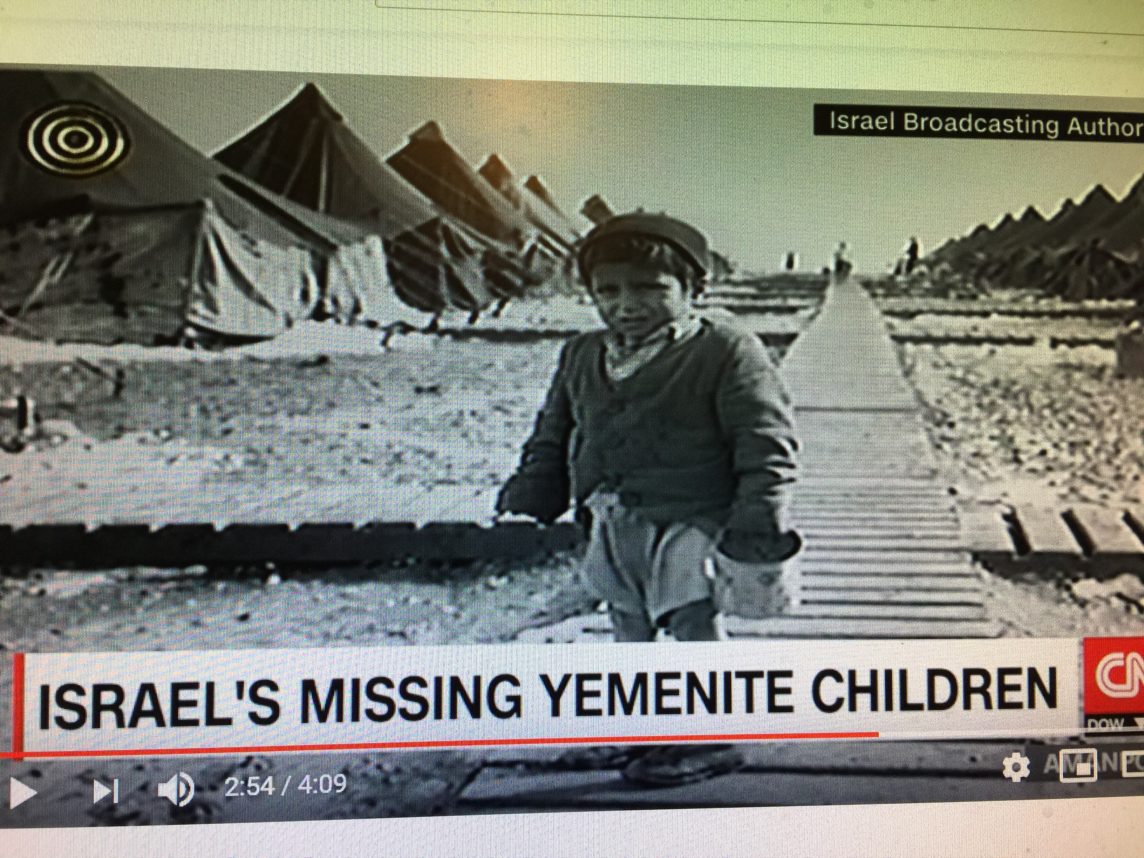
Introductory Note: I am grieved to post this, but honesty in Jewish life and in democracies demand that we confront moral failures wherever and whenever they occur. It is the only way to be assured that they we don’t repeat them.
I post here what constitutes among the most heinous moral failures of the State of Israel in its history. As a Jew, I am ashamed. That being said, anyone who knows me knows that I love the State of Israel. Israel is in my DNA. I love the people and regard the Jewish State as the greatest miracle of the past 2000 years of Jewish history.
CNN covered the story about the hundreds of missing Yemenite and Arabic Jewish children in the early 1950s when they were brought by their parents to Israel and can be viewed here – https://www.youtube.com/watch?v=kp4IDws6f74
I requested the article below from my friend Noah Efron of “The Promised Podcast” (TLV1) out of Tel Aviv who reported the story this past week on the podcast. Noah had originally brought this story to light in 2014. With the recent statement of an eye-witness, the full episode of what happened to hundreds of Yemenite and Arabic Jewish babies in Israel in the early 1950s was revealed. I share Noah’s commentary on “The Promised Podcast” with his permission:
“We heard this week the remarkable and heartbreaking testimony of 85 year-old Shoshana (שחם) Shaham, a Holocaust survivor who was a student nursemaid in the transit camp, or Maabara, in Rosh Ha’Ayin through the first half of the 1950s, and only now told journalists for the first time that she saw kids of new immigrants in the camp, mostly from Yemin, being given up for unofficial adoption, without their parents knowledge, much less agreement, and of course they would never agree, and then she saw these same parents lied to, told that their kids had died and been immediately buried.
Shacham said:
“We would see cars coming, and from the cars people would emerge, dressed well, in city clothes. They spoke a foreign language. We saw these people putting babies in their cars. So I said, “What a minute, where are they taking them? So they said, ‘We are improving their circumstances. They are going to be in a different family, so they won’t get sick and dehydrated. So they won’t get dehydrated, they’ll give them liquids, they’ll give them food.”
Shaham said she knew that they were being taken from their parents, beyond a shadow of a doubt. She says that she knew, at the time, that the parents knew nothing of this. She said that when the parents came, the doctors lied to them, saying their kids died. “We were witnesses,” she said. It was one of our crimes on the way to independence.
Shaham’s testimony is among the first to come from someone who was on the side of the people in the white coats. Until now, the only reports we had of this came from heartsick parents.
Those reports — victims testimonies — have been heard by now by a succession of three official committees (one in 1967, the next in 1988, then in 1995) assembled to investigate the disappearances documented in 745 cases, although activist organizations have gathered evidence of several times as many cases, maybe as many as five thousand. The events are known here as “The Yemenite Children Affair,” although in point of fact, a third of the missing children came from Iraq and other middle eastern and north African countries.
Reading the testimonies of long-bereaved parents before one or another of the investigating committees, one learns both that each instance of loss was unique, with its own tragic circumstances, and also that the disappearances followed patterns. Most of them happened in one of two places: a ma’abara children’s house or a medical clinic. Usually, parents were told that their children were being taken for some special care of which they were in absolute need. These parents were not given an option to refuse; in some cases, a baby was pulled from the arms of a parent wailing in protest. When the parent later came to visit their kid, they were told that a tragedy had occurred: the baby died. They were never shown a body, they were not invited to participate in a funeral. They were not given a copy of a death certificate. They were not taken to a cemetery plot. Sometimes, they were told, by way of offering comfort, that they could conceive a new baby, if they wished.
Most of these parents spent the rest of their lives looking for these kids, some into their 90s, and they never found them, which is a thing of incomprehensible weight.
But, there was more. Not only did these parents and sisters and brothers and uncles and aunts have to live their entire lives in the chilled shadow of this loss and cruelty, but they also had the secondary trial of not being believed.
Each official committee concluded that, while the testimony of families were heartbreaking and they were sincere, their kids had almost surely just died, at a time when medicine was poor and disease was hearty and records were scanty. They’d lost their child, and no one doubted the depths of their suffering, but they’d lost their kid to disease, maybe the oldest, if still the saddest, story there is.
But the parents, and in time their surviving kids, and then grandkids, knew that they knew what they knew. And for years, they insisted, and they cajoled, and they protested, and they organized. And for years, they were not believed. For years, people said, “Then why doesn’t some nursemaid come forward and say, I saw this with my own eyes. If it really happened, there would be a nursemaid who would say that.”
Well, now one has.
And I … and the podcast … are implicated in this, too, in the following way. When I introduced the subject for discussion three years ago, I said this:
Now, there are some persuasive reasons to believe that no babies were kidnapped and given to more presentable – that is, Ashkenazi – families to raise. Shifra Shvarts, the leading historian of health care in Israel, says that she’s examined 30,000-40,000 files form that time, and never seen a clue of kidnapping. And then there were those expert commissions. At the same time, if the babies just died, how did they not let the parents see them, mourn them, bury them? I mean, who does that?
So my questions for you mooks are these. If all the evidence says that no kids were kidnapped, and no direct evidence says they were, then why does the belief that they were persist?
And then the discussion pretty much ended with Don [Futterman] saying this:
It’s not the Israel of today, and I think it’s not correct to go back and judge the way the way people behaved then. I’m not talking about the prejudices, but what they were able to do with their limited capacities. Thinking about Israel today, these are two very different countries and times in history.
Which are not the most benighted things to say, but still, you can feel that I’m saying, like so many other well-fed, self-satisfied, dicks over the past 70 years: “Well, surely, something terrible happened to you all those years ago, and I know you think you know what it was, but I’ll tell you that it wasn’t what you think, and the people you blame weren’t really to blame, and it was a long time ago, after all.”
And reading and listening to Shoshana Shaham’s witness this past week, I felt so sad and so terrible, first about what she described, and second about the 70 years of awful denial. And about how easy I found it to join that legacy of denial.
There is so much pain in this world and it takes vigilance, constant vigilance, to not let your heart go hard. And here, yet again, I failed. There’s no one to apologize to, but having put those words out there.”
08 Monday Oct 2018
Steven R. Weisman does the American Jewish community and anyone interested in who we are and how we came to be who we are a deep favor. His history of the American Jewish experience (publ. 2018 – 266 pages) is a wonderful read. He covers the beginning of our history in the new world when Jews first arrived on American shores in New Amsterdam in 1654, spends much time on the dynamic 19th century, and brings it all into the present.
Weisman’s readable narrative is comprehensive. His nuanced discussion of events and trends as they reflect the influences of the American experience on our community gives insight into how we evolved from before the American Revolution through the Civil War into the industrial age and twentieth century as we strove to be at once American and Jewish.
He describes how we acclimated to the new world in every generation without losing a sense of Jewish meaning. He discusses radical and conservative religious, ideological, and practical responses to the myriad of challenges Jews encountered coming from Central Europe, Germany, Russia, and Sefardic lands over a period of two centuries.
Weisman discusses at some length the emergence of the American Reform movement, the founding of the Conservative movement, and how orthodoxy struggled to survive and then staked its ground as immigrant waves from Eastern Europe arrived during the twentieth century.
The title of the book (“The Chosen Wars”) is Weisman’s thesis. So often, there is a tendency to look back with nostalgia on our history and smooth the edges of controversy. To do so, however, is to mischaracterize history itself and especially Jewish history. He shows that we Jews were and continue to be argumentative and rarely unified even as we have aspired for unity.
He writes in the epilogue:
“Judaism’s flourishing in America was not foreordained or inevitable. Neither was it free from conflict and animosity. On the contrary, the disputes among Jews in America were emotional and personal. They were also very American…The Jews shaped their experience in America, and they were shaped by the America they found. The push and pull for Jews followed a historic tension.”
Steven R. Weisman is vice president for publications and communications at the Peterson Institute for International Economics. He previously served as a correspondent, editor and editorial board member of The New York Times. He is the author of “The Great Tax Wars: How the Income Tax Transformed America.”
I recommend this volume highly. If you want deeper understanding about who we are as an American Jewish community, how we got here, and what contemporary challenges we face, this book will not only frame it all for you but inspire you with the hope that, indeed, we are NOT the ever-dying people.
27 Thursday Sep 2018
20 Thursday Sep 2018
The following are my farewell sermons after serving Temple Israel of Hollywood for 30 years. This is my last High Holiday season before my retirement at the end of June, 2019. These are highly personal sermons, but they reflect the greater themes and challenges that Judaism presents us during the High Holidays, and were the best personal reflections on a forty-year rabbinate and thirty years at my home congregation.
For all TIOH Rabbis’ Sermons in 2018, go to
https://www.tioh.org/worship/rabbis/clergystudy These include sermons by Rabbi John Rosove, Rabbi Michelle Missaghieh, and Rabbi Jocee Hudson
The following are the sermons I delivered, the final High Holiday sermons I am ever likely to deliver:
Rosh Hashanah 5779 – “Carrying forward the Life of Our People”
Video Direct Link – https://www.youtube.com/watch?v=cqcY1nwo0tc
Kol Nidre 5779 – “What I Wish for You”
Video Direct Link – https://www.youtube.com/watch?v=IPHP_ui4YQ4
Yom Kippur Yizkor 5779 – “Midrash on the Death of Moses”
11 Friday May 2018
 [Photo by Peter Marcus]
Jerusalem, itself on a mountain, is made up of a series of mountains. On top of each mountain is an important symbol sacred to a religion or people. Taken together, these multiple symbols represent perhaps the most significant city in world history.
Har Habayit – The Mountain of God’s House, also known as Har Moriah – The Mountain of ‘Sight’ is, of course, the most sacred place in Judaism. Legend teaches that the dust that formed the first human being, Adam, was gathered here, and this mountain top is the place on which Abraham bound his son Isaac. It is here that King Solomon built the First Temple and King Harod built the Second Temple.
Har Habayit- Har Moriah is the gateway between heaven and earth, the umbilicus through which the milk of Torah flows from the Divine breast to the children of Israel, where there is Divine sight and insight.
This most ancient of Jewish mountains is claimed by Islam as its third most sacred site after Mecca and Medina. Muslims call it Haram al Sharif – The Noble Sanctuary where Quran says Mohammed ascended to heaven.
On another small mountain is the Church of the Holy Sepulcher, now shared in a delicate and sensitive balance among Armenian, Greek Orthodox, Coptic, Roman Catholic, Syrian, and Ethiopian Christians because Jesus was crucified there.
To the east is Har Hazeitim – the Mountain of Olives at the foot of which is the Garden of Gethsemane where Jesus prayed and his disciples slept the night before their Lord’s crucifixion.
Har Hazeitim contains the most holy Jewish cemetery in the world, the closest burial ground to the “The Golden Gate” of Jerusalem that was sealed by the 16th century Ottoman Qalif, Suleiman the Magnificent, because he feared that the Jewish Messiah would pass into the holy city through this gate in the end of days. Jews have been burying our dead on the Mountain of Olives for centuries so their souls would be close and ready to follow the Mashiach (“Messiah”).
Just south of the Old City walls is Har Tziyon – Mount Zion from where the prophets Isaiah (2:3) and Micah (4:2) said that Torah and God’s word came into the world. For Christians, Jesus and his disciples celebrated the Last Supper here.
A few miles west is yet another mountain made sacred by Zionism and the State of Israel, Har Herzl, on which is built the military cemetery for those who died in the defense of the state and the nation’s leaders. Har Herzl is walking distance from Yad Vashem, Israel’s Holocaust Memorial and Museum.
Jerusalem has been conquered thirty-four times since the age of David. It is arguably the most famous and fought over real estate in the world. It is a city of the in-between. It embraces old and new, past and present, east and west, reason and faith, earth and heaven, this world and the world to come, imperfection and messianic dreams, temporal and divine power. It has been and remains the symbol of a history of intensely competing interests.
Israel celebrates “Jerusalem Day” this Sunday, May 12 (28 Iyar), marking 50 years since Israel reunified the city after the 1967 Six-Day War. Though Jerusalem has rarely known peace, it is an enduring symbol of our people’s yearning for peace nevertheless.
What is to become of this sacred city for so many going forward? Most Israelis don’t want it ever divided again. For the past 50 years Israel has maintained the peace and security of Jerusalem and free access for peoples of all faiths to the city’s holy sites. Yet, distrust and hatred fills still too many hearts and pollutes too many minds. Spitting and shoving, vandalizing and threats, provocation and incitement, violence and murder continue despite efforts by Israeli security to prevent it.
The problems that continue are compounded by the absence of a two-state solution to the Israeli-Palestinian conflict. East Jerusalem’s Palestinian Arabs, non-citizens of Israel who live under Israeli military rule, do not share equal rights with Israeli citizens, nor is their property necessarily respected by Israeli military law and ultra-Orthodox Jewish squatters who use every opportunity to occupy Arab homes.
Two different sets of law are enforced and non-Israeli citizens almost always come up short.
In the coming weeks, the United States will formally move its Embassy from Tel Aviv to Jerusalem in a controversial decision taken by President Trump that shook the Arab world. Yet, Jerusalem is the people and State of Israel’s capital city. Its government buildings, the Prime Minister’s and President’s residences are there.
For Israel’s sake as a Jewish and democratic state and for the sake of the Palestinians the status quo is unsustainable, and if Jerusalem is to be the beacon of and symbol for peace throughout the world, it will take our two peoples, Israeli and Palestinian, every ounce of courage, patience, creativity, understanding, and mutual respect to make it happen.
I believe, despite the deep distrust and hostility that there is a solution, but that will take the willingness to compromise and accommodate the needs of the “other” not as some kumbaya liberal dream, but for the sake of peace, security, the survival of and the dignity of all peoples.
02 Wednesday May 2018
Posted in American Jewish Life, Israel/Zionism, Jewish History, Jewish Identity
 Rabbi John Rosove's Blog