
There are moments of decision that come to each of us when a moral choice must be made. Most of the time, those decisions have no great impact and we can make them easily without worrying about the risks such an action would carry for us or for the people near and dear to us. But there are other times in which our actions do have significant consequences and risks for us and our dear ones, and that our actions will define us for better or worse.
This blog was inspired (or better – provoked) by President Trump‘s and his administration’s ongoing efforts to bully large swaths of America’s citizenry and bend to his will government workers, the Justice department, politicians, educators, scientists, legal firms, universities, cultural, artistic, racial, and immigrant groups, and most recently six members of Congress – all respected veterans and former intelligence officials – who urged in a video disseminated widely that all members of the military not to obey unlawful orders, per the military code. President Trump’s irascible threat that they should be charged with treason and punished with execution is the most recent and stunning outrage.
Some have compared what is happening now in the United States to Germany in the 1930s when all democratic norms were destroyed in Hitler’s rapid and irrepressible march to dictatorship and the persecution and murder of Jews and others who resisted the Nazis. I don’t know if this claim is an accurate comparison or not. I have my doubts given the complexities of American democracy and the independence of federal, state, and local centers of authority that still exist, and given the noble actions of many judges at every level and of hundreds of attorneys who have filed law suits against Trump’s unconstitutional actions, though Trump is following the autocratic playbook closely, per Project 2025. I will leave the comparison to historians.
Without a doubt in my reading of history, however, the most extreme acts of moral courage, resistance and defiance against a murderous regime were taken by the many thousands of rescuers who hid or helped Jews during the Holocaust at great personal risk to themselves, their families and communities.
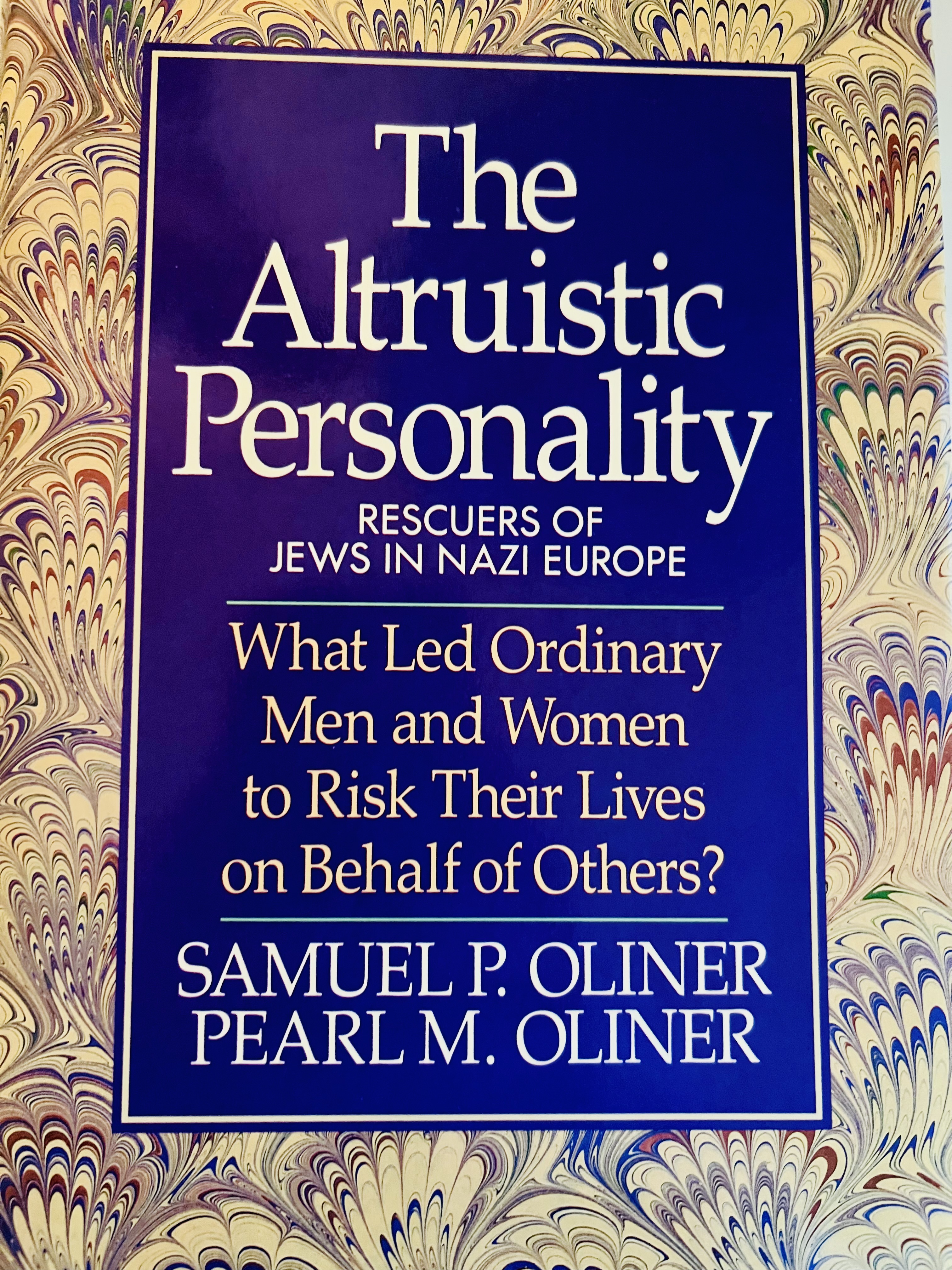
Years ago I read The Altruistic Personality: Rescuers of Jews in Nazi Europe – What Led Ordinary Men and Women to Risk Their Lives on Behalf of Others? by Samuel P. and Pearl M. Oliner with an Introduction by Rabbi Harold Schulweis (New York: The Free Press, 1988). Rabbi Schulweis, a moral giant in his generation, invited the Oliners to speak at his synagogue – Valley Beth Shalom in Los Angeles – and he invited the Board of Rabbis of Southern California to meet the authors and learn about their work.
It is written on the cover the following biographical notes about the authors and the purpose and content of the book:
“Samuel [Oliner] was ten years old when his entire family was murdered by the Nazis in Poland. Thanks to the help of a Polish Christian woman, he found a place to hide through the war – and survive. His experience left him with a profound, lifelong sense of wonder and a question that was the origin of this book.
In a time of extreme danger, what had led this woman, and a few thousand like her, to risk her own life and the lives of her family to help those who were marked for death – even total strangers – while others stood passively by?
To answer that complex and critically important question, Samuel and Pearl Oliner undertook the massive Altruistic Personality Project, which interviewed over 700 rescuers and nonrescuers living in Poland, France, Germany, the Netherlands, and Italy during the Nazi occupation.
Samuel (1930-2021) was a Professor of Sociology at Humboldt State University. Pearl (1931-2021) was a Professor of Education at Humboldt State University.
By comparing and contrasting rescuers and bystanders, [the Oliners] discovered that those who intervened were distinguished by certain common characteristics, including a deep-seated, wide-ranging empathy to others developed in their childhood homes, where moral and ethical values were not only strongly held, but acted upon by their parents. Unlike their neighbors who were concerned with their own survival and chose not to become involved, rescuers felt a more extensive concern and responsibility for the fate of the others and believed that what they did would make a difference…the Altruistic Personality explores the experiences and motivations of those uncommon individuals who aided Jews without compensation of any kind-and with full knowledge of the fatal consequences that would befall them if their actions were discovered.”
Altruism is based on a faith in a higher moral authority to which one is committed and the standards of which permeate one’s attitudes and behavior towards others, especially those outside one’s personal cultural, religious, ethnic, and national communities, and regardless of one’s personal self-interest and safety. This faith and moral commitment can come from one’s religious faith, parents, family, and other community groups to which a person belonged.
The Oliners learned in their research that rescuers did not consider themselves to be moral heroes. In their interviews these uncommon individuals explained that they could not do other than what they did and be able to live with themselves, regardless of the great risks involved. Rescuers felt instinctively and intuitively the difference between moral right and wrong and acted always according to their deeply held moral values nurtured and emphasized since childhood. They present to us a powerful model of quiet defiance and resistance.
The following are selected passages from this book:
“I did nothing unusual; anyone would have done the same thing in my place.” A Dutchman [said] who sheltered a Jewish family for two years.” (p. 113)
“Rescuers did differ from others in their interpretation of religious teaching and religious commitment, which emphasized the common humanity of all people and therefore [rescuers] supported efforts to help Jews.” (p. 156)
“I found it incomprehensible and inadmissible that for religious reasons or as a result of a religious choice, Jews would be persecuted. It’s like saving somebody who is drowning. You don’t ask them what God they pray to. You just go and save them.” (p. 166)
“…the language of care dominated [for most rescuers]: Pity, compassion, concern, affection made up the vocabulary of 76 percent of rescuers…”(p. 168)
“Rescuers described their early family relationships in general and their relationships with their mothers in particular as closer significantly more often than did non-rescuers. Rescuers also felt significantly closer to their fathers than did bystanders. From such family relationships, more rescuers learned the satisfactions accruing from personal bonds with others.” (p. 173)
“What distinguished rescuers from non-rescuers was their tendency to be moved by pain. Sadness and helplessness aroused their empathy. More frequently than others, rescuers were likely to say ‘I can’t feel good if others around me feel sad,’ ‘seeing people cry upsets me,’ ‘I get very upset when I see an animal in pain,’ ‘It upsets me to see helpless people,’ and ‘I get angry when I see someone hurt.’” (p. 174)
“…parents [in disciplining their children] of rescuers depended significantly less on physical punishment and significantly more on reasoning.” (p. 179)
“Involvement, commitment, care, and responsibility are the hallmarks of extensive persons [or ‘expansive persons’ – An extensive/expansive person is often friendly, outgoing, talkative, or generous by nature.] Disassociation, detachment, and exclusiveness are the hallmarks of constricted persons. Rescuers were marked by extensivity [or expansiveness], whereas non-rescuers and bystanders in particular, were marked by constrictedness, by an ego that perceived most of the world beyond [his/her] own boundaries as peripheral.” (p. 186)
“Constricted people experience the external world as largely peripheral except insofar as it may be instrumentally useful. More centered on themselves and their own needs, they pay scant attention to others… contractedness begins in early life. Family attachments are weak, and discipline relies heavily on physical punishment, the latter often routine and gratuitous. Reasoning and explaining [of parents to their children when a child does wrong] are infrequent [for the contracted personality]. Family values center on the self and social convention; relationships with others are guarded and generally viewed as commodity exchanges. Stereotypes regarding outsiders are common.” (p. 251)
“Moral courage is thus the conspicuous characteristic only of the independent, autonomous, ego-integrated liberal.” (p. 256)
Again, I am not making a direct comparison between what is taking place today in the United States with Germany in the 1930s. We Americans are, nevertheless, being challenged morally in ways most of us alive today have not experienced or imagined possible ever in our lifetimes. Our political leaders as well as university presidents and their boards, law firms, entertainment companies, journalists and the media, scientists and the men and women serving in the armed forces systematically are being morally challenged by a President whose clear intent is for Americans to bend the knee to his autocratic will.
The book may explain one important reason why so many Americans continue to support President Trump, though a Gallup poll released yesterday shows that Trump’s approval rating has sunk to a historic low of 36 percent with disapproval at 60 percent, and that the MAGA coalition is fracturing.
The book, though published in 1988, is still available and I recommend it highly.
 Rabbi John Rosove's Blog