
• About

Rabbi John Rosove's Blog

Rabbi John Rosove's Blog

Category Archives: Israel/Zionism

The heartbreaking testimony of a Holocaust survivor about missing Yemenite Children – by Noah Efron of “The Promised Podcast” – TLV1

14 Sunday Oct 2018

Posted by rabbijohnrosove in Ethics, Israel/Zionism, Jewish History, Social Justice

≈ 1 Comment

Introductory Note: I am grieved to post this, but honesty in Jewish life and in democracies demand that we confront  moral failures wherever and whenever they occur. It is the only way to be assured that they we don’t repeat them.

I post here what constitutes among the most heinous moral failures of the State of Israel in its history. As a Jew, I am ashamed. That being said, anyone who knows me knows that I love the State of Israel. Israel is in my DNA. I love the people and regard the Jewish State as the greatest miracle of the past 2000 years of Jewish history.

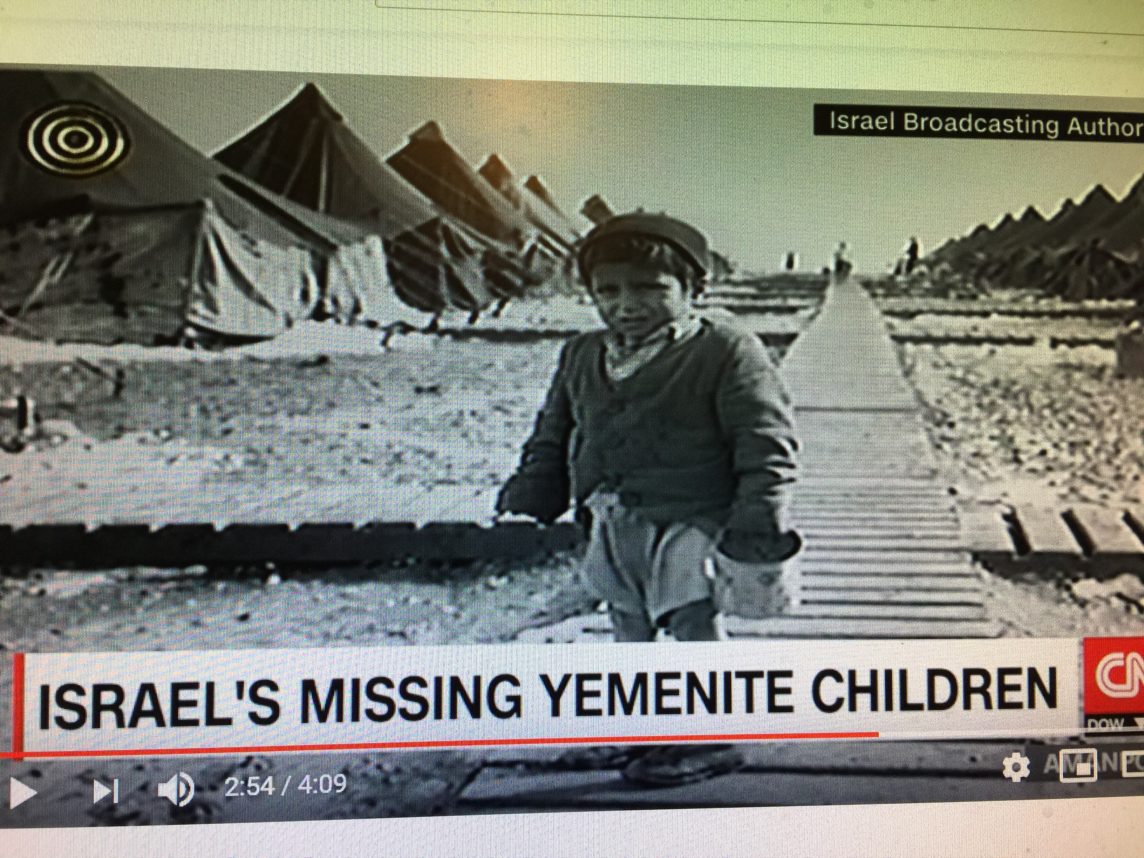
CNN covered the story about the hundreds of missing Yemenite and Arabic Jewish children in the early 1950s when they were brought by their parents to Israel and can be viewed here – https://www.youtube.com/watch?v=kp4IDws6f74

I requested the article below from my friend Noah Efron of “The Promised Podcast” (TLV1) out of Tel Aviv who reported the story this past week on the podcast. Noah had originally brought this story to light in 2014. With the recent statement of an eye-witness, the full episode of what happened to hundreds of Yemenite and Arabic Jewish babies in Israel in the early 1950s was revealed. I share Noah’s commentary on “The Promised Podcast” with his permission:

“We heard this week the remarkable and heartbreaking testimony of 85 year-old Shoshana (שחם) Shaham, a Holocaust survivor who was a student nursemaid in the transit camp, or Maabara, in Rosh Ha’Ayin through the first half of the 1950s, and only now told journalists for the first time that she saw kids of new immigrants in the camp, mostly from Yemin, being given up for unofficial adoption, without their parents knowledge, much less agreement, and of course they would never agree, and then she saw these same parents lied to, told that their kids had died and been immediately buried.

Shacham said:

“We would see cars coming, and from the cars people would emerge, dressed well, in city clothes. They spoke a foreign language. We saw these people putting babies in their cars. So I said, “What a minute, where are they taking them? So they said, ‘We are improving their circumstances. They are going to be in a different family, so they won’t get sick and dehydrated. So they won’t get dehydrated, they’ll give them liquids, they’ll give them food.”  

Shaham said she knew that they were being taken from their parents, beyond a shadow of a doubt. She says that she knew, at the time, that the parents knew nothing of this. She said that when the parents came, the doctors lied to them, saying their kids died. “We were witnesses,” she said. It was one of our crimes on the way to independence.

Shaham’s testimony is among the first to come from someone who was on the side of the people in the white coats. Until now, the only reports we had of this came from heartsick parents.

Those reports — victims testimonies — have been heard by now by a succession of three official committees (one in 1967, the next in 1988, then in 1995) assembled to investigate the disappearances documented in 745 cases, although activist organizations have gathered evidence of several times as many cases, maybe as many as five thousand. The events are known here as “The Yemenite Children Affair,” although in point of fact, a third of the missing children came from Iraq and other middle eastern and north African countries.

Reading the testimonies of long-bereaved parents before one or another of the investigating committees, one learns both that each instance of loss was unique, with its own tragic circumstances, and also that the disappearances followed patterns. Most of them happened in one of two places: a ma’abara children’s house or a medical clinic. Usually, parents were told that their children were being taken for some special care of which they were in absolute need. These parents were not given an option to refuse; in some cases, a baby was pulled from the arms of a parent wailing in protest. When the parent later came to visit their kid, they were told that a tragedy had occurred: the baby died. They were never shown a body, they were not invited to participate in a funeral. They were not given a copy of a death certificate. They were not taken to a cemetery plot. Sometimes, they were told, by way of offering comfort, that they could conceive a new baby, if they wished.

Most of these parents spent the rest of their lives looking for these kids, some into their 90s, and they never found them, which is a thing of incomprehensible weight.

But, there was more. Not only did these parents and sisters and brothers and uncles and aunts have to live their entire lives in the chilled shadow of this loss and cruelty, but they also had the secondary trial of not being believed.

Each official committee concluded that, while the testimony of families were heartbreaking and they were sincere, their kids had almost surely just died, at a time when medicine was poor and disease was hearty and records were scanty. They’d lost their child, and no one doubted the depths of their suffering, but they’d lost their kid to disease, maybe the oldest, if still the saddest, story there is.

But the parents, and in time their surviving kids, and then grandkids, knew that they knew what they knew. And for years, they insisted, and they cajoled, and they protested, and they organized. And for years, they were not believed. For years, people said, “Then why doesn’t some nursemaid come forward and say, I saw this with my own eyes. If it really happened, there would be a nursemaid who would say that.”

Well, now one has.

And I … and the podcast  … are implicated in this, too, in the following way. When I introduced the subject for discussion three years ago, I said this:

Now, there are some persuasive reasons to believe that no babies were kidnapped and given to more presentable – that is, Ashkenazi – families to raise. Shifra Shvarts, the leading historian of health care in Israel, says that she’s examined 30,000-40,000 files form that time, and never seen a clue of kidnapping. And then there were those expert commissions. At the same time, if the babies just died, how did they not let the parents see them, mourn them, bury them? I mean, who does that? 

So my questions for you mooks are these.  If all the evidence says that no kids were kidnapped, and no direct evidence says they were, then why does the belief that they were persist?

And then the discussion pretty much ended with Don [Futterman] saying this:

It’s not the Israel of today, and I think it’s not correct to go back and judge the way the way people behaved then. I’m not talking about the prejudices, but what they were able to do with their limited capacities. Thinking about Israel today, these are two very different countries and times in history.

Which are not the most benighted things to say, but still, you can feel that I’m saying, like so many other well-fed, self-satisfied, dicks over the past 70 years: “Well, surely, something terrible happened to you all those years ago, and I know you think you know what it was, but I’ll tell you that it wasn’t what you think, and the people you blame weren’t really to blame, and it was a long time ago, after all.”

And reading and listening to Shoshana Shaham’s witness this past week, I felt so sad and so terrible, first about what she described, and second about the 70 years of awful denial. And about how easy I found it to join that legacy of denial.

There is so much pain in this world and it takes vigilance, constant vigilance, to not let your heart go hard. And here, yet again, I failed. There’s no one to apologize to, but having put those words out there.”

Reform Judaism doubles down on Israel engagement and Reform Zionism

27 Thursday Sep 2018

Posted by rabbijohnrosove in American Jewish Life, Israel/Zionism, Jewish History, Jewish Identity, Social Justice, Women's Rights

≈ Leave a comment

Our Reform movement has taken the drift among some American liberal Jews seriously and is stressing the importance of the peoplehood and State of Israel as intrinsic to the fabric of American liberal Jewish identity.
 
Read this article – it’s important!
 
http://jewishjournal.com/analysis/239498/reform-judaism-doubles-zionism/

High Holiday Sermons 2018-5779 – Temple Israel of Hollywood, Los Angeles

20 Thursday Sep 2018

Posted by rabbijohnrosove in American Jewish Life, Ethics, Holidays, Inuyim - Prayer reflections and ruminations, Israel and Palestine, Israel/Zionism, Jewish History, Jewish Identity, Jewish-Christian Relations, Jewish-Islamic Relations, Musings about God/Faith/Religious life, Social Justice

≈ Leave a comment

The following are my farewell sermons after serving Temple Israel of Hollywood for 30 years. This is my last High Holiday season before my retirement at the end of June, 2019. These are highly personal sermons, but they reflect the greater themes and challenges that Judaism presents us during the High Holidays, and were the best personal reflections on a forty-year rabbinate and thirty years at my home congregation.

For all TIOH Rabbis’ Sermons in 2018, go to

https://www.tioh.org/worship/rabbis/clergystudy  These include sermons by Rabbi John Rosove, Rabbi Michelle Missaghieh, and Rabbi Jocee Hudson

The following are the sermons I delivered, the final High Holiday sermons I am ever likely to deliver:

Rosh Hashanah 5779  – “Carrying forward the Life of Our People”

Video Direct Link – https://www.youtube.com/watch?v=cqcY1nwo0tc

Text – https://www.tioh.org/images/Worship/ClergyStudy/HH_Sermons/John_Rosove/5779/Carrying_Forward_the_Life_of_Our_People-RH2018.pdf

Kol Nidre 5779 –  “What I Wish for You”

Video Direct Link – https://www.youtube.com/watch?v=IPHP_ui4YQ4

Text – https://www.tioh.org/images/Worship/ClergyStudy/HH_Sermons/John_Rosove/5779/What-I-wish-for-you-RJohn-KN-2018.pdf

Yom Kippur Yizkor 5779 – “Midrash on the Death of Moses”

Text only – https://www.tioh.org/images/Worship/ClergyStudy/HH_Sermons/John_Rosove/5779/Midrash-on-the-Death-of-Moses-RJohn-YK-2018.pdf


25 Years ago hope was in the air – Not anymore for now!

14 Friday Sep 2018

Posted by rabbijohnrosove in American Politics and Life, Israel and Palestine, Israel/Zionism

≈ Leave a comment

Former Ambassador Martin Indyk writes in The Atlantic…

“The Day Israeli-Palestinian Peace Seemed Within Reach: Perhaps when Mahmoud Abbas, Benjamin Netanyahu, and Donald Trump leave the scene, it will be time to try again. Perhaps then someone will dig up the video of that magical day in September 1993, when peace seemed within reach, and when an American president promised Israelis and Palestinians “the quiet miracle of a normal life.”

https://bit.ly/2x9ep4w

theatlantic.com
The Day Israeli-Palestinian Peace Seemed Within Reach
Twenty-five years after the Oslo Accords were signed, the process is…

Meet the Israeli Volunteers Who Offer Rides and Hope to Sick Palestinians – Haaretz by Dina Kraft

13 Thursday Sep 2018

Posted by rabbijohnrosove in Israel and Palestine, Israel/Zionism, Jewish Identity

≈ 1 Comment

In the context of so much negative press about Israeli policies in the West Bank, this story from the Israeli daily newspaper “Haaretz” is powerful, inspiring, and unexpected. Haaretz’s story speaks for itself. Jews the world over ought to feel proud that 1400 Israeli volunteers are helping thousands of Palestinians reach hospitals and clinics in Israel from the West Bank on a daily and weekly basis.

The following is the Haaretz story. Share it especially with those who ought to know that Israelis are performing the mitzvah of g’milut chassadim (loving-kindness) for their Palestinian neighbors without expectation of compensation or reward.


“The Road to Recovery organization collects Palestinians from the West Bank and Gaza borders and takes them to Israeli hospitals for treatment.

It’s almost 6:30 A.M. and the sun is rising quickly over the Sha’ar Efraim checkpoint separating Israel and the West Bank. Amid the rush of Palestinian workers heading toward vans that will take them to jobs inside Israel stand the Alwaneh family, including 3-year-old Kais clutching a “Bob the Builder” backpack.

The father, Samir Alwaneh, 41, smokes a cigarette, his face tense. The family is waiting for a driver from Israel – someone they have never met before – who will collect them and take them the 32 kilometers (20 miles) to Israel’s largest hospital, Sheba Medical Center, near Tel Aviv. It is time for another surgery for Kais, who was badly burned in a fire last year, leaving his face severely disfigured and his hands as stumps. This will be his fourth surgery and is meant to help repair damage to the skin around one of his eyes.

The family looks up to see Orli Shalem, 56, driving up in a blue hatchback. Shalem, a member of Kibbutz Ma’abarot, is with Derech Hachlama (The Road to Recovery), an organization boasting some 1,400 Israeli volunteers who drive Palestinians from border checkpoints – both in Gaza and the West Bank – for medical treatment inside Israel.

Tens of thousands of Palestinians are treated in Israeli hospitals every year, most for cancer or heart problems, and many of them are children. There are between 30 and 60 rides given per day; without them, the Palestinian patients and their families would be left to foot the cost of taxis to the hospitals, which can cost anything from 150 to 400 shekels ($41 to $110) each way.

“It’s a small way of helping, but it is some kind of help, and a way to show we care so they [the Palestinians] can see there is not just the brutal, threatening side of Israel,” explains Shalem as she heads west to the hospital.

Shalem and the Alwanehs had exchanged a quick and limited greeting of “Shalom” when they met, since Shalem does not speak Arabic and the Alwanehs do not speak Hebrew. It is a common problem.

Tami Suchman, 71, from Kibbutz Beeri near the Gaza border, started volunteering as a driver five years ago. In the past she would try to talk to her passengers as much as possible, even if it meant pushing through the language barrier with hand gestures and facial expressions. “But these days I prefer to speak less,” admits Suchman.

“What is there to say after we agree conditions are bad?” she asks. “We both want things to be good, but understand that it’s going to take a long time till things get better. For me personally, I feel guilt. I find myself apologizing for the situation that I’m ashamed we are even in.”

“I don’t justify what they are doing – for example, with the burning kites,” Suchman adds, referring to the recent incidents that have set thousands of dunams of kibbutz fields ablaze, “but I understand where it comes from.”

This language gap can feel like a metaphor for the Israeli-Palestinian conflict itself. Road to Recovery was founded in 2006 with the hope that, amid the seemingly intractable conflict, the human connection and goodwill forged in these rides might eventually help break down walls, both psychological and real, between Israelis and Palestinians.

It was established by Yuval Roth, who had become active in the Parents Circle Families Forum – which brings bereaved families from both sides of the conflict together – after his brother was killed by Hamas terrorists in 1993. It was at one of these meetings, in 2005, that he met a Palestinian woman whose brother was ill. She asked Roth to drive him from a checkpoint for treatment in Israel – and that one ride developed into a nonprofit that is now on the brink of expanding inside the West Bank as well, offering Palestinians rides to both sides of the checkpoint. Legendary Canadian singer Leonard Cohen was the project’s first donor.

Road to Recovery describes itself as an apolitical organization, drawing volunteers from across the political spectrum – including retired army officers and even a small number of Jewish settlers. For people like Shalem, however, the act of volunteering is also a political one. She opposes the Israeli occupation and says the rides are one of the few ways she has found to express that opposition in a practical and, she says, hopefully helpful way.

Alwaneh says the round-trip rides to the Israeli hospitals are a big help. And the medical care his son has received in Israel has moved him, noting: “Their treatment of Israeli and Palestinians is the same there – they treat Kais like a boy, like any other boy.”

Neely Gardin, 53, opens the gate that leads from her house to her car on a narrow street in a Tel Aviv suburb. This is her first day as a volunteer driver and she has given herself extra time to get to the Efraim checkpoint. Once there, she will rendezvous with Shalem – who will help if there are any problems – and the Palestinians she is driving to hospital.

She’s never been to a checkpoint before and says she does not know any Palestinians from either the West Bank or Gaza. She is not a particularly political person, she points out, but heard about the organization and just knew she wanted to help out.

The dawn sky grows lighter as she navigates her car past olive groves, open fields and, eventually, the sprawling Arab-Israeli city of Taibeh. The checkpoint comes into view and she calls Naim Albeida when she parks.

Palestinians need permits to enter Israel, and the permit system can be cumbersome and slow – final authorizations from the Israeli army usually only come a day before a patient’s appointment at the hospital, and if they arrive too late the patient cannot travel. Albeida, a Palestinian who lives in the West Bank, oversees the logistics for the Palestinian patients, working as a link between the PA, the Israeli army and Road to Recovery.

Gardin follows Albeida’s instructions and finds her Palestinian patient at the border. She greets Rami, 32, a cancer patient who has finished his treatment but is going to Israel for some tests. He is accompanied by his wife and mother. Neely and Rani start chatting in Hebrew and he tells her about his young daughters, showing her some photos.

“The thing that struck me most was how normal, how everyday, it all felt,” Gardin tells Haaretz afterward. “It’s very important to see that the person who stands on the other side [of the border] is a human being. We know that theoretically, but until we are with someone real, that remains only an idea. We forget everything that we have in common, because we are all so focused on the conflict, each side wrapped up in their own justifications.”

Albeida has only been a Road to Recovery staffer for a few months. But he’s been helping out as a volunteer since 2010, when he stumbled upon the organization while looking for ways to help a neighbor find an affordable way to get to an Israeli hospital.

When he first heard about it, he admits not believing that such help could really exist. He called Roth, who told him, “Sure, no problem.”

“And I said, ‘No problem? What do you mean no problem?” recounts Albeida – who even traveled with his neighbor to see with his own eyes that it was all real.

“I met the volunteer at the crossing and I thought to myself, ‘She’s like an angel, not a person,’” recalls Albeida, who lives in Kafr Jayus, near the city of Qalqilyah. Every day after that, he started communicating with Roth, helping to coordinate the rides.

It was not easy: He was working in construction, often receiving urgent phone calls while he was atop a ladder or up scaffolding. He says he lost two jobs because of those phone calls. “It interfered with my focus on the job, but what could I do? There were medical emergencies going on,” Albeida explains.

He credits his fluent Hebrew not only to 25 years working on construction sites in Israel but also to a woman named Dalia, whom his mother befriended when he was a young boy. His mother worked as a cleaner in an Israeli hospital, where Dalia was a nurse.

“I learned early on that not all Israelis are soldiers who come into our homes and arrest us. They are also people living their normal lives,” says Albeida. “I know the occupation is what ruined lives on both sides.”

Albeida adds that he noticed the Israeli volunteers’ desire to connect more deeply with Palestinians, so now he hosts lunches at his home once a month for people on both sides of the border to get together. “After the meal we sit and talk, and discuss our shared future,” he says.

After about an hour’s drive, Shalem pulls up at the Sheba Medical Center. Kais is whimpering in the backseat. Seeking to distract him, his mother, Hanna, tickles him and covers his burned face with kisses.

Shalem watches as the family walks toward the hospital entrance. “Goodbye, and good luck,” she calls out.

https://bit.ly/2MqgqxS

A Prayer for Peace in the New Year

06 Thursday Sep 2018

Posted by rabbijohnrosove in American Jewish Life, Ethics, Holidays, Inuyim - Prayer reflections and ruminations, Israel/Zionism, Jewish Identity, Uncategorized

≈ 1 Comment

May we hold lovingly in our thoughts / those who suffer from tyranny, subjection, cruelty, and injustice / and work every day towards the alleviation of their suffering.

May we recognize our solidarity / with the stranger, outcast, downtrodden, abused, and deprived / that no human being be treated as “other” / that our common humanity weaves us together / in one fabric of mutuality / one garment of destiny.

May we pursue the Biblical prophet’s vision of peace / that we might live harmoniously with each other / and side by side / respecting differences / cherishing diversity / with no one exploiting the weak / each living without fear of the other / each revering Divinity in every human soul.

May we struggle against institutional injustice and governmental corruption / free those from oppression and contempt / act with purity of heart and mind / despising none / defrauding none / hating none / cherishing all / honoring every child of God and every creature of the earth.

May the Jewish people, the State of Israel, and all peoples / know peace in this New Year / and may we nurture kindness and love everywhere.

L’shanah tovah tikateivu

Rabbi John L. Rosove – Temple Israel of Hollywood, Los Angeles

Jerusalem – A City of the In-between and Not-Yet Peace

11 Friday May 2018

Posted by rabbijohnrosove in Holidays, Israel and Palestine, Israel/Zionism, Jewish History, Jewish Identity, Jewish-Christian Relations, Jewish-Islamic Relations

≈ Leave a comment

[Photo by Peter Marcus]

Jerusalem, itself on a mountain, is made up of a series of mountains. On top of each mountain is an important symbol sacred to a religion or people. Taken together, these multiple symbols represent perhaps the most significant city in world history.

Har Habayit – The Mountain of God’s House, also known as Har Moriah – The Mountain of ‘Sight’ is, of course, the most sacred place in Judaism. Legend teaches that the dust that formed the first human being, Adam, was gathered here, and this mountain top is the place on which Abraham bound his son Isaac. It is here that King Solomon built the First Temple and King Harod built the Second Temple.

Har Habayit- Har Moriah is the gateway between heaven and earth, the umbilicus through which the milk of Torah flows from the Divine breast to the children of Israel, where there is Divine sight and insight.

This most ancient of Jewish mountains is claimed by Islam as its third most sacred site after Mecca and Medina. Muslims call it Haram al Sharif – The Noble Sanctuary where Quran says Mohammed ascended to heaven.

On another small mountain is the Church of the Holy Sepulcher, now shared in a delicate and sensitive balance among Armenian, Greek Orthodox, Coptic, Roman Catholic, Syrian, and Ethiopian Christians because Jesus was crucified there.

To the east is Har Hazeitim – the Mountain of Olives at the foot of which is the Garden of Gethsemane where Jesus prayed and his disciples slept the night before their Lord’s crucifixion.

Har Hazeitim contains the most holy Jewish cemetery in the world, the closest burial ground to the “The Golden Gate” of Jerusalem that was sealed by the 16th century Ottoman Qalif, Suleiman the Magnificent, because he feared that the Jewish Messiah would pass into the holy city through this gate in the end of days. Jews have been burying our dead on the Mountain of Olives for centuries so their souls would be close and ready to follow the Mashiach (“Messiah”).

Just south of the Old City walls is Har Tziyon – Mount Zion from where the prophets Isaiah (2:3) and Micah (4:2) said that Torah and God’s word came into the world. For Christians, Jesus and his disciples celebrated the Last Supper here.

A few miles west is yet another mountain made sacred by Zionism and the State of Israel, Har Herzl, on which is built the military cemetery for those who died in the defense of the state and the nation’s leaders. Har Herzl is walking distance from Yad Vashem, Israel’s Holocaust Memorial and Museum.

Jerusalem has been conquered thirty-four times since the age of David. It is arguably the most famous and fought over real estate in the world. It is a city of the in-between. It embraces old and new, past and present, east and west, reason and faith, earth and heaven, this world and the world to come, imperfection and messianic dreams, temporal and divine power. It has been and remains the symbol of a history of intensely competing interests.

Israel celebrates “Jerusalem Day” this Sunday, May 12 (28 Iyar), marking 50 years since Israel reunified the city after the 1967 Six-Day War. Though Jerusalem has rarely known peace, it is an enduring symbol of our people’s yearning for peace nevertheless.

What is to become of this sacred city for so many going forward? Most Israelis don’t want it ever divided again. For the past 50 years Israel has maintained the peace and security of Jerusalem and free access for peoples of all faiths to the city’s holy sites. Yet, distrust and hatred fills still too many hearts and pollutes too many minds. Spitting and shoving, vandalizing and threats, provocation and incitement, violence and murder continue despite efforts by Israeli security to prevent it.

The problems that continue are compounded by the absence of a two-state solution to the Israeli-Palestinian conflict. East Jerusalem’s Palestinian Arabs, non-citizens of Israel who live under Israeli military rule, do not share equal rights with Israeli citizens, nor is their property necessarily respected by Israeli military law and ultra-Orthodox Jewish squatters who use every opportunity to occupy Arab homes.

Two different sets of law are enforced and non-Israeli citizens almost always come up short.

In the coming weeks, the United States will formally move its Embassy from Tel Aviv to Jerusalem in a controversial decision taken by President Trump that shook the Arab world. Yet, Jerusalem is the people and State of Israel’s capital city. Its government buildings, the Prime Minister’s and President’s residences are there.

For Israel’s sake as a Jewish and democratic state and for the sake of the Palestinians the status quo is unsustainable, and if Jerusalem is to be the beacon of and symbol for peace throughout the world, it will take our two peoples, Israeli and Palestinian, every ounce of courage, patience, creativity, understanding, and mutual respect to make it happen.

I believe, despite the deep distrust and hostility that there is a solution, but that will take the willingness to compromise and accommodate the needs of the “other” not as some kumbaya liberal dream, but for the sake of peace, security, the survival of and the dignity of all peoples.


“Netanyahu’s Use And Abuse Of American Jews: A Review of ‘Bibi’” By Anshel Pfeffer – Batya Ungar-Sargon for The Forward

02 Wednesday May 2018

Posted by rabbijohnrosove in American Jewish Life, Israel/Zionism, Jewish History, Jewish Identity

≈ 1 Comment

For those of us watching up close the Prime Minister of Israel over the last number of years, this piece in the Forward is not surprising.
It documents the disdain that PM Netanyahu feels towards American Jews and why the relationship between the current Israeli government and the American Jewish community is so fraught with dissension. The blame/responsibility can be laid at Netanyahu’s feet. For any of us to think otherwise is to be ostriches with our heads in the sand.
 
“American Jews have always been prepared to forgive any of his shortcomings. This toxic relationship was the work of their love for Benjamin Netanyahu. Another Israeli leader must never again be allowed to use and abuse American Jews in such a way and take the Diaspora for granted.”
 
Anshel Pfeffer’s ‘Bibi: The Turbulent Life and Times of Benjamin Netanyahu’ is published by Basic Books.
 
Read more: https://forward.com/opinion/400112/how-american-jews-enable-bibis-never-ending-cycle-of-abuse/
 

Telling the Whole Truth – Rabbi Micky Boyden

01 Tuesday May 2018

Posted by rabbijohnrosove in Israel and Palestine, Israel/Zionism, Jewish History

≈ Leave a comment

My friend and Israeli Reform Rabbi Michael (Micky) Boyden writes another must read piece about the current Gaza war:

“Reading what Beinart has to say, one would have thought that Israel was living alongside a harmless neighbor not intent upon her destruction. He seems to have forgotten that we are at war.”

Micky’s entire piece can be found at  Telling The Whole Truth – Posted on April 29, 2018 by Rabbi Michael (Micky) Boyden

https://weareforisrael.org/2018/04/29/telling-the-whole-truth/


More on Gaza, Hamas, Israel, and the American Jewish Community – Peter Beinart

29 Sunday Apr 2018

Posted by rabbijohnrosove in American Jewish Life, Ethics, Israel and Palestine, Israel/Zionism, Jewish History, Uncategorized

≈ 2 Comments

Everything I wrote this morning is true, but there is much more to the equation. This isn’t only a matter about the current tensions and the Friday demonstrations, it’s about the horrible conditions of life in Gaza and how it came to be that way.

Peter Beinart writes in his must-read article in The Forward about all of this – “American Jews Have Abandoned Gaza – And the Truth”.

Read it here – https://forward.com/opinion/399738/american-jews-have-abandoned-gaza-and-the-truth/

← Older posts
Newer posts →

Enter your email address to subscribe to this blog and receive notifications of new posts by email.

Join 367 other subscribers

Archive

  • February 2026 (4)
  • January 2026 (8)
  • December 2025 (4)
  • November 2025 (6)
  • October 2025 (8)
  • September 2025 (3)
  • August 2025 (6)
  • July 2025 (4)
  • June 2025 (5)
  • May 2025 (4)
  • April 2025 (6)
  • March 2025 (8)
  • February 2025 (4)
  • January 2025 (8)
  • December 2024 (5)
  • November 2024 (5)
  • October 2024 (3)
  • September 2024 (7)
  • August 2024 (5)
  • July 2024 (7)
  • June 2024 (5)
  • May 2024 (5)
  • April 2024 (4)
  • March 2024 (8)
  • February 2024 (6)
  • January 2024 (5)
  • December 2023 (4)
  • November 2023 (4)
  • October 2023 (9)
  • September 2023 (8)
  • August 2023 (8)
  • July 2023 (10)
  • June 2023 (7)
  • May 2023 (6)
  • April 2023 (8)
  • March 2023 (5)
  • February 2023 (9)
  • January 2023 (8)
  • December 2022 (10)
  • November 2022 (5)
  • October 2022 (5)
  • September 2022 (10)
  • August 2022 (8)
  • July 2022 (8)
  • June 2022 (5)
  • May 2022 (6)
  • April 2022 (8)
  • March 2022 (11)
  • February 2022 (3)
  • January 2022 (7)
  • December 2021 (6)
  • November 2021 (9)
  • October 2021 (8)
  • September 2021 (6)
  • August 2021 (7)
  • July 2021 (7)
  • June 2021 (6)
  • May 2021 (11)
  • April 2021 (4)
  • March 2021 (9)
  • February 2021 (9)
  • January 2021 (14)
  • December 2020 (5)
  • November 2020 (12)
  • October 2020 (13)
  • September 2020 (17)
  • August 2020 (8)
  • July 2020 (8)
  • June 2020 (8)
  • May 2020 (8)
  • April 2020 (11)
  • March 2020 (13)
  • February 2020 (13)
  • January 2020 (15)
  • December 2019 (11)
  • November 2019 (9)
  • October 2019 (5)
  • September 2019 (10)
  • August 2019 (9)
  • July 2019 (8)
  • June 2019 (12)
  • May 2019 (9)
  • April 2019 (9)
  • March 2019 (16)
  • February 2019 (9)
  • January 2019 (19)
  • December 2018 (19)
  • November 2018 (9)
  • October 2018 (17)
  • September 2018 (12)
  • August 2018 (11)
  • July 2018 (10)
  • June 2018 (16)
  • May 2018 (15)
  • April 2018 (18)
  • March 2018 (8)
  • February 2018 (11)
  • January 2018 (10)
  • December 2017 (6)
  • November 2017 (12)
  • October 2017 (8)
  • September 2017 (17)
  • August 2017 (10)
  • July 2017 (10)
  • June 2017 (12)
  • May 2017 (11)
  • April 2017 (12)
  • March 2017 (10)
  • February 2017 (14)
  • January 2017 (22)
  • December 2016 (13)
  • November 2016 (12)
  • October 2016 (8)
  • September 2016 (6)
  • August 2016 (6)
  • July 2016 (10)
  • June 2016 (10)
  • May 2016 (11)
  • April 2016 (13)
  • March 2016 (10)
  • February 2016 (11)
  • January 2016 (9)
  • December 2015 (10)
  • November 2015 (12)
  • October 2015 (8)
  • September 2015 (7)
  • August 2015 (10)
  • July 2015 (7)
  • June 2015 (8)
  • May 2015 (10)
  • April 2015 (9)
  • March 2015 (12)
  • February 2015 (10)
  • January 2015 (12)
  • December 2014 (7)
  • November 2014 (13)
  • October 2014 (9)
  • September 2014 (8)
  • August 2014 (11)
  • July 2014 (10)
  • June 2014 (13)
  • May 2014 (9)
  • April 2014 (17)
  • March 2014 (9)
  • February 2014 (12)
  • January 2014 (15)
  • December 2013 (13)
  • November 2013 (16)
  • October 2013 (7)
  • September 2013 (8)
  • August 2013 (12)
  • July 2013 (8)
  • June 2013 (11)
  • May 2013 (11)
  • April 2013 (12)
  • March 2013 (11)
  • February 2013 (6)
  • January 2013 (9)
  • December 2012 (12)
  • November 2012 (11)
  • October 2012 (6)
  • September 2012 (11)
  • August 2012 (8)
  • July 2012 (11)
  • June 2012 (10)
  • May 2012 (11)
  • April 2012 (13)
  • March 2012 (10)
  • February 2012 (9)
  • January 2012 (14)
  • December 2011 (16)
  • November 2011 (23)
  • October 2011 (21)
  • September 2011 (19)
  • August 2011 (31)
  • July 2011 (8)

Categories

  • American Jewish Life (458)
  • American Politics and Life (417)
  • Art (30)
  • Beauty in Nature (24)
  • Book Recommendations (52)
  • Divrei Torah (159)
  • Ethics (490)
  • Film Reviews (6)
  • Health and Well-Being (156)
  • Holidays (136)
  • Human rights (57)
  • Inuyim – Prayer reflections and ruminations (95)
  • Israel and Palestine (358)
  • Israel/Zionism (502)
  • Jewish History (441)
  • Jewish Identity (372)
  • Jewish-Christian Relations (51)
  • Jewish-Islamic Relations (57)
  • Life Cycle (53)
  • Musings about God/Faith/Religious life (190)
  • Poetry (86)
  • Quote of the Day (101)
  • Social Justice (355)
  • Stories (74)
  • Tributes (30)
  • Uncategorized (831)
  • Women's Rights (152)

Blogroll

  • Americans for Peace Now
  • Association of Reform Zionists of America (ARZA)
  • Congregation Darchei Noam
  • Haaretz
  • J Street
  • Jerusalem Post
  • Jerusalem Report
  • Kehillat Mevesseret Zion
  • Temple Israel of Hollywood
  • The IRAC
  • The Jewish Daily Forward
  • The LA Jewish Journal
  • The RAC
  • URJ
  • World Union for Progressive Judaism

Blog at WordPress.com.

  • Subscribe Subscribed
    • Rabbi John Rosove's Blog
    • Join 367 other subscribers
    • Already have a WordPress.com account? Log in now.
    • Rabbi John Rosove's Blog
    • Subscribe Subscribed
    • Sign up
    • Log in
    • Report this content
    • View site in Reader
    • Manage subscriptions
    • Collapse this bar
 

Loading Comments...