• About

Rabbi John Rosove's Blog

Rabbi John Rosove's Blog

Category Archives: Jewish History

The December Dilemma Revisited

21 Thursday Dec 2017

Posted by rabbijohnrosove in American Jewish Life, Holidays, Jewish History, Jewish Identity, Jewish-Christian Relations, Musings about God/Faith/Religious life

≈ 2 Comments

Every year I’m asked what I think about Jews bringing Christmas trees into their homes. For Jews, my answer is simple – it’s inappropriate. But, when a Jew is married or living with a Christian, it isn’t an unreasonable request, as emotionally difficult as it may be, for the Jew to accept having a Christmas tree in the home. After all, for the Christian partner, the tree is a tactile and joyous symbol of the season, the coming together of family, and for more than 50% of American Christians (according to recent polls) the Christmas tree is representative of a deeply held religious belief in Jesus as the Christ Messiah.

For so many Jews, the thought of bringing a Christmas tree into the house feels like a betrayal against the Jewish people, Jewish tradition, Jewish history, and one’s own Jewish identity. Not only this. For Jewish couples to have a Christmas tree in their homes, unwittingly perhaps, is disrespectful of the sacred symbols of Christianity.

Though many regard the Christmas season in America as a secular celebration, the Christmas tree is far more than a secular sign of the season. According to many Christian religious authorities the tree represents the cross upon which Jesus was executed. The crowning star recalls the star over Bethlehem on the eve of the Christian savior’s birth. The tinsel represents angel hair. The bulbs recall the apple on the tree of knowledge and the Christian dogma of “original sin.” The holly wreath symbolizes the crown of thorns worn by Jesus as he carried the cross, and the berries are drops of blood symbolizing the Christian Messiah’s vicarious suffering for the sins of humanity.

For Jews to appropriate cavalierly the sacred symbols of another faith tradition for our own use and purposes is a profound act of disrespect.

All this being said, I confess that there’s something magical about this time of year. I personally love Christmas carols. I enjoy the smell of pine and the beauty of the tree decorated in my Christian friends’ homes. I appreciate it all and I value the deeper religious meaning of these symbols for Christians. But as Dr. Ron Wolfson of the American Jewish University has written, it is one thing for a Jew to “appreciate” Christmas and it is quite another for a Jew to “appropriate” Christmas as it is not ours to appropriate.

A good rule of thumb for Jews when questioning whether we should use a symbol is to ask if that symbol would be appropriate to place in a synagogue lobby.

“Of course not!” most of us would say. “After all – the synagogue is a Jewish house of worship, a place of study and assembly!”

Jewish tradition teaches that not only is the synagogue a holy place, but so too is the home which is called a mik’dash m’at (a small sanctuary). Therefore, what is observed at home ought not to conflict with what is observed in the synagogue.

I once suggested to an interfaith couple that was arguing vehemently about having a Christmas tree in their living room that the Jewish partner might consider creating a “fiction” whereby he would consider the corner of the house in which the tree is placed to be temporarily not part of his home. He’d be a “visitor” there and after the holiday, when the tree is removed, he could reclaim that space as part of his home. That bout of mental gymnastics worked for him, and I’ve suggested it to others as well.

What about the children of interfaith marriages? Can they be raised in both traditions, as so many couples claim to be doing?

I believe it’s a mistake to think that children can be raised in two different religious traditions. Not only is such an effort lacking in integrity, it’s confusing to children.

Judaism and Christianity fundamentally hold different religious world-views, theologies, beliefs, customs, rites, rituals, practices, histories, and traditions. One cannot be “half-Jewish” and “half-Christian.” One is either Jewish or Christian.

For parents of children who believe that during the Christmas season it’s easier to acquiesce to their children’s desires for Christmas in their own home, I have two responses. First, Judaism provides many ongoing opportunities for celebration including Shabbat every week, the holidays, festivals, and life-cycle events. And second, parents often say “no” to their children, whether it be “no” to more toys, television and social media time, high fat foods, and staying up late. Why should it be any different when it comes to having a Christmas tree in a Jewish home?

Parents need to be able to explain that Christmas does not belong to Jews. It isn’t our holiday. It’s certainly appropriate and even enriching for children to visit the homes of their Christian friends and relatives during this season and enjoy the holiday there, but they need to understand that Christmas does not belong in a Jewish home. Giving this clear message to our children is important for as we do so we are teaching them that we Jews have self-respect and that we respect others as well.

My Position on President Trump’s Position on Jerusalem and Reaction to Mahmoud Abbas’ Slander

17 Sunday Dec 2017

Posted by rabbijohnrosove in American Jewish Life, Israel and Palestine, Israel/Zionism, Jewish History, Jewish Identity

≈ 2 Comments

Kotel

Photo by Peter Marcus

This week’s Los Angeles Jewish Journal printed my statement (below) on President Trump’s proclamation on Jerusalem as the capital of Israel.

I add my dismay and anger about the destructive and hostile rhetoric of Palestinian President Mahmoud Abbas that was delivered in the wake of Trump’s proclamation. Abbas was speaking to the Organization of Islamic Cooperation (OIC) and there he asked the international community to withdraw its recognition of the State of Israel. He added that the Jewish people has no historic claim to Jerusalem.

On its face, his statements are inflammatory and destructive. His claim that the Jewish people has no historic claim to Jerusalem is historically false. Though I can understand his frustration with the Trump message on Jerusalem, a statement avoided by every American President before Trump because they understood that such a statement ought to be considered only in final status negotiations between Israel and the Palestinian Authority. There is no excuse for Abbas’ defaulting hardline rejection of Israel’s national right to a homeland and a State in the land of Israel and to the lie denying that Jews established Jerusalem as their capital city since the time of King David (1000 BCE).

What follows is my statement as it appears in this past week’s print edition of the Los Angeles Jewish Journal (Community Reacts to Jerusalem News – jewishjournal.com/cover_story/228595/community-reacts-jerusalem-news/) 

“All Jews who love Israel recognize that Jerusalem is the capital of the the Jewish state. For me this has never been a question. 

Our people’s yearning for international recognition of Jerusalem as Israel’s capital is as old as the state itself. Our yearning at last has been addressed by President Trump’s proclamation this week. 

As satisfying as this is, there was something significantly missing in President Trump‘s address – recognition that Jerusalem is also the capital of a future Palestinian state.  

Had the President said that, world reaction would be magnanimous and I believe positive, and there would be less risk of violence against Jews, Americans, and Palestinians.

Now that Jerusalem has been so recognized, I would hope that the United States and Israel would be able to say publicly that East Jerusalem can one day be the capital of a Palestinian state in an end-of-conflict negotiated two state solution. 

Only a two state solution can address the long term security needs of the State of Israel, preserve it’s Jewish character, and sustain its democratic system of government.

I hope that the needle has been moved in a positive direction as a consequence of President Trump‘s proclamation. I also hope that there is a secret strategic plan that the United States has developed to bring about a peaceful resolution of the Israeli-Palestinian conflict.

Both Israel and the Palestinians need to be prepared to make painful compromises in a negotiated settlement, and only the United States has the authority and power to help the two sides make peace.  

I pray for the peace of Jerusalem.”


Israel’s Reform Watershed Moment is Now!!!!

15 Friday Dec 2017

Posted by rabbijohnrosove in American Jewish Life, Israel/Zionism, Jewish History, Jewish Identity, Social Justice, Women's Rights

≈ 1 Comment

Rabbi Josh Weinberg (President of ARZA) and Rabbi John Rosove (National Board Chair of ARZA) hold a first edition of Theodor Herzl’s Der Judenstaat

When I was a first-year rabbinic student at the Hebrew Union College in Jerusalem (1973- 1974), I did not tell my Israeli family what I was doing there. I was studying to be a Reform Rabbi, and at that time the Reform movement in the Jewish state was seen as an American transplant and wasn’t at all understood. Some Israelis dismissed it, while others went so far as to accuse it of being a Christian-Jewish movement meant to destroy Judaism.

In those years, Israelis were either Orthodox, traditional (i.e. they weren’t necessarily observant themselves but believed that Orthodox Judaism was the only legitimate practice), or they were secular.

All that changed in 2017. According to the Dialogue Company, a leading public opinion research firm headed by respected researcher Professor Camil Fuchs, Israel has never been as open to Reform Judaism as it is today.

Dr. Fuchs conducted a comprehensive survey assessing the status of the Reform Movement and religious pluralism in the State of Israel. The survey found the following:

  • The rate of self-identification with Reform Judaism is at an historic high in Israel;
  • More than half (56%) of the secular Israeli public say they have attended a lifecycle ceremony officiated by a Reform or Conservative rabbi, up about 10% from 2010;
  • There is overwhelming support (81%) among the secular public for giving full equality to non-Orthodox religious streams;
  • There is wide support (49%) among the traditional public for Reform and Conservative Judaism;
  • A vast majority (90%) of all respondents recognized the importance of the relationship with Diaspora Jewry for the State of Israel;
  • The number of Israelis who identify as Reform Jews has doubled since 2011 (3.5%). Today it is 7%. When added to the 4% of the Jewish population of Israel that identifies with Conservative Judaism, there are now nearly 700,000 Israelis that identify with either Reform or Conservative Judaism in Israel. That number is equal to the number of Haredim (Ultra-Orthodox Jews).

The Israeli Reform movement has succeeded in establishing itself without any government financial support. Substantial accomplishments include:

  • 50 Reform congregations around the country;
  • A full Rabbinic seminary – Hebrew Union College in Jerusalem;
  • 100 ordained Israeli Reform Rabbis;
  • 2 Reform Kibbutzim (Lotan and Yahel in the south);
  • The Leo Baeck High School in Haifa;
  • A Reform public elementary school in Holon;
  • An active Reform youth movement, Noar Telem;
  • MASA pre-army programs for high school graduates;
  • An Israeli Religious Action Center (IRAC) that advocates against racism and misogyny, and on behalf of equal justice and religious pluralism before the Knesset and the courts;
  • Dozens of local social action projects conducted by Reform congregations fighting hunger and poverty, on behalf of women’s and LGBTQ rights, African refugee asylum, economic justice, and a shared society with Arab Israeli citizens;
  • Thousands of life-cycle events (baby namings and britot milah, bnai mitzvah, conversions, weddings, and funerals) all performed by Israeli Reform Rabbis.

The Israeli Reform movement is winning battle after battle in the courts, and it is winning the hearts and minds of large numbers of Israelis. Many are attracted to egalitarian prayer and holiday celebrations, Jewish liberal values, and a place to raise their children according to their own values.

The Israeli Reform movement does not receive funds from the Israeli government due to the stranglehold on the budget by the Ultra-Orthodox political parties that hold exclusive control over funds for religious activity. Orthodox and ultra-Orthodox rabbis, synagogues, and schools receive millions of Israeli shekels annually from the Israeli tax-payer.

While our movement fights for equal rights and religious pluralism, we continue to expand with the help of North American Jews and the international Reform Zionist movement called ARZENU.

The Association of Reform Zionists of America (ARZA) led by President Rabbi Josh Weinberg and me as the national Board Chair, is launching the “Campaign for Religious Equality.”

We do with the full support of the Union for Reform Judaism, representing the North American Reform movement. The campaign goal is to double down the investment of our movement in Israel in the coming year. Rabbi Rick Jacobs, President of the Union for Reform Judaism, made that announcement in his d’var Torah on Shabbat morning at the Biennial Convention of the URJ.

Our goal is for every American Reform congregation (i.e. about 900 Reform synagogues in North America) to contribute an average of $3600 in each of the next three years to the “Campaign for Religious Equality.” Money can be raised from individuals in our congregations, from our congregational budgets, from special campaigns, and from Rabbinic and Cantorial discretionary funds.

We ask that you make checks out to ARZA, with “Campaign for Religious Equality” in the memo line, and send them to the ARZA office at 633 3rd Avenue (7th Floor), NY, NY 10017. We will forward your contributions to the Israel Movement for Reform and Progressive Judaism (IMPJ).

This money will be used to build Israeli Reform congregations, support legal advocacy in the courts on behalf of religious pluralism, democracy, and human rights, and sustain a public relations campaign to promote our shared values and expand the base of our movement in Israel.

The Israeli Reform movement is a positive way for North American Reform Jews to participate in the building of our national home and in advocating for Israeli religious equality and democracy in the Jewish state.

Visit our ARZA website – www.arza.org.


Hanukah – A Major Battleground for the Heart and Soul of the Jewish People

13 Wednesday Dec 2017

Posted by rabbijohnrosove in American Jewish Life, Divrei Torah, Holidays, Israel/Zionism, Jewish History, Jewish Identity, Musings about God/Faith/Religious life

≈ Leave a comment

Hanukiya- Besht - Ukraine 1809

[The photo is of a Hanukiya from Ukraine (circa 1809) that is crafted in the style of the Baal Shem Tov. It is part of the Judith and Bernard Briskin Fine Judaica Collection at Temple Israel of Hollywood, Los Angeles.]

Without the success of the Maccabean Revolt in 165 BCE, there would be no Judaism, no Christianity, and no Islam today. That being said, what is the real story of Hanukah as opposed to the traditional story we teach our children?

The traditional story tells of the heroic battle of the Maccabean family against the Greeks, the Greek desecration of the Temple Mount, the miracle of the oil lasting eight days instead of one, the lighting of the Hanukiyah (the 8-branch Hanukah Menorah), eating latkes, and spinning dreidels, but this isn’t the true history of this holiday. The real history is more interesting and even more important for us in 21st century America and Israel (based on the 1st and 2nd Books of Maccabees).

The Maccabean Revolt was a battle for the heart and soul of Judaism and the Jewish people. That revolt affirmed Jewish self-identity and survival, themes that are applicable to every ethnicity, religion, and nation in the modern world.

A few years ago Dr. Noam Zion of the Shalom Hartman Institute in Jerusalem, spoke to the Board of Rabbis of Southern California on the theme: “The Reinvention of Hanukkah in the 20th Century as A Jewish Cultural Civil War between Zionists, Liberal American Judaism, and Chabad.”

He offered a comprehensive view of Hanukah from its beginnings 2200 years ago (165 BCE), and how it is understood and celebrated today by Israelis, American liberal non-Haredi Jews, and Chabad Lubavitch. Based on Hanukah’s history and the corpus of sermons written by rabbis throughout the centuries, Dr. Zion noted that three questions have been asked consistently through the ages:

‘Who are the children of light and darkness?’

‘Who are our people’s earliest heroes and what made them heroic?’

‘What relevance can we find in Hanukah today?’

Jewish tradition considers Hanukah a “minor holiday,” but Hanukah occupies an important place in the ideologies of the State of Israel, American liberal Judaism, and Chabad.

Before and after the establishment of the State of Israel in 1948, the Maccabees served as a potent symbol for “Political Zionism,” for those laboring to create a modern Jewish state as a response to anti-Semitism and as a refuge for oppressed Jews the world over. The early Zionists rejected God’s role in bringing about the miracle of Jewish victory during Hasmonean times. Rather, they emphasized that Jews themselves are the central actors in our people’s restoration of Jewish sovereignty on the ancient land, not God.

For 20th century liberal American Jews Hanukah came to represent Judaism’s aspirations for religious freedom consistent with the First Amendment to the United States Constitution. Even as Hanukah reflects universal aspirations, the Hanukiyah remains a particular symbol of Jewish pride and identity for American Jews living in a dominant Christian culture.

For Chabad, Hanukah embodies the essence of religious identity on the one hand and the mission of Jews on the other. Each Hassid is to be “a streetlamp lighter” who ventures into the public square and kindles the nearly extinguished flame of individual Jewish souls, one soul at a time (per Rebbe Sholom Dov-Ber). This is why Chabad strives to place a Hanukiyah in public places. Every fulfilled mitzvah kindles the flame of a soul and restores it to God.

Dr. Zion concluded his talk to us rabbis by noting that the cultural war being played out in contemporary Jewish life is based in the different responses to the central and historical question that has always given context to Hanukah – ‘Which Jews are destroying Jewish life and threatening Judaism itself?’

The Maccabean war was not a war between the Jews and the Greeks, but rather a violent civil war between the established radically Hellenized Jews and the besieged village priests outside major urban centers in Eretz Yisrael (the Land of Israel). The Maccabees won that war only because moderately Hellenized Jews recognized that they would lose their Jewish identity if the radical Hellenizers were victorious. They joined in coalition with the village priests and together retook the Temple and dedicated it (The Hebrew Hanukah means “dedication”). That historic struggle has a parallel today in a raging cultural civil war for the heart and soul of the Jewish people and for the nature of Judaism itself in the State of Israel.

The takeaway? There is something of the zealot in each of us, regardless of our Jewish camp. If we hope to avoid the sin of sinat chinam (baseless hatred between one Jew and another) that the Talmud teaches was the cause of the destruction of the 2nd Jerusalem Temple in 70 C.E. (Babylonian Talmud, Yoma 9b), we need to prepare ourselves to be candles without knives, to bring the love of God and our love for the Jewish people back into our homes and communities. To be successful will take much courage, compassion, knowledge, understanding, faith, and grit. The stakes are high – the future of Israel and the Jewish people.

Is it any wonder that Hanukah, though defined by Judaism as a “minor holiday,” is in truth a major battle-ground for the heart and soul of Judaism and the Jewish people?

Chag Hanukah Sameach!

November 29, 1947 – The UN Partition of Palestine – 70th Anniversary

29 Wednesday Nov 2017

Posted by rabbijohnrosove in American Jewish Life, Israel and Palestine, Israel/Zionism, Jewish History, Jewish Identity, Tributes

≈ Leave a comment

Seventy years ago today, November 29, 1947, the newly formed United Nations voted to partition Palestine into two states, one Jewish state and one Arab state. The Jewish people led by David Ben Gurion accepted the Partition Plan but it was rejected by all Arab States.

Rabbi Abba Hillel Silver, a leading American Reform Rabbi and Zionist from Cleveland, and the Director of the Jewish Agency for Israel, spoke to the United Nations. Among other things he said eloquently the following:

“… it is of course appropriate that it be clear – and I am sorry that messages delivered in recent days by certain representatives may confused what ought to be clear – that when we speak of a Jewish state we do not mean a racist or theocratic state; but a state which will be based upon full equality and full rights for all if its inhabitants, without any discrimination between religions or races, and without a take-over or enslavement …”

Rabbi Silver also spoke about the moral and practical necessity in the establishment of a Jewish state in Eretz Yisrael (the Land of Israel) following the horrors of the Holocaust that had ended only two years before. At the same time, he emphasized the human lesson from those years:

“… We are an ancient people, and even though we frequently experienced disappointment in the long and hard road we’ve traveled, our hearts have never dissolved. We have never lost our belief in the superiority and victory of grand moral principles. In the recent tragic years, when the entire house of Israel turned into one big house of torment, we could not build what we have built if we had not placed our safety in true victory…”

Here, Rabbi Silver speaks about the role of American Jewry in the building of the future Jewish state:

“American Jewry is obligated – to itself and to the entire nation – to completely accept upon itself the burden of scripture and the historic future of Judaism. This grand responsibility will have to gain strength from within itself. It cannot once again depend on the table of the old world… to our satisfaction, American Jewry holds great human material, filled with belief and pride and a sense of responsibility… with which we can strengthen the foundation of the central and necessary institution in Jewish community life – the synagogue, which also a school. It is our duty to strongly emphasize the importance of Hebrew language and literature education. Without the study of the Hebrew language, American Jewry will be destined to spiritual infertility…

If Jewish destiny is placed in the hands of Jews for which Judaism is only a result of persecution, chance or a random gesture of kindness, it will surely sink into ignorance and indifference… if the steering wheel is left in the hands of Jews whose Judaism is an inner necessity, a covenant in their soul, who wish to continue to path of Jewish glory – both people and culture – only then can we be sure that the necessary institutions to enrich our lives, most importantly the synagogue and school – and particularly the school – will be established.

This link includes a speech given by Rabbi Silver before the United Nations on November 29, 1947 beginning at two minutes and thirty seconds to nine minutes and forty seconds. You can hear, as well, the roll call vote of the nations voting on the Partition plan beginning at eleven minutes and fifty seconds.

The final vote was 33 to 13 with 10 abstentions in favor. The map as determined by the partition plan can be seen here and there is also a link to what countries voted for, against, and abstained.

Watch here http://www.reform.org.il/Eng/About/NewsItem.asp?ContentID=2341

“Take Our Tired Our Poor Our Huddled Masses Yearning to Breathe Free” – TLV1 The Promised Podcast

24 Friday Nov 2017

Posted by rabbijohnrosove in Ethics, Israel/Zionism, Jewish History, Jewish Identity, Jewish-Christian Relations, Jewish-Islamic Relations, Social Justice

≈ 1 Comment

Eritrean and Sudanese Refugees in TA - AP photo
Sudanese and Eritrean asylum seekers in Israel – 2013 – AP Photo

This week Israeli Prime Minister Benjamin Netanyahu proposed a solution to the Eritrean and Sudanese refugee challenge in Israel. These people had come to Israel between 2003 and 2010 as part of a great northward migration of Africans who were en mass escaping brutal dictatorships and instability of their respective countries.

In 2010, to stop the flow of refugees coming into Israel at the rate of about 3000 people per month, Israel built a fence. These refugees had walked from Africa into Israel. Many had died along the way from a variety of causes.

In 2010, 37,000 refugees were living in South Tel Aviv where Israeli soldiers, who had picked them up upon their entry into Israel, dropped them to fend for themselves. They had come, of course, without work permits. There was massive overcrowding in small tenement apartments, and local Israeli residents were fearful of the large numbers of black African men who had concentrated there (85% of the Refugees are men).

The Israeli NGO “Hot Line for Refugees,” based in Tel Aviv, was helping these people get jobs and make application for political asylum. To date, however, not one Eritrean or Sudanese refugee has been granted asylum. Though many Israelis feared a rise in the crime rate due to the growth of this refugee population, the Hot Line notes that the crime rate among the refugee population is far lower than the national Israeli crime rate.

The challenge before the government of Israel was what to do with these refugees. There have always been options – accept them as seekers of political asylum, offer them permanent settlement with work permits, offer them a pathway to become citizens, or treat them as interlopers and economic migrants and expel them?

The Prime Minister finally announced his solution this week. In cooperation with Rwanda, Israel will deport 20,000 Africans, give Rwanda $5000 per refugee to help settle them, and give $3500 as a “gift” to each refugee who is deported. If the refugees refuse to be deported, then they will be sent to a real prison.

This option has been condemned by the United Nations Commission for Refugees and other human rights groups.

Traditional Jewish values of welcoming the stranger and our own Jewish historical experience has led many of us to hope that Israel would welcome these people and grant them political asylum. 37,000 people in a nation of 7.5 million is a very small percentage of the total population. Welcoming them clearly has not happened.

The host of the Israeli TV1 Broadcast “The Promised,” Noah Efron, and his fellow journalists Don Futterman (the Director of the Moriah Fund and Haaretz columnist), and Charlotte Halle (the Haaretz International Director) this week discuss this challenging issue thoughtfully, critically, and with liberal Jewish values in mind. I urge you to listen to their discussion. The segment “Take Our Tired Our Poor Our Huddled Masses Yearning to Breathe Free” begins at 15 minutes and 40 seconds and concludes at 29 minutes and 40 seconds.

Click here https://tlv1.fm/full-show/promised-podcast/2017/11/23/the-take-our-tired-our-poor-our-huddled-masses-yearning-to-breathe-free-edition/


“Why Judaism Matters – Letters of a Liberal Rabbi to His children and the Millennial Generation” – Reading and Book Signing – November 27 at 7 PM – Chevaliers Bookstore, Los Angeles

19 Sunday Nov 2017

Posted by rabbijohnrosove in American Jewish Life, American Politics and Life, Book Recommendations, Divrei Torah, Ethics, Health and Well-Being, Holidays, Israel and Palestine, Israel/Zionism, Jewish History, Jewish Identity, Life Cycle, Musings about God/Faith/Religious life, Social Justice, Stories, Uncategorized

≈ Leave a comment

Book cover

Chevaliers Books is the oldest independent book store in Los Angeles and is located at 126 N Larchmont Blvd, Los Angeles, CA 90004 in Hancock Park.

I would love to see you there!

“Why Judaism Matter – Letters of a Liberal Rabbi to His Children and the Millennial Generation” with an Afterword by Daniel and David Rosove is now available for purchase on Amazon.com (publishing date – October 10). This book is a collection of thirteen letters offering a common sense guide and roadmap for a new generation of young men and women who find Jewish orthodoxy, tradition, issues, and beliefs impenetrable in 21st Century society. It is published by Jewish Lights Publishing, a division of Turner Publishing.

Endorsements

“Rabbi Rosove’s letters to his sons are full of Talmudic tales and practical parables, ancient wisdom with modern relevance, spiritual comfort, and intellectual provocation. Whether his subject is faith, love, intermarriage, success, Jewish continuity or the creation of a meaningful legacy, you’ll find yourself quoting lines from this beautiful book long after you’ve reached its final blessing.” – Letty Cottin Pogrebin, writer, speaker, social justice activist, author of eleven books including Debora, Gold, and Me: Being Female & Jewish in America, a founding editor of  Ms. Magazine, a regular columnist for Moment Magazine, and a contributor of op-eds in the New York Times, Washington Post, Boston Globe, Philadelphia Inquirer, Toronto Star, and LA Times, among other publications.

 “John Rosove does what so many of us have struggled to do, and does it brilliantly: He makes the case for liberal Judaism to his children. As Rosove shows, liberal Judaism is choice-driven, messy, and always evolving, “traditional” in some ways and “radical” in others. It is also optimistic, spiritual, and progressive in both personal and political ethics. Without avoiding the hard stuff, such as intermarriage and Israel, Rabbi Rosove weaves all of these strands together to show the deep satisfactions of living and believing as a liberal Jew. All serious Jews, liberal or otherwise, should read this book.” – Rabbi Eric H. Yoffie, President Emeritus of the Union for Reform Judaism and a regular columnist for the Israeli daily newspaper Haaretz.

“Rabbi John Rosove has given a gift to all of us who care about engaging the next generation in Jewish life. The letters to his sons are really love-letters from countless voices of Jewish wisdom across history to all those young people who are seeking purpose in their lives. From wrestling with God, to advocating for peace and justice in Israel and at home, and living a life of purpose, this book is a compelling case for the joy of being Jewish.” – Rabbi Jonah Pesner, Director of the Religious Action Center of Reform Judaism in Washington, D.C.

“Rabbi John Rosove gets it. Here is a religious leader not afraid to tell it like it is, encapsulating for his audience the profound disaffection so many young Jews feel towards their heritage. But instead of letting them walk away, he makes a powerful case for the relevance of tradition in creating meaningful lives. In our technology-saturated, attention-absorbing age, Rosove offers religion-as-reprieve, his fresh vision of a thoroughly modern, politically-engaged and inclusive Judaism.” – Danielle Berrin, columnist and cover-story journalist for the Los Angeles Jewish Journal, commentator on CNN and MSNBC, and published work for The Guardian, British Esquire, and The Atlantic.

 “If you’re a fellow Reform millennial, give yourself the gift of John’s insights. This book is written in a breezy, gentle, readable style that is welcoming without losing sharp insight. It was so enjoyable and refreshing to read and persuasive without ever being pushy. Rosove managed to do what only a truly worthy slice of kugel or chance viewing of Fiddler has done for me; reactivate my sense of wonder and gratitude about being Jewish. I’m a huge fan of WJM.” – Jen Spyra, staff comedy writer on The Late Show with Stephen Colbert (CBS), former senior writer for The Onion, actress, and stand-up comedian. Jen’s writing has appeared in The New Yorker, The Wall Street Journal, The New York Daily News, and The Daily Beast, and has been featured by The Laugh Factory Chicago’s Best Standup Show Case.

“Rabbi Rosove has written a wonderful book, a love letter to his children, and through them, to all our children. Prodigiously knowledgeable, exceedingly wise, and refreshingly honest, Rabbi Rosove has described why Judaism Matters. It should serve as a touching testament of faith, spanning the generations for generations to come.” – Rabbi Ammiel Hirsch, Senior Rabbi of Stephen Wise Free Synagogue in NYC, former Executive Director of the Association of Reform Zionists of America-World Union for Progressive Judaism, author of One People, Two Worlds: A Reform rabbi and an Orthodox rabbi explore the issues that divide them with Rabbi Yaakov Yosef Reinman.

“Rabbi Rosove has written a book of the utmost importance for our time. It is an imperative read for all those who struggle with the changing and evolving attitudes towards belonging, behavior and belief.  His analysis, stemming from deeply personal contemplation and decades of rabbinic experience, offers clear yet sophisticated approaches to tackling the challenges facing this generation and those to come. This book offers a treasure of wisdom through the lens of Jewish texts – both ancient and modern – which help to frame life’s major issues taking the reader from the particular to the universal. Israel is one of the most complicated of issues and he bridges the divide between Israel’s critics and staunch supporters and moves beyond the conversation of crisis for the millennial generation.” – Rabbi Joshua Weinberg, President of the Association of Reform Zionists of America

“John Rosove’s letters to his sons based on his life, philosophy, and rabbinic work address what it means to be a liberal and ethical Jew and a lover of Israel in an era when none are automatic. He writes in an unassuming personal style steeped in traditional texts as he confronts conflicts of faith and objectivity, Zionist pride and loving criticism of the Jewish state, traditional observance and religious innovation. He is never gratuitous and invites his readers into his family conversation because what he says is applicable to us all.” – Susan Freudenheim, Executive Director of Jewish World Watch,  journalist, former managing Editor of the Los Angeles Jewish Journal, and a former editor at the Los Angeles Times.

See 11 Reader 5 Star Reviews at Amazon.com

Kristallnacht, a small Torah saved from the fires – a Personal Account by Ruth Nussbaum z’l

08 Wednesday Nov 2017

Posted by rabbijohnrosove in American Jewish Life, Jewish History, Jewish Identity, Stories, Tributes

≈ 3 Comments


Nussbaum Torah

The small Torah, known as “The Nussbaum Scroll” (above) written on parchment no more than 12 inches wide in very small but exquisitely beautiful k’tiv (writing) was taken from the Berlin synagogue served by Rabbi Max Nussbaum as it burned on Kristallnacht (November 9, 1938). Max and Ruth smuggled it out of Germany in 1940 as per this account by Ruth Nussbaum. The Torah now occupies an honored place in the Temple Israel of Hollywood Sanctuary Ark.

The following account is that of Ruth Nussbaum, the wife of Rabbi Max Nussbaum, who served as Senior Rabbi of Temple Israel of Hollywood from 1942 to 1974. Ruth died in 2009, but she wrote a memoir and her account of of what occurred in Berlin on the 8th, 9th, and 10th of November 1938 during “Kristallnacht” is personal and riveting. It appears in an unpublished memoir in a chapter called “The Fire by Night and the Cloud by Day” (All rights reserved, 1985). The photo of the small Torah is in Temple Israel of Hollywood’s Nussbaum Sanctuary Ark.

“It was 2 o’clock in the morning, and we had piled pillows on top of the phone to muffle the sound, but to the group of people huddled in our quiet Living room it sounded shrill and startling enough. 

We let it ring a few times, then I picked up the receiver silently, listening. A voice came over the wire, artificially eerie and hollow, repeating over and over in a slow, droning, melodramatic monotone: “Vorsicht, Vorsicht – caution, careful, watch out, watch out, watch out…”. 

…my husband shrugged: “Nothing really, just a crank call.”

It was the night of mass arrests of German Jews, the night of November 10, 1938. The place was our flat in the Lietzenburger Strasse of Berlin – West, and it had been a long day. 

It had started with another phone call, at five o’clock in the morning. The Shammess (sexton) of the “Friedenstempel” (Temple of Peace) – the synagogue closest to our home – had awaked us: “Come quickly, Rabbi,” he had whispered breathlessly, “our Temple is burning.”

Rabbi Max Nussbaum was a young assistant to Rabbi Leo Baeck, the titular head of the liberal rabbinic community in Berlin from 1936 to 1940.

“We dressed hurriedly, and rushed through the still dark streets of the quiet Westside of Berlin, down the Kurfeuerstandamm toward the Markgraf-Albrecht Strasse where the Temple was located. The sky seemed to show the first tinge of daylight – so we thought until we realized that the reddish, flickering glow spotting the sky over the city here and there was nothing as innocent as the dawn: it was the reflection of flames. 

… we saw the Friedentempel, our Temple of Peace, on fire. Clouds of black smoke fringed with red were billowing from broken windows and from the skeleton of the roof. A cordon of Stormtroopers and firemen were trying to put out the fire? Certainly not. The fire engines were idle, and the water hoses, unused as yet, were trained on the neighboring houses to protect their Aryan roofs from being ignited by a Jewish spark. No, unbelievable as it seemed, they were only trying to hold back the people who had rushed to gawk at the scene. 

There were crowds of people, in spite of the early hour. Neighbors, jovial burghers of Berlin, mostly women, wrapped in shawls against the morning chill, many of them holding small children in their arms or by the hand. We stopped among them – there was nowhere else to go – and unthinkingly I said to no one in particular something like “How horrible!” subconsciously expecting to get an echo from whoever was next to me, a normal human reaction to a disaster, like: “Yes isn’t it awful?” Or: “What a crime!” But no, not a word! 

Only then did I turn and look into the woman’s face, …; she seemed happy and excited, obviously having the time of her life. Surely this must be a case of singular human callousness.  

The expressions I saw in this moment of horror I shall never forget: they were all simply and honestly delighted, full of glee, thrilled by the spectacular entertainment, radiant with a kind of triumphant vengefulness, approving, applauding, lifting up their children so they would not miss this historic occasion: “Look here, Karle, look, they’re burning down that Jew-Church… Wake up. Frieda, come, take a good look, that’s the least you can do since Momma took you specially to see it…” 

I didn’t believe it. We had lived under Hitler for five years and not like some other people with our eyes closed or in a fool’s paradise. We had no illusions as to his and his cohorts’ capacity for evil. Nevertheless, I had preserved some of my innate faith in the basic humanness of the average person. Well aware that under terror he might easily turn into a dehumanized fiend I never thought he would do so on his own, by choice, voluntarily as it were. That moment against a background for which a Rembrandt might have mixed the colors out of fire and night with the weird palette of a Hieronymus Bosch supplying the faces, – that brief moment taught me differently, – a lesson never to be forgotten. 

“Wait here for me,” my husband said suddenly, very softly, barely moving his lips. “No, better go slowly toward the Kurfeuerstendamm. Wait for me at the corner. I’ll just be a few minutes.” He gave my arm a reassuring squeeze and slowly moved away from me, melting into the crowd. I was apprehensive but knew that any protest would have been futile and dangerous. 

After the twenty longest minutes of my life we met at the appointed corner. It was daylight now, the greyish, gloomy light of a November morning in Berlin, – and it was drizzling. We held hands and walked home, without looking back at the fire nor at its admiring audience.

We walked automatically, not thinking, not talking, and only came back to reality when something made a crunching sound underneath our shoes. We were stepping on broken glass. The shops we were just passing were some of the small number still owned by Jews, and sporadic looting had just started, although none of the perpetrators were in sight. Some windows had been smashed, window displays were gone, and shelves and racks inside looked suspiciously empty. 

The drizzle turned into light rain, and we walked as fast as we could without actually running. We were out of breath when we finally let ourselves into our flat; I locked the door behind us and leaned against it, exhausted and bewildered. 

Hannele, my child, burst out of her room and ran up to us, wanting to know where we had been. Our combination housekeeper – friend – and nanny had taken care of her and was about to take her to nursery school, so we hugged her and promised her a story for later on and sent her off. 

There was coffee waiting for us, and we sat down at our breakfast table, going through familiar motions, as if nothing had changed, knowing full well that everything had changed. 

Then Max told me: he and the Schammes had managed to rescue the smallest of the Torah scrolls from the Sanctuary. “How did you do it – and where is it?” I was incredulous. “Mr. N. seemed to know the guard at the rear entrance, – that’s how we got in. And he is going to bring it over to us later, for safe keeping…” 

It was about 9 o’clock then, and after a few phone calls and having listened to the official radio announcement, the enormousness of what had happened began to dawn on us: most of the synagogues of the German Reich had been burnt down during the preceding night (267 of them)…”due to the people’s indignation at the cold blooded murder on November 7th of a German consular attaché in Paris, a certain Herrn vom Rath, at the hands of a Polish Jew.”  

This was the gist of the official version. 

Added of course were the standard phrases always used to cover up acts of atrocity…: “Schlagartige Einzelaktion auf Grund der kochenden Volkssseele,” meaning … “Spontaneous, single acts caused by the righteous wrath of the soul of the people,” and not a master plan instigated and mapped out in Dr. Goebbels’ office.  

“The fire departments” so we heard on the radio, “had done their best, but alas, had not been able to prevent the partial or total destruction of most synagogues. Regrettably, but understandably of course” – so the radio version continued – “The boiling soul of the German people had then turned against the Jewish-owned shops, and much damage to property and decorum of the city streets had been done – all the direct result of the fiendish deed perpetrated by the Jewish conspiracy in Paris. It was obvious – and the Fuehrer in his wisdom would see to it – that the guilty party, namely the Jews of Germany, would pay in full for the damage done.…” 

Synagogues burnt, Jewish shops smashed and looted, and Jews to pay for the damage…It seemed the pinnacle of insanity.  

… the Jews of Germany were to pay the German Government immediately the sum of one Billion Riechsmark. … mass arrests were taking place all over the country. Jewish men were seized, rounded up and placed under “Shcutzhfat” – protective custody, a euphemistic term meaning jail or concentration camp. 

Now it was night again, and our living room was filled. … my husband was not a German citizen but had a Rumanian passport. Therefore our apartment was something like an asylum, offering just a little bit more security than the homes of most of our German-born friends and colleagues. 

About eight or ten of them had come to us that night, some couples who were lucky enough to be still together and at liberty… 

Earlier in the evening our good friend Louis Lochner, chief of the Associated Press office in Berlin, had stopped by…to give and get information and to offer help … He was one of those gallant Christians who constantly used whatever influence he had with German or American authorities on behalf of Jews in Germany. He often risked his position and his own safety by befriending us – a man whose courage equaled his kindness. 

On that night, our plea to him was mainly to discover the whereabouts of those who had been arrested and to find out, if possible, how much longer this wave of arrests would continue… 

I poured coffee. Voices were hushed for the walls had ears and we had good reason to suspect that the telephone was tapped… 

Ruth and Max Nussbaum - Wedding Day July 13 1938 in Berlin

Rabbi Leo Baeck had just officiated at the marriage of Rabbi Max and Ruth Nussbaum on July 13, 1938 in Berlin. Ruth told me that the Gestapo had permitted their marriage as a “wedding gift” to them. They are seen leaving the synagogue immediately following their marriage.

We were all tired and enervated…Max stood up, stretched, and yawned. “Time to turn in” he said. “Why don’t’ you all relax and spend the night?” 

…an uneasy quiet settled over the makeshift dormitory on the third floor of a quiet apartment house, in the heart of the capital of Nazi Germany. 

…the previous nights… proved to be the beginning of the liquidation of German Jewry… 

…the following morning…dispelled some of the dread of the night before; fortified by the irresistible combination of fresh coffee and hot crisp “Kneuppel” (“sticks”) as the Berliner calls his famous breakfast rolls…our friends left quickly, one by one, for their homes or offices. 

They had not been gone long – I had just bundled up all the linens and, luckily, sent them off to the laundry when the doorbell rang. A look through the peephole revealed an unmistakable Brown uniform.  

My husband was at the moment soaking in a hot bath, a therapy prescribed by me as an unfailing cure for a stiff and aching back which was the aftermath of a night spent on or rather between two equally stiff chairs. 

I opened the door and faced not one but two brown uniforms. Two young guys, probably not much older than me, Hiel Hitlered me smartly and one of them, studying a paper in his hand, asked: “Is Mr. Nussbaum at home?” I smiled my best drama-school-smile, thinking very very fast ‘this is no good, – how do I handle this?” trying to look honest but a little bit honestly confused – so I blushed – I know I blushed, I did it easily – and said: “Frankly I’m not sure. He may have gone out while I was out taking my little girl to nursery school.” 

…I saw they had their feet already in the door, so I smiled again and said: “Why don’t you come in?” figuring by invitation was better than by invasion. 

They seemed a bit perplexed – this …was not in their script – but after wiping their shoes carefully on the doormat they followed me into the living room. I left them there, while I aimlessly pretended to search the apartment, opening doors, closing doors, all the while talking very loud – so my husband could hear me and understand – “No, he is not here, I hope he’ll be back soon” – which on that day, when thousands of men had been rounded up and taken to concentration camps – might have been understood by them as the devout wish of a Jewish wife – – or not. 

…I had asked them to sit down…with this nice looking young woman who could have been a schoolmate of theirs a few years ago. I had gone to the kitchen and came back with some coffee and coffeecake.  

“These are some schnecken, my Mom baked them yesterday.”

“O your Mom makes them too?”

“Aren’t they delicious?” They were obviously bewildered, but they went for it. 

[Ruth then took the SS soldiers on a tour of her apartment avoiding the bathroom where Max was hiding and deeply afraid that Max would burst out “to rescue me.”]

“Na, alright Frau Doktor,” one of the guys finally said in his best Berliner accent, “must have been a false alarm.”  

They clicked their heels and clattered down the stairs. 

“I have a gambler for a wife,” said my husband. “How did you dare do it?”  

I denied it. We actually had nothing to lose, nor did I have any choice. Had they found him, all hell would have broken loose, so my way was our only chance. And it worked because I knew these kinds of boys. I knew how their dirty little minds worked; I spoke their language and could act the role of the “girl next door”, so yes, maybe it was a gamble, but a small investment for very high stakes! 

It had been an inconsequential incident, compared to the massive historic tragedy of taking place around us at the same time. But then our life under the Nazis was a succession of such insignificant incidents; fate did not deal us only the unspeakable and deadly blows which have become synonymous with the Third Reich but also aimed a steady barrage of tiny poisoned arrows at us – the pinpricks of destiny, the thousand-and-one chicaneries that beset us in every phase of our daily lives in those years.” 

Postscript – Rabbi Max and Ruth Nussbaum remained in Berlin to assist the members of their synagogue community in attaining visas until 1940 when they got word that the Gestapo was coming to arrest them. In the middle of the night, Ruth and Max left their young daughter Hannah with Ruth’s parents (they had no visas so they could not leave all together), took the small Torah that Max had saved from his burning synagogue ark on the night of Kristallnacht, and fled to Amsterdam. From there they journeyed to New York. Rabbi Stephen S. Wise had secured a position as rabbi for Max in a small synagogue in Muskogee, Oklahoma. Before going there, Rabbi Wise had arranged an interview for them with the New York Times to describe the situation in Germany. Ruth spoke English. Max would learn the language in Oklahoma.  They met as well with Secretary of the Treasury Hans Morgenthau in Washington, D.C. who arranged passage for Hannah and Ruth’s parents who would join Ruth and Max in Oklahoma six months later.

In 1942, Temple Israel of Hollywood invited Rabbi Max Nussbaum to be its rabbi and he happily accepted bringing distinction to our congregation for the next 32 years. The small “Nussbaum Torah” (as we affectionately call it) remains in our Sanctuary ark, an icon of a memory of a story that can never be forgotten, thanks to Ruth.



The Kotel Agreement and the Conversion Law – A Report from Jerusalem

05 Sunday Nov 2017

Posted by rabbijohnrosove in American Jewish Life, Israel and Palestine, Israel/Zionism, Jewish History, Jewish Identity, Social Justice, Women's Rights

≈ 2 Comments

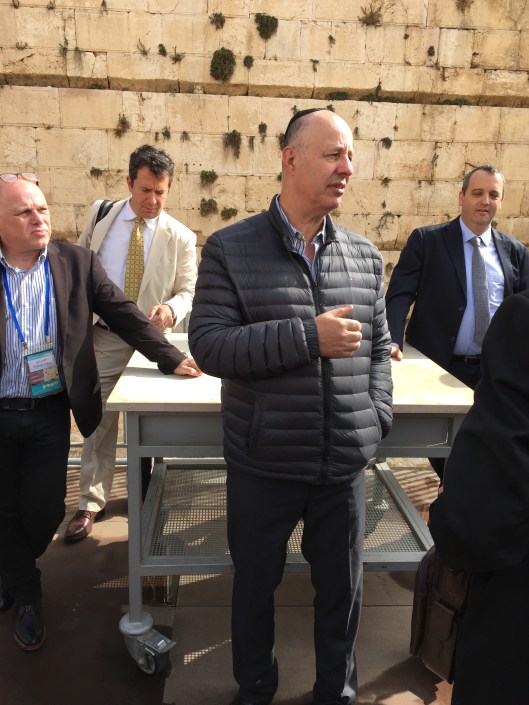
Tzachi Hanegbi at Kotel - November 2017

Tzachi Hanegbi above. Rabbi Gilad Kariv, Executive Director of the Israel Movement for Progressive Judaism is standing behind Minister Hanegbi and to his left. My photo.

I just returned from meetings of the Board of Governors of the Jewish Agency for Israel (BOG of JAFI) and the Zionist Council of the World Zionist Organization (Vaad HaPoel of the WZO) that met this past week in Jerusalem. (See historical notes below about these two national institutions of the Jewish people).

Two items were prominent on the agenda of JAFI – The Kotel Agreement compromise reached by the government of Israel in January 2016 (19 months ago) and the Conversion Law introduced before the Knesset by the ultra-Orthodox religious parties.

Re: the Kotel Agreement compromise – This agreement was reached after nearly four years of negotiations. If implemented the agreement would create an egalitarian prayer space in the southern Kotel plaza that would be equal in size and accessibility with the traditional Kotel plaza. Whereas the traditional Kotel plaza would continue to be controlled and supervised by the ultra-Orthodox Administrator of the Wall, the new southern Kotel plaza would be controlled and supervised by the Reform and Conservative movements, the Jewish Federations of North America, and the Women of the Wall. There would be a common entrance and both the traditional and southern plazas would be visible from that entrance. The new southern Kotel plaza would include egalitarian mixed-gender prayer.

Prime Minister Netanyahu had asked Natan Sharansky in 2013 to find a compromise agreement that would calm the tensions that had developed as a consequence of the monthly prayer minyanim observed by Women of the Wall in the back of the women’s section for the last 25 years, and would address the concerns of many Israelis that the entire Kotel plaza had been turned into an ultra-Orthodox synagogue. Non-religious ceremonies had once been conducted in the plaza by the State of Israel including the induction of soldiers into the IDF. Whereas the plaza represented the modern State of Israel as a national heritage site, it had been taken over by the most extreme religious forces in the state.

Natan Sharansky and the committee representing all interested parties (including the ultra-Orthodox Administrator of the Wall) succeeded in reaching a compromise. Should the agreement then be implemented as intended, it would have marked a victory for religious pluralism and democracy as stated in Israel’s Declaration of Independence.

However, on June 25, 2017, the Prime Minister abandoned the agreement when the ultra-Orthodox religious parties in his ruling government coalition threatened to leave the government should the compromise agreement be implemented. This action infuriated Natan Sharansky, the Board of Governors of the Jewish Agency for Israel that Sharansky now chaired, and the leadership of non-Orthodox Jews in Israel and around the world.

Also on June 25, 2017, the ultra-Orthodox parties submitted a bill to the Knesset that would restrict authority over all conversions in Israel to the ultra-Orthodox Chief Rabbinate. This means that 350,000 Israeli citizens who are not Jewish according to traditional Halacha (“Jewish law” defines a Jew as someone born of a Jewish mother) must convert according to the most rigid and strict standards as determined by the Israeli Chief Rabbinate. The 350,000 Israelis are primarily immigrants and children of immigrants from the former Soviet Union who either do not have a Jewish mother or who are spouses and family of Jews who would like to convert to Judaism but who would prefer to study with Reform or Conservative Rabbis and to live their Jewish lives according to Reform and/or Conservative standards and practices. Many would also choose to live their Jewish lives as does the vast majority of Israelis who practice Jewish tradition on Shabbat and the Holidays but are not Orthodox.

These non-Jewish Israelis, by the way, serve in the Israeli Defense Forces, speak Hebrew, pay taxes, and in every way identify as Israeli citizens. Many have been living in Israel for decades. But, they cannot marry in Israel unless they convert to Judaism. The Conversion Bill would make it far more difficult for them to ever convert. The ultra-Orthodox rabbinate converts only a few hundred individuals each year. If this bill were to pass it would take 1167 years to convert all 350,000 Israeli citizens. The Reform and Conservative movements in Israel are willing and able to convert thousands of individuals who seek to live their lives as Jews.

The Conversion Bill also rejects for purposes of Aliyah under the Law of Return any Jew converted in Diaspora communities by rabbis not approved by the Chief Rabbinate. This means that no Reform and Conservative rabbis, no modern Orthodox rabbis, and even many Haredi rabbis are not approved by the chief rabbinate as authentically Jewish.

The Kotel Agreement and the Conversion Law dominated our meetings of the Board of Governors of the Jewish Agency this past week.

In response to the outrage of the members of JAFI, Prime Minister Netanyahu asked his close political and personal ally, Minister of Regional Cooperation Tzachi Hanegbi (see photo above), to meet with us and explain the government’s position. The American Reform movement led by Rabbi Rick Jacobs, the Israeli Reform movement led by Rabbi Gilad Kariv, and the American Conservative movement led by Rabbi Steven Wernick expressed to Minister Hanegbi emphatically our demand that the original Kotel agreement be implemented immediately and that the Conversion Law be withdrawn from consideration permanently. PM Netanyahu had tabled the Conversion Law for six months and that period expires at the end of December.

In the same week when we celebrated the hundredth anniversary of the signing of the Balfour Declaration (November 2, 1917) in which the British government declared its support for the establishment of a national home for the Jewish people in the land of Israel, it was shocking to confront the reactionary response of the Netanyahu government concerning the Kotel and Conversion Law.

These issues in and of themselves are important, but they are only the tip of the iceberg. The wider and deeper issue at stake is whether Israel will remain religiously pluralistic and democratic.

By his actions, the Prime Minister has created a serious rift between the government of the State of Israel and the Jewish Diaspora, so much so that for the first time in history an Israeli Prime Minister was not invited to address the Jewish Agency Board of Governors. For the first time in my memory as well, the Prime Minister will not attend nor address by video the General Assembly (GA) of Jewish Federations, the most important American Jewish body taking place next week in Los Angeles.

We of the Board of Governors of the Jewish Agency convened at the Kotel last week in a demonstration of our support for the original Kotel agreement. It is important to note that there are those in the JAFI BOG leadership who would take whatever we can get from the government now and continue to fight for the implementation of the rest of the original compromise agreement. There are others including our Reform movement leaders who argue that the negotiated agreement reached in June, 2016 is already a compromise and should be implemented without changes.

At the Kotel, after Minister Hanegbi tried to reassure us of the Prime Minister’s good intentions on behalf of the entirety of the Jewish people, I asked him an obvious question:

“It seems to much of world Jewry that Prime Minister Netanyahu is more concerned with holding his position as Prime Minister and keeping his governing coalition together than he is concerned with the best interests of klal Yisrael, the entirety of the Jewish people. How do you respond to this widely held belief?”

Minister Hanegbi said that this was not true, that the Prime Minister has political challenges to consider, and that he still believes that a compromise is achievable.

No one I know standing there at the holiest site in Judaism believed that PM Netanyahu would become a “profile of courage” and risk his government on this issue or, for that matter, on any issue. But, I for one would be thrilled if he did so and would earn my deepest respect.

What is the take-away for us as progressive Zionists?

First, it is our duty as Diaspora Jews to continue to support the State of Israel as the national home of the entire Jewish people and not walk away from her. We need Israel and Israel needs us.We need to learn the history of the state of Israel if we don’t already know it, and stay engaged with her.

Second, it is our obligation as progressive Jews and Zionists to align ourselves with progressive democratic forces in Israel that advocate for religious pluralism, democracy, and human rights. After all, that is the vision expressed in Israel’s Declaration of Independence.

The following day, the 120 members of the Jewish Agency Board of Governors went to the Knesset and met individually in groups of four with thirty-four MKs. Our message was simple – We asked the government to implement the original Kotel Agreement and to reject the Conversion Law.

After our individual hour-long discussions, we met in a large Knesset Conference room and many MKs spoke to us including members of Likud, the Zionist Union, Kulanu, Yesh Atid, Bayit Hayehudi, Yisrael Beiteinu, and Meretz.

To a person, each supported our agenda and said so forthrightly and without equivocation. We did not meet, however, with any members of the extremist ultra-Orthodox parties or the Arab List.

Historical Notes:

JAFI and the WZO are two of the three national institutions of the Jewish people. The third is Keren Kayemet L’Yisrael (i.e. KK’L – or JNF).

Theodor Herzl, the Father of Zionism, founded the WZO in 1897 in Basel, Switzerland. It is called “the Parliament of the Jewish people” and includes representatives from every major Israeli political party and all world Zionist organizations.

David Ben Gurion founded the Jewish Agency for Israel in 1935 and served as its first Chair. He was also the chair of the WZO before the state was founded. Today, Natan Sharansky serves as chairman of the Jewish Agency Executive.

JAFI’s purpose is to “inspire Jews throughout the world to connect with their people, heritage, and land, and empower them to build a thriving Jewish future and a strong Israel.”

The WZO’s purpose “… aims at establishing for the Jewish people a legally assured home in Palestine.” Today, the WZO includes the World Zionist Unions, international Zionist federations, and international organizations that define themselves as Zionist, such as WIZO, Hadassah, B’nai Brith, Maccabi, the International Sephardic Federation, the three religious streams of world Judaism (Orthodox, Conservative, Reform), a delegation from the Commonwealth of Independent States (i.e. the former Soviet Union), the World Union of Jewish Students (WUJS), and more.

Both national institutions bring the State of Israel and the Jewish Diaspora together to debate the great issues facing the Jewish people, to promote the Jewish people’s general welfare, and to fund programs and projects that support world Zionism and the connections of world Jewry to the State of Israel.

Additional note: I serve as the national Chair of the Association of Reform Zionists of America (ARZA), the largest American Zionist organization representing 1.5 million American Reform Jews. ARZA’s President, Rabbi Josh Weinberg and other members of our ARZA national board were present in Jerusalem for these meetings, along with the leaders of Israel’s Reform movement, the Israel Movement for Progressive Judasim, the international Reform movement called ARZENU whose President is Rabbi Lea Muelstein from Great Britain, and Rabbi Daniel Freelander, President of the World Union for Progressive Judaism and his top leadership from Canada and around the world.

An Evening with the Israeli Ambassador to the United States

24 Tuesday Oct 2017

Posted by rabbijohnrosove in American Jewish Life, American Politics and Life, Israel and Palestine, Israel/Zionism, Jewish History, Jewish Identity

≈ Leave a comment

 Prossor - Grundwerg - Rosove

Right to left – Ambassador Ron Dermer, Israeli Consul General Sam Grundwerg, and me. (Photo by Rabbi Stanley Davids)

Israeli Ambassador to the United States Ron Dermer is an impressive, intelligent, and well-spoken advocate for Israel and the American-Israel partnership.

In meeting him last evening at Stephen S. Wise Temple I was impressed by his rhetorical skills, intelligence, optimism, and comprehensive presentation that touted all the positives about the State of Israel. Among other things, he noted that Israel is now regarded as the 8th most powerful nation in the world according to US News and World Report (https://www.usnews.com/news/best-countries/power-full-list). Its world leadership in start-ups are second only to the United States. Its ongoing positive diplomatic efforts with large nations around the world along with its strong economy, military, intelligence services, innovative technology, and Jewish values represent the fulfillment of one hundred generations since the destruction of Jerusalem by Rome.

The several hundred in attendance were overwhelmingly friendly and the Ambassador was gracious and felt clearly at home.

He began his talk by arguing why the Iran Agreement must be renegotiated. He saw us walking towards “a cliff” because he said that at the end of the term of the agreement, he claimed that there will be nothing stopping Iran from gaining a nuclear bomb.

Despite his dark assessment, others in the Israeli intelligence and military community believe that this agreement, while imperfect, is effective and must remain in place and that Iran is abiding by what it signed.

I refer you to an article that addresses his fears about what happens after the 15-year term of the agreement and what restrictions and safeguards will remain in place. Though no one, me included, trusts Iran, without this agreement Iran would be within months of the development of nuclear capability. The agreement did in fact result in the destruction of much of Iran’s nuclear capacity.

The Ambassador supported President Trump’s desire to renegotiate this deal which would blow the deal apart altogether and undermine international trust in the United States by our allies.

For a deeper explanation read “The world can’t afford a nuclear Iran. Keep the current deal” –  by Ernest Moniz, one of America’s chief negotiators:

https://www.bostonglobe.com/opinion/2017/10/04/the-world-can-afford-nuclear-iran-keep-current-deal/9d7JW61RDyRwQWQNoT2HCP/story.html

Ambassador Dermer noted that the single most existential threat to Israel is the spreading influence of Iran throughout the Middle East. It has armed Hezbollah in the north, has a growing relationship with Hamas in Gaza, and is attempting to take over Yemen so as to threaten Saudi Arabia. Ambassador Dermer said that when Arab countries and Israel are on the same page, one has to take notice. He is right. I had no disagreement with him on the threat against Israel, but I do disagree with his assessment of dangers of the Iran Agreement.

I was pleased to hear the Ambassador thank President Obama for signing a ten-year security agreement with Israel.

There were two other existential threats to the people and state of Israel that Mr. Dermer did not mention. Though he noted in passing the Israeli-Palestinian conflict that must be addressed, he said nothing about the corrosive effect of Israel’s occupation of the West Bank on both Palestinians living under the Israeli military administration there and upon Israeli soldiers who serve as occupiers. And he said nothing about the growing ultra-Orthodox stranglehold on the ruling governing coalition.

Before the meeting, with his childhood friend Consul General Sam Grundwerg, I told Mr. Dermer in my role representing the Association of Reform Zionists of America (ARZA) that the liberal American Jewish community has lost trust in Prime Minister Netanyahu primarily because he cancelled the Kotel agreement that he has advocated for the passage of the Conversion Law that would disenfranchise all Diaspora Jewry from the State of Israel.

I told him that we liberal American Zionists need Israel and I asked him to communicate our love of Israel and our concerns about his government’s direction to the Prime Minister. He said he would do so, but sadly, I have no expectation that Prime Minister Netanyahu will do anything that threatens his own government’s survivability, including standing up to the anti-democratic hegemonic intentions of the ultra-Orthodox political parties in his coalition.

This week I will be traveling to Israel to participate in meetings of the Board of Governors of the Jewish Agency for Israel and the Vaad HaPoel of the World Zionist Organization. The main challenge in our meetings with the WZO is to fight back the attempts of Israel’s right-wing parties to change the WZO constitution that would weaken Diaspora Zionism with Israel.

I will write from Israel, so stay tuned.


← Older posts
Newer posts →

Enter your email address to subscribe to this blog and receive notifications of new posts by email.

Join 367 other subscribers

Archive

  • February 2026 (4)
  • January 2026 (8)
  • December 2025 (4)
  • November 2025 (6)
  • October 2025 (8)
  • September 2025 (3)
  • August 2025 (6)
  • July 2025 (4)
  • June 2025 (5)
  • May 2025 (4)
  • April 2025 (6)
  • March 2025 (8)
  • February 2025 (4)
  • January 2025 (8)
  • December 2024 (5)
  • November 2024 (5)
  • October 2024 (3)
  • September 2024 (7)
  • August 2024 (5)
  • July 2024 (7)
  • June 2024 (5)
  • May 2024 (5)
  • April 2024 (4)
  • March 2024 (8)
  • February 2024 (6)
  • January 2024 (5)
  • December 2023 (4)
  • November 2023 (4)
  • October 2023 (9)
  • September 2023 (8)
  • August 2023 (8)
  • July 2023 (10)
  • June 2023 (7)
  • May 2023 (6)
  • April 2023 (8)
  • March 2023 (5)
  • February 2023 (9)
  • January 2023 (8)
  • December 2022 (10)
  • November 2022 (5)
  • October 2022 (5)
  • September 2022 (10)
  • August 2022 (8)
  • July 2022 (8)
  • June 2022 (5)
  • May 2022 (6)
  • April 2022 (8)
  • March 2022 (11)
  • February 2022 (3)
  • January 2022 (7)
  • December 2021 (6)
  • November 2021 (9)
  • October 2021 (8)
  • September 2021 (6)
  • August 2021 (7)
  • July 2021 (7)
  • June 2021 (6)
  • May 2021 (11)
  • April 2021 (4)
  • March 2021 (9)
  • February 2021 (9)
  • January 2021 (14)
  • December 2020 (5)
  • November 2020 (12)
  • October 2020 (13)
  • September 2020 (17)
  • August 2020 (8)
  • July 2020 (8)
  • June 2020 (8)
  • May 2020 (8)
  • April 2020 (11)
  • March 2020 (13)
  • February 2020 (13)
  • January 2020 (15)
  • December 2019 (11)
  • November 2019 (9)
  • October 2019 (5)
  • September 2019 (10)
  • August 2019 (9)
  • July 2019 (8)
  • June 2019 (12)
  • May 2019 (9)
  • April 2019 (9)
  • March 2019 (16)
  • February 2019 (9)
  • January 2019 (19)
  • December 2018 (19)
  • November 2018 (9)
  • October 2018 (17)
  • September 2018 (12)
  • August 2018 (11)
  • July 2018 (10)
  • June 2018 (16)
  • May 2018 (15)
  • April 2018 (18)
  • March 2018 (8)
  • February 2018 (11)
  • January 2018 (10)
  • December 2017 (6)
  • November 2017 (12)
  • October 2017 (8)
  • September 2017 (17)
  • August 2017 (10)
  • July 2017 (10)
  • June 2017 (12)
  • May 2017 (11)
  • April 2017 (12)
  • March 2017 (10)
  • February 2017 (14)
  • January 2017 (22)
  • December 2016 (13)
  • November 2016 (12)
  • October 2016 (8)
  • September 2016 (6)
  • August 2016 (6)
  • July 2016 (10)
  • June 2016 (10)
  • May 2016 (11)
  • April 2016 (13)
  • March 2016 (10)
  • February 2016 (11)
  • January 2016 (9)
  • December 2015 (10)
  • November 2015 (12)
  • October 2015 (8)
  • September 2015 (7)
  • August 2015 (10)
  • July 2015 (7)
  • June 2015 (8)
  • May 2015 (10)
  • April 2015 (9)
  • March 2015 (12)
  • February 2015 (10)
  • January 2015 (12)
  • December 2014 (7)
  • November 2014 (13)
  • October 2014 (9)
  • September 2014 (8)
  • August 2014 (11)
  • July 2014 (10)
  • June 2014 (13)
  • May 2014 (9)
  • April 2014 (17)
  • March 2014 (9)
  • February 2014 (12)
  • January 2014 (15)
  • December 2013 (13)
  • November 2013 (16)
  • October 2013 (7)
  • September 2013 (8)
  • August 2013 (12)
  • July 2013 (8)
  • June 2013 (11)
  • May 2013 (11)
  • April 2013 (12)
  • March 2013 (11)
  • February 2013 (6)
  • January 2013 (9)
  • December 2012 (12)
  • November 2012 (11)
  • October 2012 (6)
  • September 2012 (11)
  • August 2012 (8)
  • July 2012 (11)
  • June 2012 (10)
  • May 2012 (11)
  • April 2012 (13)
  • March 2012 (10)
  • February 2012 (9)
  • January 2012 (14)
  • December 2011 (16)
  • November 2011 (23)
  • October 2011 (21)
  • September 2011 (19)
  • August 2011 (31)
  • July 2011 (8)

Categories

  • American Jewish Life (458)
  • American Politics and Life (417)
  • Art (30)
  • Beauty in Nature (24)
  • Book Recommendations (52)
  • Divrei Torah (159)
  • Ethics (490)
  • Film Reviews (6)
  • Health and Well-Being (156)
  • Holidays (136)
  • Human rights (57)
  • Inuyim – Prayer reflections and ruminations (95)
  • Israel and Palestine (358)
  • Israel/Zionism (502)
  • Jewish History (441)
  • Jewish Identity (372)
  • Jewish-Christian Relations (51)
  • Jewish-Islamic Relations (57)
  • Life Cycle (53)
  • Musings about God/Faith/Religious life (190)
  • Poetry (86)
  • Quote of the Day (101)
  • Social Justice (355)
  • Stories (74)
  • Tributes (30)
  • Uncategorized (831)
  • Women's Rights (152)

Blogroll

  • Americans for Peace Now
  • Association of Reform Zionists of America (ARZA)
  • Congregation Darchei Noam
  • Haaretz
  • J Street
  • Jerusalem Post
  • Jerusalem Report
  • Kehillat Mevesseret Zion
  • Temple Israel of Hollywood
  • The IRAC
  • The Jewish Daily Forward
  • The LA Jewish Journal
  • The RAC
  • URJ
  • World Union for Progressive Judaism

Blog at WordPress.com.

  • Subscribe Subscribed
    • Rabbi John Rosove's Blog
    • Join 367 other subscribers
    • Already have a WordPress.com account? Log in now.
    • Rabbi John Rosove's Blog
    • Subscribe Subscribed
    • Sign up
    • Log in
    • Report this content
    • View site in Reader
    • Manage subscriptions
    • Collapse this bar
 

Loading Comments...