Weeping and alone in a field

Chayei Sarah is a monumental Torah portion in the Book of Genesis (23:1-25:18) that establishes Hebron as one of our people’s holiest cities in the land of Israel.

The sidra begins by telling the story of Abraham buying burial space in the Cave of Machpelah for his wife Sarah. That site would become holy to Judaism and Islam through the generations, and the city of Hebron, which is overwhelmingly Arab with a small enclave of right-wing Jewish religious extremist settlers, is a hot spot between Israel and the Palestinians today.

The parashah also tells the moving story of Isaac’s and Rebekah’s meeting, betrothal and marriage arranged by Abraham through his servant Eliezer who his master sent to find a wife for his son Isaac.

For the first time in Jewish history we witness the passing of the baton of inheritance and leadership from one generation to the next.

I offer here a poetic Midrash on Isaac’s and Rebekah’s encounter leading to their marriage. It is based loosely on the Torah story as amplified by rabbinic Midrash and is a revisiting of a poem I wrote a few years ago and posted on this blog.

I love this story because Isaac’s and Rebecca’s meeting is simple and sweet. It offers a the hope of what’s possible between individuals and tribes that make up the Jewish people today and the peoples of the Middle East who suffer too much polarization, suspicion, distrust, and hatred of each other.

Imagine the scene – Isaac is alone meditating in an open field and Rebecca and Abraham’s servant Eliezer approach from afar in a camel caravan. I shift voices in the poem between Isaac, Rebekah and Eliezer. I begin with Isaac:

“To be alone amidst shifting wheat and rock, / Beneath the sun and stirred-up clouds / Hearing singing angels audible in the wind.

I’ve secluded myself as my father did / When he went out alone leaving all he knew / For a place he’d never been that God would show him.

I can do nothing else / Because Father broke my heart and crushed my soul / When he betrayed me by nearly offering me to his God / Stealing me away one morning before my mother Sarah awoke.

When my mother learned her soul passed from the world./ O how she loved me! / And filled me up with laughter, love and tears. / Bereft now I’m desolate in this field.

Compassionate One – / Do You hear me from this arid place / Filled with snakes and beasts, / Polluted by hatred and vengeance?”

As if in response from afar / A caravan appears of people and camels, / Led by Eliezer, Abraham’s servant, / With a young girl.

Isaac, burdened in grief neither looks nor sees. / He sits still lasuach basadeh / Meditating and weeping / Beneath the afternoon sun / And swirling clouds / And singing angels / Whom he cannot hear.

Rebekah asks: / “Who is that man crying alone in the field?” / Eliezer says: / “He is my master Isaac, your intended one, / Whose seed you will carry and make the future.”

“Vatipol min hagamal – And she fell from her camel” / Shocked and afraid onto the hard ground.

She veiled her face and bowed her head. / And Rebekah and Isaac entered Sarah’s tent, / And Rebekah comforted him.”

Poem by Rabbi John L. Rosove based on traditional Midrashim


Living patiently until November 6

For the past two years I have experienced, like so many of us, wide mood swings taking me from righteous indignation, disgust and outrage on one side to patience, perseverance and suffering on the other.

As we approach the mid-term elections on November 6, both extremes have filled me up.

On Sunday this past week, my family and I attended a 2000-person packed auditorium at the Culver City High School to hear Pete Souza, the personal photographer of President Obama (he is promoting a new book of photographs of the President called “Shade – A Tale of Two Presidents”). Most everyone in the hall was supportive and relived with sweet nostalgia, joy and longing the eight years of the Obama presidency.

Pete took us down memory lane and showed us many of his memorable candid photos of Obama (he took 1.9 million photographs during Obama’s eight-year term). Taken all together these photos reveal the humanity, grace, intellect, vision, thoughtful and considered brilliance of the 44th President.

Pete contrasted the current occupant of the White House with the man he respects and loves so deeply. Not once, as I can recall, did Pete mention the name of the current White House occupant – he referred to him several times as “that guy.” Only in hindsight did it occur to me that his not saying the President’s name was deliberate, that should he have done so would have dirtied his speech.

As November 6 approaches I have been remarkably impatient, short-tempered and excruciatingly worried. I don’t know the outcome to this crucial mid-term election, whether the Democrats will take back the House of Representatives or not (I don’t expect the Senate to change hands). No one knows what will happen and where we’ll be on November 7.

President Obama was right yesterday when he said to a crowd in Nevada as he campaigned that this is the most important election in our lifetime because it will determine the state of our democracy going forward at least over the next two years. All we can do is to be certain that everyone we know votes, especially in swing House districts and purple states.

Rainer Maria Rilke, the Bohemian-Austrian poet and novelist (1875-1926), offered the following wisdom about living patiently:

“Be patient toward all that is unsolved in your heart and try to love the questions themselves, like locked rooms and like books that are now written in a very foreign tongue. Do not now seek the answers, which cannot be given you because you would not be able to live them. And the point is, to live everything. Live the questions now. Perhaps you will then gradually, without noticing it, live along some distant day into the answer.”

I hope that on November 7 we will live the answer so many of us yearn to know.

How Abraham healed God

The greatest Jewish theological revolution since the destruction of the Temple (70 CE) was brought about by Kabbalah. The greatest new idea about the relationship between God and humankind during the past 2000 years was introduced by Jewish mystics who boldly asserted that we humans have the ability to restore God’s wholeness and effect the end of God’s exile within the Divine Self.

Much of this new thinking was stimulated by Rabbi Isaac Luria (15th century, Safed) whose ideas about the origins of the universe led to the belief that the Jewish people has the capacity to create the conditions necessary for the coming of the Messiah.

Isaac Luria’s cosmology is powerfully innovative. He explains that when God contemplated creating the universe the Creator realized that there was no room for anything except God’s Self, Who filled time and space.

To accommodate the new creation God underwent contraction (tzimtzum). Before the beginning God was light, and so God took away some of the light and placed it in giant vessels (keilim), but the vessels were not strong enough to contain the light and an explosion shattered the vessels (sh’virat ha-keilim) flinging the shards (kelipot) to the four corners of the universe. Trapped in the shards were sparks (n’tzitzot). Whenever a Jew performs a mitzvah (commandment), a spark is released from a shard. When all Jews perform all the mitzvot all the sparks are released, the Messiah is ‘awakened,’ and Tikun Olam (restoration/repair of the world) results. When this occurs God too undergoes Tikun and the holiest Name (YHVH or Yod–Heh–Vav–Heh) is reunified.

Jewish mystics explain that the Yod–Heh (the first two letters of the 4-letter Name) represents the “highest” and purest of God’s ten emanations (Sefirot), but were separated from the Vav–Heh (the third and fourth letters of the holy Name) when the vessels shattered. The Vav-Heh represents the “lower” Divine Sefirot. As such, the “upper” and “lower” worlds were split apart mirroring the brokenness of our own world.

Enter Abraham, who in this week’s Parashat Lech L’cha (Genesis 12:1-17:27) receives the Divine call. That call and Abraham’s receptive response was a necessary stage leading to the unification (Yihud) of God’s holiest 4-letter Name. How so?

In Genesis 12:2 we read of God’s promise to Avram :

“I will make of you a great nation, and I will bless you; I will make your name great, and You shall be a blessing (Veh’yeh b’rachah).”

Note that God’s 4-letter Name (Yod-Heh-Vav-Heh) is comprised of the same 4 letters as Veh’yeh (“…and be a blessing”), but appear in a different order (Vav-Heh-Yod-Heh).

Rabbi Levi Yitzhak of Berditchev (1740-1809, Ukraine), teaching that nothing is to be overlooked in Torah and  every word and letter have deeper metaphysical significance wrote:

“The letter Yod-Heh [the ‘higher’ Divine emanations] in the word Veh’yeh is an allusion to God, whereas the letters Vav-heh [the ‘lower’ Divine emanations] is an allusion to the Jewish people. As long as Abraham had not existed, there had not been a human being who tried to ‘awaken’ God’s largess to be dispensed in the lower regions. God’s largess, whenever the Eternal One dispensed it for the good of humankind, owed this exclusively to the Creator’s goodwill [i.e. meritless Grace]. As soon as Abraham became active on earth, there were deeds on earth that ‘awakened’ God to dispense the Divine largess as a result of acts performed by human beings. In other words, prior to Abraham, God’s Name could be spelled in the order Yod-Heh-Vav-Heh, whereas this order had now been reversed and God’s Name could be spelled as Vav-Heh-Yod-Heh… The reversal of the sequence of the letters Vav-Heh hints at this largess having its origin in the ‘lower,’ rather than the celestial regions.” (Kedushat Levi, translation and commentary by Rabbi Eliahu Monk, Lambda Press, volume 1, pages 43-44)

What is the meaning of this complicated understanding of the 4 letters in God’s Name? Until Abram appeared, Levi Yitzhak taught, there was no mutual relationship between God and humankind. However, with Abram all that changed. Abram’s capacity to “hear” God’s call (i.e. prophesy) and respond augured well not only for the future spiritual development of the Jewish people but signaled the beginning of Divine Tikun.

The Torah’s reversing the order of the letters represents Abram reversing the direction of largess that had exclusively come from God to humankind to a new paradigm that moved from humankind to God.

The idea that Jews can affect the internal life of God is revolutionary, not only in Judaism but in the history of religion. This is why, according to Jewish mystics, Abram was the world’s first Jew. As a Jew, each of us carries a burden, responsibility and opportunity to work towards tikun olam, the restoration/repair of a shattered universe. When that occurs so too is there a Tikun Shem M’forash (a restoration of God’s holiest 4-letter Name).

Shabbat Shalom.


“Why the Midterms Terrify American Jews” – Eric Yoffie, Haaretz, October 17

Note: As always, Rabbi Eric Yoffie articulates as well as anyone the core values and central issues confronting the American Jewish community  and Israel. Today, he published in Haaretz his concerns about the mid-term elections and why he believes American Jews are so worried about the outcome.

I reprint his piece here in its entirety because many readers of this blog do not subscribe to Haaretz where his article appears. His piece is, I believe, important enough to disseminate beyond Haaretz readership. Please forward this to anyone you believe ought to read it.


“We know where bigoted, autocratic, indecent and parochial views like those of Donald Trump lead. U.S. Jews should be praying for every Democratic candidate canvasser to succeed: the American Jewish future depends on it

The midterm elections are less than three weeks away, and Donald Trump and his Republican party might even win.

The Republicans are certain to retain control of the Senate, probably adding several seats to their current majority. And while the Democrats are still favored to take the House of Representatives, their lead in the polls is small and shrinking.

What does this mean for American Jews? Nothing good. Mainstream American Jewry is terrified. (More on that in a moment.)

But it is not the Jews alone who are dismayed. Much of middle-class America feels panicky and threatened, fearing both for the future of the Republic and their own well-being.

In my home congressional district in central New Jersey, concern about a Trump victory has generated furious energy and a firestorm of anti-Trump activism. No one remembers when the district was last represented by a Democrat, but the race this year is fiercely competitive.

The Democratic challenger is impressive, smart, and articulate, and is running even in the polls.

His opponent, the incumbent, is a more-or-less moderate Republican. But like virtually all Republicans these days, he refrains from even the gentlest criticism of Donald Trump. The problem with this strategy, of course, is that Donald Trump is the only real issue in the campaign.

The waves of volunteers in my area who are registering voters and canvassing neighborhoods on behalf of the Democrats are an interesting bunch. Most of them have never volunteered before, and some are not even Democrats. But they know a threat when they see one, and when they look at Mr. Trump, they are incredulous at what he is doing to their country.

These volunteers, mostly women, are generally establishment types, not given to alarmism or conspiracy theories. But in Trump they see a man who is fully capable of leading America down the path to autocracy.

It is not the corruption that they fear; New Jersey is hardly a stranger to corruption. Neither is it Trump’s predatory tax policies, intended both to punish blue states and reward the extremely wealthy. Unfair taxation, while deplorable, has been around for a long time.

The volunteers are scared of other, more insidious things: Trump’s brazen, non-stop attacks on the media, intended to delegitimize any criticism before it is even uttered; his heartless and cruel treatment of children, tearing toddlers from their mothers’ arms at the Texas border; his contempt for the law, demanding that his Attorney General pledge loyalty to him rather than to the Constitution; and on and on.

These women are not radicals but they have become resisters. Are there no limits, they ask? Are there no basic democratic norms to which the President can be held? Can we not expect from him some measure of fundamental human decency?

And that is why the midterms have assumed such importance. These activists know that if the Republicans retain control of both the Senate and House, the floodgates will be opened. “I have been endorsed by the people,” Trump will proclaim, with some justification.

If that happens, Americans know what to expect. The President will likely fire Sessions and Rosenstein and terminate the Mueller investigation. He may pardon all those already implicated.

Other possibilities include ratcheting up anti-immigrant rhetoric, instituting a new family separation policy at the U.S.-Mexican border, encouraging more voter suppression at the state level, and pushing out James Mattis and the few competent staffers that remain in the cabinet and White House.

Perhaps he will even signal to the Russians that interference in another presidential election would not be seen as too big a deal.

Not long ago, any one of these actions would have been utterly unthinkable. Today, every one is possible, and many are likely. And the list is far from complete.

And that is the reason that volunteers in my district and around the country are working with such energy, every minute of every day, to win control of the House for the Democrats. They know that with a House majority comes investigative power, and that such power is the only check and balance available to combat an out-of-control president.

Without it, there might be nothing to prevent Trump from undermining our democracy in irreversible ways.

And what of the Jews? Among the volunteers, there are many Jews, both in my district and elsewhere. Most would probably say that they oppose Trump for the same reasons as everyone else.

But my view is that the fear quotient among Jews is probably higher than it is for most Americans. After all, as a dispersed and vulnerable minority for much of their history, Jews have more experience than most other Americans with demagogues and autocrats. Decimated by the Holocaust, they also have a fuller understanding of how fragile modern democratic governments are.

And the result of this experience is that Jews crave the stability and security that attracted them to America in the first place and enabled them to thrive here. They prefer solid, established, middle-class governments. Rank populism scares them. Massive income inequality rattles them. Leaders who play coy with white supremacists frighten them to death.

But a solid, steady America is not Trump’s America. After almost two years of a Trump presidency, American Jews see an angry and divided country, a leader who thrives on chaos and disruption, a governing tone of incitement and petulance, and an America that has been turned upside down before their very eyes.

And if Jews know anything, they know this:  When large segments of the electorate are filled with rage, normal standards of decency and civility fall quite easily, almost without notice.

Does this mean the emergence of anti-Semitism? Well, yes and no.

On the one hand, America is not an anti-Semitic country. Anti-Semitism exists here, but mostly on the fringes. On the other hand, anti-Semitic hate crimes rose almost 60% last year, the largest single-year jump on record.

This trend has attracted attention in my congressional district. In the last few months alone, swastikas have been painted on the walls of local high schools, KKK and other white supremacy literature has been distributed throughout the area, an explosive device was planted in a Jewish cemetery, and the home of a Jewish congressman was defaced.

Each incident, by itself, would likely be seen as “low level.” Collectively, they constitute a worrisome trend.

And the best explanation for what is happening is the nature of Trump’s leadership. The President, it should be noted, is not an anti-Semite and has not attacked the Jews. But he has shown no reluctance to attack and offend African-Americans, Hispanics, Muslims, and immigrants.

In expressing bigoted ideas about other minorities and foreigners, the President has crossed a threshold not even imagined by any other modern President. And the result is that the lowlifes on the anti-Semitic fringe have been emboldened to come out from under their rocks and go after the Jews. And Jewish voters, in my area at least, have taken notice.

And finally, Israel. Support for Israel is strong in my district, and the President’s decision to move the American embassy to Jerusalem won wide backing. Some Jews will vote for Trump’s party for that reason alone.

But most will not. Israel, after all, is an important consideration for American Jews on election day, but rarely the only – or even the decisive factor. And in any case, the idea of Trump as Israel’s savior doesn’t quite compute for many Jews, even enthusiastic Israel supporters like me who praised the embassy move as long overdue.

Let’s be brutally honest here. Trump has an allegiance to the Kremlin, expressed at Helsinki and elsewhere, that is so bizarre that we must wonder if he is even an American patriot. And let’s remember what Russia is doing right now: Allowing Iran to become entrenched in Syria, limiting Israeli intervention against Iran on Syrian soil, and colluding with Iran to evade American sanctions on Iranian oil. Is this really the best time for President Trump to be turning America into a Russian-proxy state?

The bottom line is that Trump is an America Firster, an isolationist, a nativist, and a protectionist. Trump has never really believed in American leadership in the world. And without such leadership, Israel will never be secure.

What Israel needs is an ally in America that is the dominant world power, militarily strong, and committed to prudent globalism. What Trump offers instead is a narrow parochialism that is simply untenable – dangerous for America, dangerous for the world, dangerous for Israel, and dangerous for the Jews. Right-wingers who pay attention to Trump’s bluster and think only of the embassy are being bamboozled.

For all these reasons, most American Jews will vote for Democrats this November.

For all these reasons, masses of American volunteers of all faiths and ethnicities will work until the last possible moment to assure a Democratic House of Representatives in the midterms.

And for all these reasons, if we value our democratic rights, fear the Trumpian drift toward autocracy, care about repairing our social fabric, and desire to recreate a real sense of American community, let us hope and pray those volunteers succeed.

Everything – including the fate of the American experiment and the welfare of the Jewish community – depends on the outcome.”

Eric H. Yoffie, a rabbi, writer and teacher in Westfield, New Jersey, is a former president of the Union for Reform Judaism. Twitter: @EricYoffie

https://bit.ly/2P3rvKM



“The Ban on Lara Alqasem Is a Gift for BDS, and a Disaster for Israel” – by Jeremy Ben-Ami, Haaretz

Note: The following is a clear and compelling statement why Israel’s policy of denying entrance to pro-BDS activists is wrong-headed and counterproductive strategically and democratically.

To be clear, I am opposed to BDS (the Boycott, Divestiture and Sanctions movement against Israel) for the same reasons stated in Jeremy Ben-Ami’s op-ed in Haaretz below.

Israel is, after all, a democracy and the best way to shine a light on ideas that are repugnant to most pro-Israel activists and Israelis is to allow them to be expressed freely and then criticized forthrightly in the public square. Persuasion, not suppression, is what has driven democracy and Jewish tradition over the centuries.

Israel has detained an American student Lara Alqasem (age 22) whose grandparents are Palestinian because of her former activism (2014-2017) in the BDS movement, arguably an anti-Israel movement. Yet, she had applied and was accepted for study at the Hebrew University in Jerusalem. What better way to show a young student what Israel is really all about than to permit her entrance to live in Israel and learn about its vitality and democratic diversity.

For the Haaretz article, go to https://bit.ly/2PwAgK1 or read Jeremy Ben-Ami’s open letter to Israel’s Minister of Strategic Affairs and Public Security Erdan below:


Dear Minister Erdan:

I am aware that, as Israel’s Minister of Strategic Affairs and Public Security, your portfolio includes managing Israel’s response to BDS. Over the years, you and other officials of the Israeli government have met with J Street and with other liberal Jewish leaders to ask for advice on countering the global boycott divestment and sanctions movement.

Allow me to say to you today, in no uncertain terms: What you are doing in the case of Lara Alqasem is not only morally wrong, it is the most un-strategic and damaging move that the state could make if it hopes to minimize support for BDS and promote Israel’s interests and standing around the world.

J Street is a pro-Israel, pro-peace organization that supports a two-state solution and opposes occupation. We oppose the BDS movement because it doesn’t recognize the Jewish people’s right to self-determination, it doesn’t support a two-state solution and it makes no distinction in its fight between occupation and the existence of Israel itself.

As progressives who fight for democratic values, diplomacy and peace, we are well-positioned on campuses and in our communities to make the case against boycotts – even as we oppose many of the policies that your government is implementing.

We firmly believe that the only way for Israel to effectively counter BDS, on campus and beyond, is to pursue and reach a two-state peace agreement that resolves the Israeli-Palestinian conflict and brings an end to the occupation.

Targeting BDS supporters – or those who merely have critical political views – and banning them from entering Israel does not counter their arguments or stem the global tide of concern for the Palestinian people. Like other anti-democratic actions by your government, it empowers Israel’s fiercest critics and undermines pro-Israel, pro-peace advocacy.

What exactly is the threat posed by allowing a 22 year-old American student to study for a year at Hebrew University? How will she harm the economy? How will she damage the strongest military in the Middle East? What is so frightening about someone who seeks to learn more about Israelis and Palestinians?

The only harm being done to Israel right now is the terrible damage to its reputation as a democracy that results from detaining a young student in a holding cell at the airport, for days and weeks on end, because of her political beliefs.

Subjecting those who wish to visit and study in your country to ideological litmus tests cuts at the very heart of the values on which the U.S.-Israel relationship is based and threatens to further shred the ties between us. This is the kind of action we have come to expect from authoritarian regimes – not from fellow democracies and allies.

Let me give you my clearest and simplest advice on how to counter BDS and advance the long-term interests of your country: Drop the case against Lara Alqasem.

Let her study at Hebrew University. Invite her to share her views with you. Encourage her to see the many things in Israel of which we are so rightly proud. Respect her right to tell you and your colleagues what she believes that you are doing wrong. Recognize that the right way to deal with speech you don’t like is to counter it, not silence it.

Let me be equally clear that the surest way to damage support for Israel and build up the BDS movement is to continue to interrogate people about their political beliefs at the border, to penalize young students and to promote laws – both in the Knesset and in the U.S. Congress – designed to criminalize boycotts and non-violent political protests.

Perhaps that is your strategy: instead of treating the BDS movement as the pesky but largely toothless challenge it is, your government treats it as a strategic threat to distract Israelis and Israel’s supporters from the real threat posed to the country’s future by the ever-deepening and never-ending occupation.

I hope that is not the case. But if that is the goal, it is doomed to fail.

In the meantime, know this: the majority of Israel’s supporters in the U.S. will not give up on our efforts to promote a two-state solution, to end the occupation and help secure Israel’s future as a democratic homeland for the Jewish people.

And we will not keep quiet while the misguided policies of your government do such serious damage to the interests of the State of Israel and to the values of the Jewish people.

Jeremy Ben-Ami is president and founder of J Street, the political arm of the pro-Israel, pro-peace movement. Twitter: @JeremyBenAmi


Top of Form

Bottom of Form

Top of Form

Bottom of Form


The heartbreaking testimony of a Holocaust survivor about missing Yemenite Children – by Noah Efron of “The Promised Podcast” – TLV1

Introductory Note: I am grieved to post this, but honesty in Jewish life and in democracies demand that we confront  moral failures wherever and whenever they occur. It is the only way to be assured that they we don’t repeat them.

I post here what constitutes among the most heinous moral failures of the State of Israel in its history. As a Jew, I am ashamed. That being said, anyone who knows me knows that I love the State of Israel. Israel is in my DNA. I love the people and regard the Jewish State as the greatest miracle of the past 2000 years of Jewish history.

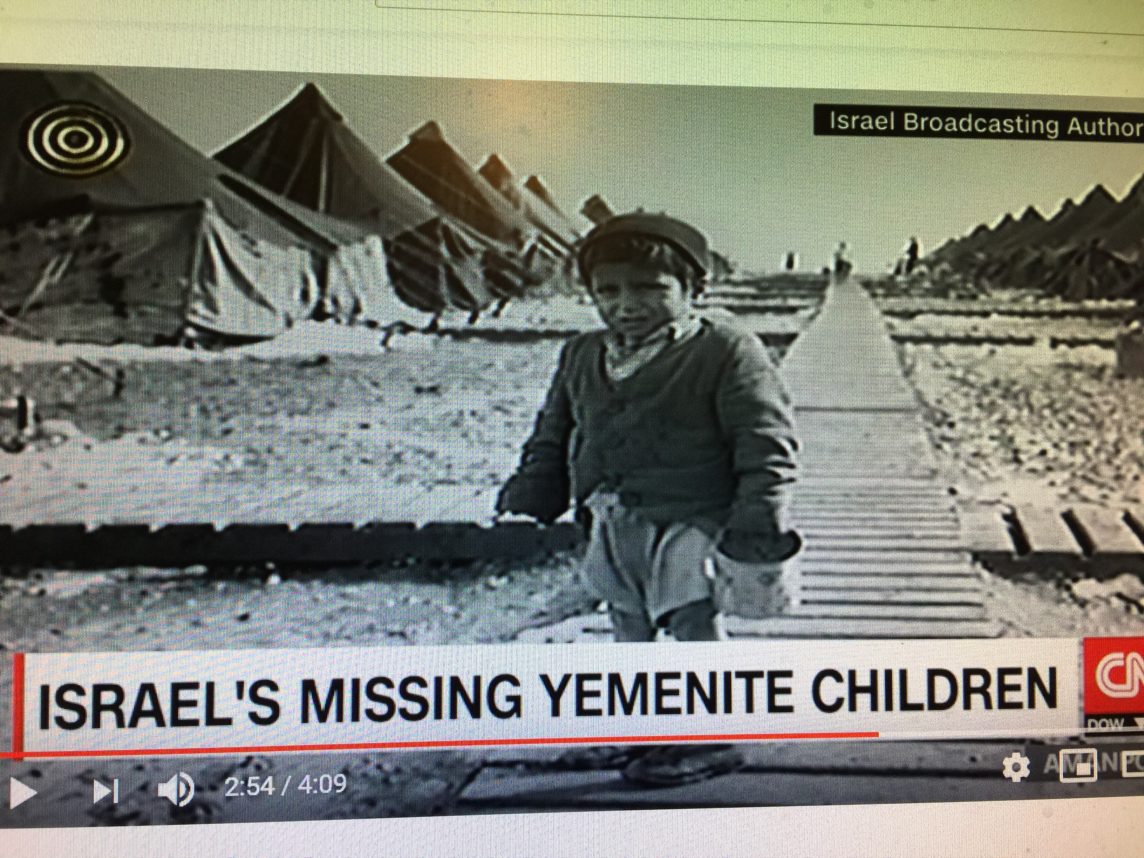
CNN covered the story about the hundreds of missing Yemenite and Arabic Jewish children in the early 1950s when they were brought by their parents to Israel and can be viewed here – https://www.youtube.com/watch?v=kp4IDws6f74

I requested the article below from my friend Noah Efron of “The Promised Podcast” (TLV1) out of Tel Aviv who reported the story this past week on the podcast. Noah had originally brought this story to light in 2014. With the recent statement of an eye-witness, the full episode of what happened to hundreds of Yemenite and Arabic Jewish babies in Israel in the early 1950s was revealed. I share Noah’s commentary on “The Promised Podcast” with his permission:

“We heard this week the remarkable and heartbreaking testimony of 85 year-old Shoshana (שחם) Shaham, a Holocaust survivor who was a student nursemaid in the transit camp, or Maabara, in Rosh Ha’Ayin through the first half of the 1950s, and only now told journalists for the first time that she saw kids of new immigrants in the camp, mostly from Yemin, being given up for unofficial adoption, without their parents knowledge, much less agreement, and of course they would never agree, and then she saw these same parents lied to, told that their kids had died and been immediately buried.

Shacham said:

“We would see cars coming, and from the cars people would emerge, dressed well, in city clothes. They spoke a foreign language. We saw these people putting babies in their cars. So I said, “What a minute, where are they taking them? So they said, ‘We are improving their circumstances. They are going to be in a different family, so they won’t get sick and dehydrated. So they won’t get dehydrated, they’ll give them liquids, they’ll give them food.”  

Shaham said she knew that they were being taken from their parents, beyond a shadow of a doubt. She says that she knew, at the time, that the parents knew nothing of this. She said that when the parents came, the doctors lied to them, saying their kids died. “We were witnesses,” she said. It was one of our crimes on the way to independence.

Shaham’s testimony is among the first to come from someone who was on the side of the people in the white coats. Until now, the only reports we had of this came from heartsick parents.

Those reports — victims testimonies — have been heard by now by a succession of three official committees (one in 1967, the next in 1988, then in 1995) assembled to investigate the disappearances documented in 745 cases, although activist organizations have gathered evidence of several times as many cases, maybe as many as five thousand. The events are known here as “The Yemenite Children Affair,” although in point of fact, a third of the missing children came from Iraq and other middle eastern and north African countries.

Reading the testimonies of long-bereaved parents before one or another of the investigating committees, one learns both that each instance of loss was unique, with its own tragic circumstances, and also that the disappearances followed patterns. Most of them happened in one of two places: a ma’abara children’s house or a medical clinic. Usually, parents were told that their children were being taken for some special care of which they were in absolute need. These parents were not given an option to refuse; in some cases, a baby was pulled from the arms of a parent wailing in protest. When the parent later came to visit their kid, they were told that a tragedy had occurred: the baby died. They were never shown a body, they were not invited to participate in a funeral. They were not given a copy of a death certificate. They were not taken to a cemetery plot. Sometimes, they were told, by way of offering comfort, that they could conceive a new baby, if they wished.

Most of these parents spent the rest of their lives looking for these kids, some into their 90s, and they never found them, which is a thing of incomprehensible weight.

But, there was more. Not only did these parents and sisters and brothers and uncles and aunts have to live their entire lives in the chilled shadow of this loss and cruelty, but they also had the secondary trial of not being believed.

Each official committee concluded that, while the testimony of families were heartbreaking and they were sincere, their kids had almost surely just died, at a time when medicine was poor and disease was hearty and records were scanty. They’d lost their child, and no one doubted the depths of their suffering, but they’d lost their kid to disease, maybe the oldest, if still the saddest, story there is.

But the parents, and in time their surviving kids, and then grandkids, knew that they knew what they knew. And for years, they insisted, and they cajoled, and they protested, and they organized. And for years, they were not believed. For years, people said, “Then why doesn’t some nursemaid come forward and say, I saw this with my own eyes. If it really happened, there would be a nursemaid who would say that.”

Well, now one has.

And I … and the podcast  … are implicated in this, too, in the following way. When I introduced the subject for discussion three years ago, I said this:

Now, there are some persuasive reasons to believe that no babies were kidnapped and given to more presentable – that is, Ashkenazi – families to raise. Shifra Shvarts, the leading historian of health care in Israel, says that she’s examined 30,000-40,000 files form that time, and never seen a clue of kidnapping. And then there were those expert commissions. At the same time, if the babies just died, how did they not let the parents see them, mourn them, bury them? I mean, who does that? 

So my questions for you mooks are these.  If all the evidence says that no kids were kidnapped, and no direct evidence says they were, then why does the belief that they were persist?

And then the discussion pretty much ended with Don [Futterman] saying this:

It’s not the Israel of today, and I think it’s not correct to go back and judge the way the way people behaved then. I’m not talking about the prejudices, but what they were able to do with their limited capacities. Thinking about Israel today, these are two very different countries and times in history.

Which are not the most benighted things to say, but still, you can feel that I’m saying, like so many other well-fed, self-satisfied, dicks over the past 70 years: “Well, surely, something terrible happened to you all those years ago, and I know you think you know what it was, but I’ll tell you that it wasn’t what you think, and the people you blame weren’t really to blame, and it was a long time ago, after all.”

And reading and listening to Shoshana Shaham’s witness this past week, I felt so sad and so terrible, first about what she described, and second about the 70 years of awful denial. And about how easy I found it to join that legacy of denial.

There is so much pain in this world and it takes vigilance, constant vigilance, to not let your heart go hard. And here, yet again, I failed. There’s no one to apologize to, but having put those words out there.”

A sign – A midrash on the rainbow – 2018


God looked upon creation and saw violence, chaos and mean-spirited self-centeredness engulfing every heart. There was neither kindness nor justice in the world. Empathy had ceased. Fear and hatred had replaced peace and love. In an instant God determined to destroy the world and return existence to primordial darkness.

The Eternal God mourned and recalled how great was the effort to create the heavens and earth, give life to growing things, design and fashion the birds, sea creatures and animals in their variety, shape, color, function, and form. That thought grew within the Divine mind. The Creator hesitated and thought thinking how great the tragedy to destroy that which God had called “good.”

God wondered ‘Is there one human on earth, different from the rest, who fathoms Me, who hasn’t been consumed by the sitra achra, the evil that brought darkness to My creation.’

In a blink of the Divine eye, God peered into every human soul seeking that one, better than the rest, who though not yet a complete tzadik might be good enough and able to hear  the Divine voice and save what could be saved.

God found Noah and plucked him out and instructed him to build an ark, to save his family and two of every creature that all might not be lost and the world might begin anew.

As God contemplated the potential devastation Divine tears fell heavily to earth in a torrential downpour that lasted forty days and nights.

When finally God’s tear ducts were dry the waters receded, dry land appeared, and the ark docked. The Eternal God spoke to Noah:

“I am God, Noah, Who created you and brought you into this new land. Look around you and see the cleansed earth. The world is once again new. There is no longer rage nor hatred, violence nor hubris in the human heart. I will make with you a covenant marked by a sign that will remind us both how I created the world in peace, then destroyed it allowing it to begin anew that it should be a place of peace for all time.

And the sign of this covenant will be a radiant smile stretching across the heavens and filling the sky, an arc of light shining through the flood waters, a vision of loveliness inspiring love for and awe of Me. 

This promise, Noah, shall be called the ‘rainbow,’ and this bow in the sky will remind you, your progeny and Me that I will never again bring such devastation to the earth. 

Your duty and the duty of your children and children’s children must be to protect My creation, to preserve and nurture it, for there will come no one after you to set it right if you destroy it.”

God bent towards the earth and stretched the Divine arm across the sky and created an arc. Where God’s hand had been appeared a sheltering bow of every color spread across the blue canvas of sky.

And God spoke of the colors and the rainbow sign:

“First comes red to stand for the blood pulsing through human veins that carries My Godly soul and makes all things live; orange is for the comforting warmth of fire and its potential to create, build and improve upon what I created; yellow is for the glory of the sun that lights the earth and gives vision to earthly souls that they might see Me in all things and live; green is for the grass and the leaves of trees and their fruit, that all creatures might be sustained in life; blue is for the sky, sea and rivers that joins air and ground and makes clear that all is One, divinely linked and a reflection of Me; indigo appears each day at dusk and dawn to signal evening and morning, the passage of time and the seasons, the ever renewing life force that is intrinsic to all things; violet is for the coming of night when the world rests and is renewed, and it carries the hope that all might awake in the morning and utter words of thanksgiving and praise.”

God explained to Noah that the rainbow appears to the human eye as a half circle:

“Do not be fooled, my most righteous one! There is more to life than what the eye can see. There is both the revealed and the hidden, and the hidden half of the bow reaches deep into earth that you and those who yearn after Me might come and discover Truth, and reveal and make whole the revealed and the hidden in My world.”

Remember this blessing, My child, and you will remember My promise – Baruch Atah Adonai Eloheinu Melech ha-olam, zocheir habrit v’neeman biv’rito v’kayam b’maamaro – Praised are You, Eternal God, Sovereign of the revealed and the hidden, Who remembers, is faithful to and fulfills the Divine covenant and promise.”

Written by Rabbi John Rosove and inspired by classic Midrashim

“The Chosen Wars – How Judaism Became an American Religion” by Steven R. Weisman – A Review

Steven R. Weisman does the American Jewish community and anyone interested in who we are and how we came to be who we are a deep favor. His history of the American Jewish experience (publ. 2018 – 266 pages) is a wonderful read. He covers the beginning of our history in the new world when Jews first arrived on American shores in New Amsterdam in 1654, spends much time on the dynamic 19th century, and brings it all into the present.

Weisman’s readable narrative is comprehensive. His nuanced discussion of events and trends as they reflect the influences of the American experience on our community gives insight into how we evolved from before the American Revolution through the Civil War into the industrial age and twentieth century as we strove to be at once American and Jewish.

He describes how we acclimated to the new world in every generation without losing a sense of Jewish meaning. He discusses radical and conservative religious, ideological, and practical responses to the myriad of challenges Jews encountered coming from Central Europe, Germany, Russia, and Sefardic lands over a period of two centuries.

Weisman discusses at some length the emergence of the American Reform movement, the founding of the Conservative movement, and how orthodoxy struggled to survive and then staked its ground as immigrant waves from Eastern Europe arrived during the twentieth century.

The title of the book (“The Chosen Wars”) is Weisman’s thesis. So often, there is a tendency to look back with nostalgia on our history and smooth the edges of controversy. To do so, however, is to mischaracterize history itself and especially Jewish history. He shows that we Jews were and continue to be argumentative and rarely unified even as we have aspired for unity.

He writes in the epilogue:

“Judaism’s flourishing in America was not foreordained or inevitable. Neither was it free from conflict and animosity. On the contrary, the disputes among Jews in America were emotional and personal. They were also very American…The Jews shaped their experience in America, and they were shaped by the America they found. The push and pull for Jews followed a historic tension.”

Steven R. Weisman is vice president for publications and communications at the Peterson Institute for International Economics. He previously served as a correspondent, editor and editorial board member of The New York Times. He is the author of “The Great Tax Wars: How the Income Tax Transformed America.

I recommend this volume highly. If you want deeper understanding about who we are as an American Jewish community, how we got here, and what contemporary challenges we face, this book will not only frame it all for you but inspire you with the hope that, indeed, we are NOT the ever-dying people.

Senator Susan Collins – Two important op-eds – NY Times and Washington Post

What happened this last week in the United States Senate has disturbed deeply the majority of the country given the low approval rating of Judge Kavanaugh and the Senate’s majority vote for him to assume a seat on the High  Court.

So many wanted to see a few Republican and Democratic Senators show that they are “Profiles in Courage” who would choose to vote on principle “no” on Kavanaugh’s nomination.

The following op-ed articles in the NY Times and Washington Post articulate well the meaning of Maine’s Senator Susan Collins’s pivotal speech and deciding vote for Kavanaugh.

After she made her speech, former Obama Administration leader Susan Rice said that she may challenge Collins in her 2020 reelection bid. If Rice does, I will support her with my dollars. One friend, Glenn Krinsky, who referred me to these two articles, promised to fly to Maine and knock on doors in an effort to elect Rice and defeat Collins.

Here are the two op-eds.

Susan Collins Is the Worst Kind of Maverick – She votes with the most right-wing members of her party, even while attempting to occupy some imaginary moral high ground. – By Jennifer Finney Boylan – New York Times – https://nyti.ms/2zUTIuT

Susan Collins’s Declaration of Cowardice – By Dana Milbank – Washington Post

https://wapo.st/2EcF85Q