
• About

Rabbi John Rosove's Blog

Rabbi John Rosove's Blog

Tag Archives: holocaust

The Altruistic Personality Revisited

30 Sunday Nov 2025

Posted by rabbijohnrosove in Uncategorized

≈ Leave a comment

Tags

history, holocaust, Israel, palestine, politics

There are moments of decision that come to each of us when a moral choice must be made. Most of the time, those decisions have no great impact and we can make them easily without worrying about the risks such an action would carry for us or for the people near and dear to us. But there are other times in which our actions do have significant consequences and risks for us and our dear ones, and that our actions will define us for better or worse.

This blog was inspired (or better – provoked) by President Trump‘s and his administration’s ongoing efforts to bully large swaths of America’s citizenry and bend to his will government workers, the Justice department, politicians, educators, scientists, legal firms, universities, cultural, artistic, racial, and immigrant groups, and most recently six members of Congress – all respected veterans and former intelligence officials – who urged in a video disseminated widely that all members of the military not to obey unlawful orders, per the military code. President Trump’s irascible threat that they should be charged with treason and punished with execution is the most recent and stunning outrage.

Some have compared what is happening now in the United States to Germany in the 1930s when all democratic norms were destroyed in Hitler’s rapid and irrepressible march to dictatorship and the persecution and murder of Jews and others who resisted the Nazis. I don’t know if this claim is an accurate comparison or not. I have my doubts given the complexities of American democracy and the independence of federal, state, and local centers of authority that still exist, and given the noble actions of many judges at every level and of hundreds of attorneys who have filed law suits against Trump’s unconstitutional actions, though Trump is following the autocratic playbook closely, per Project 2025. I will leave the comparison to historians.

Without a doubt in my reading of history, however, the most extreme acts of moral courage, resistance and defiance against a murderous regime were taken by the many thousands of rescuers who hid or helped Jews during the Holocaust at great personal risk to themselves, their families and communities.

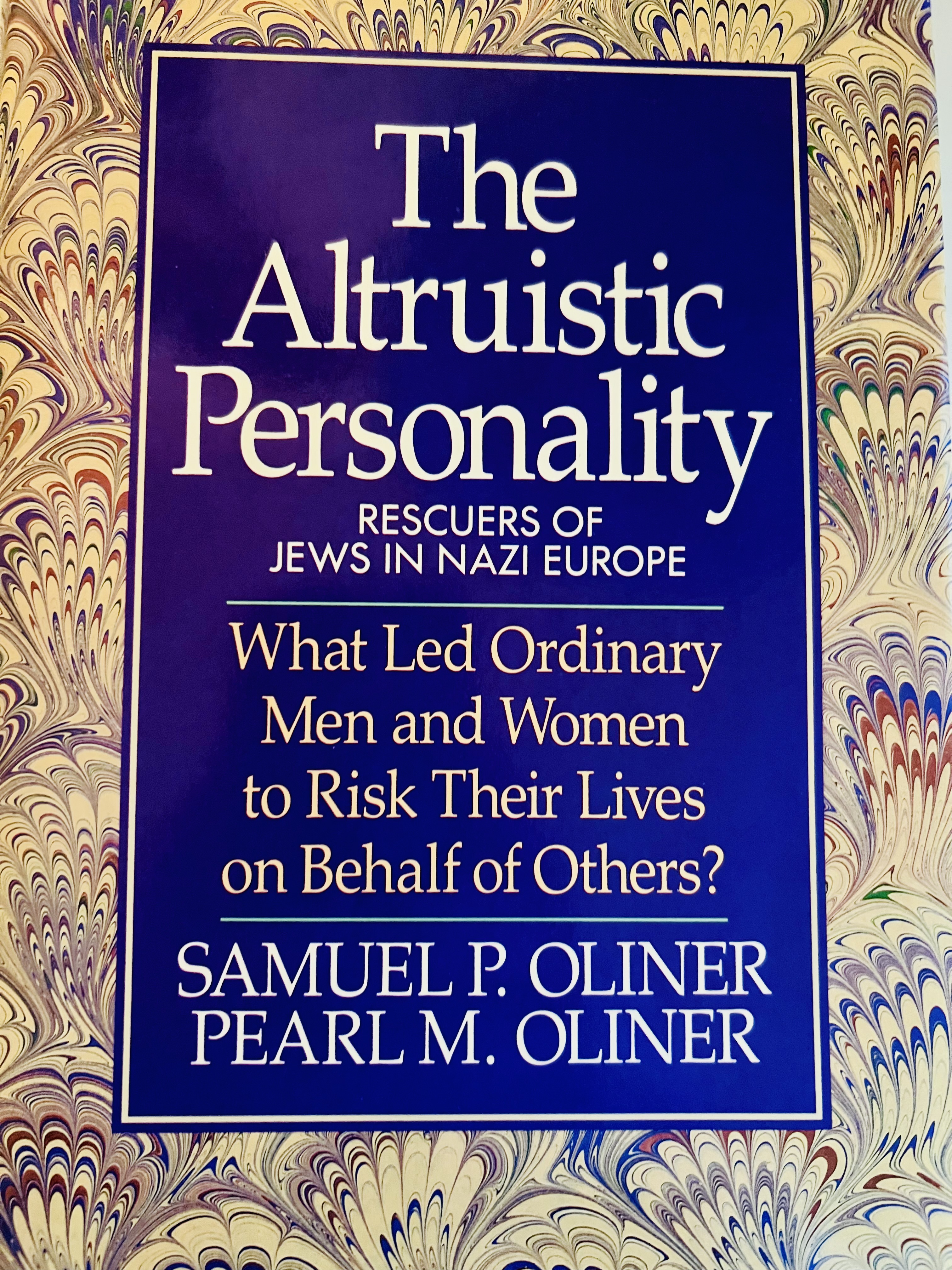
Years ago I read The Altruistic Personality: Rescuers of Jews in Nazi Europe – What Led Ordinary Men and Women to Risk Their Lives on Behalf of Others? by Samuel P. and Pearl M. Oliner with an Introduction by Rabbi Harold Schulweis (New York: The Free Press, 1988). Rabbi Schulweis, a moral giant in his generation, invited the Oliners to speak at his synagogue – Valley Beth Shalom in Los Angeles – and he invited the Board of Rabbis of Southern California to meet the authors and learn about their work.

It is written on the cover the following biographical notes about the authors and the purpose and content of the book:

“Samuel [Oliner] was ten years old when his entire family was murdered by the Nazis in Poland. Thanks to the help of a Polish Christian woman, he found a place to hide through the war – and survive. His experience left him with a profound, lifelong sense of wonder and a question that was the origin of this book.

In a time of extreme danger, what had led this woman, and a few thousand like her, to risk her own life and the lives of her family to help those who were marked for death – even total strangers – while others stood passively by?

To answer that complex and critically important question, Samuel and Pearl Oliner undertook the massive Altruistic Personality Project, which interviewed over 700 rescuers and nonrescuers living in Poland, France, Germany, the Netherlands, and Italy during the Nazi occupation.

Samuel (1930-2021) was a Professor of Sociology at Humboldt State University. Pearl (1931-2021) was a Professor of Education at Humboldt State University.

By comparing and contrasting rescuers and bystanders, [the Oliners] discovered that those who intervened were distinguished by certain common characteristics, including a deep-seated, wide-ranging empathy to others developed in their childhood homes, where moral and ethical values were not only strongly held, but acted upon by their parents. Unlike their neighbors who were concerned with their own survival and chose not to become involved, rescuers felt a more extensive concern and responsibility for the fate of the others and believed that what they did would make a difference…the Altruistic Personality explores the experiences and motivations of those uncommon individuals who aided Jews without compensation of any kind-and with full knowledge of the fatal consequences that would befall them if their actions were discovered.”

Altruism is based on a faith in a higher moral authority to which one is committed and the standards of which permeate one’s attitudes and behavior towards others, especially those outside one’s personal cultural, religious, ethnic, and national communities, and regardless of one’s personal self-interest and safety. This faith and moral commitment can come from one’s religious faith, parents, family, and other community groups to which a person belonged.

The Oliners learned in their research that rescuers did not consider themselves to be moral heroes. In their interviews these uncommon individuals explained that they could not do other than what they did and be able to live with themselves, regardless of the great risks involved. Rescuers felt instinctively and intuitively the difference between moral right and wrong and acted always according to their deeply held moral values nurtured and emphasized since childhood. They present to us a powerful model of quiet defiance and resistance.

The following are selected passages from this book:

“I did nothing unusual; anyone would have done the same thing in my place.” A Dutchman [said] who sheltered a Jewish family for two years.” (p. 113)

“Rescuers did differ from others in their interpretation of religious teaching and religious commitment, which emphasized the common humanity of all people and therefore [rescuers] supported efforts to help Jews.” (p. 156)

“I found it incomprehensible and inadmissible that for religious reasons or as a result of a religious choice, Jews would be persecuted. It’s like saving somebody who is drowning. You don’t ask them what God they pray to. You just go and save them.” (p. 166)

“…the language of care dominated [for most rescuers]: Pity, compassion, concern, affection made up the vocabulary of 76 percent of rescuers…”(p. 168)

“Rescuers described their early family relationships in general and their relationships with their mothers in particular as closer significantly more often than did non-rescuers. Rescuers also felt significantly closer to their fathers than did bystanders. From such family relationships, more rescuers learned the satisfactions accruing from personal bonds with others.” (p. 173)

“What distinguished rescuers from non-rescuers was their tendency to be moved by pain. Sadness and helplessness aroused their empathy. More frequently than others, rescuers were likely to say ‘I can’t feel good if others around me feel sad,’ ‘seeing people cry upsets me,’ ‘I get very upset when I see an animal in pain,’ ‘It upsets me to see helpless people,’ and ‘I get angry when I see someone hurt.’” (p. 174)

“…parents [in disciplining their children] of rescuers depended significantly less on physical punishment and significantly more on reasoning.” (p. 179)

“Involvement, commitment, care, and responsibility are the hallmarks of extensive persons [or ‘expansive persons’ – An extensive/expansive person is often friendly, outgoing, talkative, or generous by nature.] Disassociation, detachment, and exclusiveness are the hallmarks of constricted persons. Rescuers were marked by extensivity [or expansiveness], whereas non-rescuers and bystanders in particular, were marked by constrictedness, by an ego that perceived most of the world beyond [his/her] own boundaries as peripheral.” (p. 186)

“Constricted people experience the external world as largely peripheral except insofar as it may be instrumentally useful. More centered on themselves and their own needs, they pay scant attention to others… contractedness begins in early life. Family attachments are weak, and discipline relies heavily on physical punishment, the latter often routine and gratuitous. Reasoning and explaining [of parents to their children when a child does wrong] are infrequent [for the contracted personality]. Family values center on the self and social convention; relationships with others are guarded and generally viewed as commodity exchanges. Stereotypes regarding outsiders are common.” (p. 251)

“Moral courage is thus the conspicuous characteristic only of the independent, autonomous, ego-integrated liberal.” (p. 256)

Again, I am not making a direct comparison between what is taking place today in the United States with Germany in the 1930s. We Americans are, nevertheless, being challenged morally in ways most of us alive today have not experienced or imagined possible ever in our lifetimes. Our political leaders as well as university presidents and their boards, law firms, entertainment companies, journalists and the media, scientists and the men and women serving in the armed forces systematically are being morally challenged by a President whose clear intent is for Americans to bend the knee to his autocratic will.

The book may explain one important reason why so many Americans continue to support President Trump, though a Gallup poll released yesterday shows that Trump’s approval rating has sunk to a historic low of 36 percent with disapproval at 60 percent, and that the MAGA coalition is fracturing.

The book, though published in 1988, is still available and I recommend it highly.

“The Art Spy” by Michelle Young – A Book Review

10 Tuesday Jun 2025

Posted by rabbijohnrosove in Uncategorized

≈ Leave a comment

Tags

book-review, books, historical-fiction, history, holocaust

Rose Valland

What most intrigued and shocked me in reading this well-written and deeply researched new biography and history called The Art Spy (New York: HarperCollins, 2025, 390 pages, including notes) by the American art historian Michelle Young about Rose Valland (1898-1980), the acting curator of Jeu de Palme Museum in Paris from the 1930s to 1950s, and an art spy on behalf of the French Resistance against the Nazis, was the massive crime of greed the Nazis perpetrated against the world of fine art in Paris, how that greed began like a trickle of water at the beginning of the occupation and then became a torrential wave that helped transform the “City of Light” into a ‘city of darkness.’ This book details the heroic commitment of Rose Valland as she recorded in stunning detail what happened to the art stolen by the Nazis between 1939 and 1944.  

Rose cataloged every work of art by classical and modern painters and sculptors that were taken from Jewish homes and galleries, art collectors and French museums by Nazi criminals for themselves, for Hitler’s “Führermuseum,” or for the purpose of selling them at inflated prices to support the German war effort. The Jeu de Paume Museum in Paris was the art center the Nazis used to accumulate tens of thousands of stolen paintings, drawings, sculptures, jewelry, furniture, books, and other fine art to ship out of the French capital.

Hitler’s second-in-command, Hermann Göring (1893-1946), who Michelle Young characterized as “an insatiable predator,” visited Jeu de Palme from Berlin dozens of times and walked away cumulatively with thousands of master-works for himself that he promised he would pay for, but never sent a franc. Göring was convicted by the Nuremberg War Crimes Tribunal after the war for his many crimes against the Jews and others and sentenced to hang, but he committed suicide a day before the execution could take place.

Another Nazi art thief, standing six feet and four inches, was the “handsome and athletic Bruna Lohse” (1911-2007). He absconded with hundreds of master paintings and pieces of fine art, was tried after the war in a French military trial – Rose served as one of the prosecution witnesses – but Lohse charmed his American interrogators and ultimately was acquitted. He went on to become wealthy as a German art dealer well into his 80s, never expressing any remorse for his war crimes.

Michelle Young cites the names of many Nazis and collaborating French art historians whose names and deeds have subsided into the rear-view mirror of history. She brings them forward so we now know who they were and what crimes they committed.

Young reports:

“The Nazis looted approximately 650,000 works of art [thousands from 69,619 Jewish homes] by war’s end in Europe during WWII. Rose and her team were responsible for the restitution of more than sixty-one thousand works of art in the decade after World War II. Even when the world moved on, Rose was still fighting. Today, it is believed that over one hundred thousand pieces of Nazi-confiscated artwork, taken from all over Europe, have yet to be recovered.”

This means that thousands of today’s contemporary private art collectors and art museums around the world are holding, unwittingly perhaps, many famous art objects stolen from French Jews, from other collectors and from European museums. They include the master works of Da Vinci, Veronese, Rembrandt, Delacroix, David, Picasso, Degas, Monet, Manet, Van Gogh, Gauguin, Duchamp, Chagall, Matisse, Braque, Leger, Ensor, Klee, Rodin, Pissarro, and many others.

Over a period of four years, Michelle Young (fluent in French, German and English) painstakingly, and with the assistance of her husband, read every letter, list, and document written and saved by Rose Valland, who safe-guarded all her records meticulously in her apartment.  

Rose was unpaid for years at Jeu de Palme because of the misogynist and petty hostility of Henri Verne who oversaw the national museums in France and the Ecole du Louvre. For Rose, she continued to do her work because for her, preserving the world’s great art was a labor of love.

Rose lived with her life-partner, Joyce Heer, in Paris’ Latin Quarter. Joyce was a “half-German British citizen employed by the US embassy…who lived in a world of constant uncertainty because the British, even before the war began, were treated like the enemy, even by non-Germans.”

Joyce was imprisoned for about six months and suffered hunger and humiliation before being released. The two women “lived in perpetual terror that they might be overheard speaking English or spied on.” Undeterred, Rose understood that her role was to chronicle what was happening to the fine art the Nazis stole for shipment by train and truck to Germany.

Paul Rosenberg (1881-1959), one of the most wealthy prewar Paris Jewish gallery owners, collectors and agents for modern masters including Pablo Picasso and Henri Matisse, escaped Paris with his entire family to New York City before the Nazis conquered Paris. Only his son Alexandre (1921-1987) refused to go to America and instead fought in the French Resistance under the leadership of the exiled General Charles de Gaulle (1890-1970). Michelle Young tells the Rosenberg family story fully in this book. The Nazis stole virtually everything the Rosenbergs owned except what they had sent abroad or hid in the French country-side before the war began.

One might think, while reading this well-documented biography, that the theft of such massive amounts of art is secondary to the murder of six million Jews and the havoc and brutality the Nazis wreaked upon Europe, and they would be right. The point of the book, nevertheless, is to highlight the heroism of Rose Valland who risked her life daily to save French high culture. That is a story worth telling that Michelle Young told so very well.

Young wrote eloquently of the essence of art itself and the Nazi destruction of master works they called “degenerate art”:

“Each painting held thousands of years of collective evolution in the art of representation, to humanize, …thousands of years of contemplation on how the real three-dimensional world and the complexity of human nature could be embodied on a two-dimensional canvas. Art is transcendent–a visual medium that stirs emotion and helps people understand their place in a world that can never be fully comprehended. Even the earliest men and women made rudimentary art within the environment around them. This wanton destruction in the Nazi rooms in the Louvre served to erase a form of expression through which humans differentiated themselves from animals. And yet, here were men of a supposedly superior race acting in the most inhuman, destructive way.”

Young wrote about Rose’s deepest intention:

“It would have been painful for Rose to see her museum used as a laundering facility [Rose called the Jeu de Paume a “confiscation factory”] for stolen art by deceitful men with dubious intentions. Her job, her life calling, was about celebrating the beauty in art and presenting it to the public, but now she was witnessing the wholesale theft of the world’s finest creations.” [Rose’s hope was that the Allies] “would one day prevail and her intelligence could be used. With her inside glimpse into Nazi operations, she could see how, as she later stated, ‘the persecution against the Jews was coupled with the looting of their property.’”

Michelle Young tells the stories of other French heroes during war as well, specifically Jacque Jaujard (1895-1967), Valland’s ally, who sought to stand in the way whenever possible of the Nazi plunder of Europe’s art treasures as the director of the Louvre Museum. Jaujard also had deep concern for his Jewish workers in the museum. Presciently, Jaujard evacuated major works starting in 1938 when many in France thought the war was about to start. Villard quoted Jaujard: “I would like my Jewish colleagues to leave first.” Young wrote: “…knowing what fate might befall them in the hands of the Germans. There was no detail that Jaujard would overlook.”

As they did everywhere, the Nazis created euphemisms to describe the worst of their crimes (e.g. “The Final Solution” for the Shoah – “transfer” and “safeguarding” for the plunder of Europe’s art). Rose described the Nazi thievery as a “camouflage of intentions.” The Nazis, under the mastermind of Alfred Rosenberg (1893-1946), a Baltic German Nazi theorist and ideologue who was tried and convicted at the Nuremberg Trials and executed for his war crimes in 1946, was the one who classified many artworks as “degenerate art,” that is, art that did not fit with the racial-creed of the Aryan vision of culture.

Rose was stoic throughout the war and “did not allow herself the luxury of crying or feeling sorry for herself.” Rather, she developed her spy craft, “discreetly eyeing the shipping labels to decipher their destinations…surveilling Nazi staffers, even discovering their home addresses down to the floors and apartments they lived in.”

Young concludes the book by describing the allied invasion of France on the Normandy beaches on D-Day (June 6, 1944), and the eventual re-taking of Paris by the allied powers and the French Resistance, as well as some of the violent retribution by Parisians upon French collaborators with the Nazis. She also describes Rose’s eight-year-long effort to retrieve what she estimated to be 100,000 works of art that had been looted from France alone, and return it, to the best of her ability, to their rightful owners based upon her detailed journals and record-keeping.

Rose died in Paris in 1980 in obscurity at the age of eighty-one, three years after her life-partner Joyce Heer died. They are buried together in a cemetery in Rose’s hometown, Saint-Etienne-de-Saint-Geoirs, France.

Michelle Young’s thorough historical and biographical treatment of this heroine of the French Resistance fills a gaping hole in our knowledge of one of the greatest crimes in history and one of the most courageous women of the Nazi era. I recommend this book highly. It ought to be part of every library covering the history of art, WWII and the Holocaust.

2 Recommendations this Summer – a Netflix Series and a Book

20 Thursday Jun 2024

Posted by rabbijohnrosove in Uncategorized

≈ Leave a comment

Tags

auschwitz, history, holocaust, poland, world-war-ii

The first time I encountered the Holocaust as a child I was 5 years-old. In my father’s home study I found a Life Magazine with photographs of what the allied armies discovered when they entered the death camps and liberated what remained of abused and emaciated survivors. Over the years I read multiple histories, novels and theologies focused on the Shoah. I saw many films and documentaries about WWII, Nazi antisemitism, and how an entire nation and continent succumbed to its inhumane policies towards Jews.

As a congregational rabbi, I taught about the Holocaust to high school students and I debated with my fellow educators how best to teach the Shoah to young students without traumatizing them as I was traumatized as a 5 year-old so long ago. In recent days, I encountered the Shoah anew in watching a powerful documentary series meant to introduce the criminality and evil of the Nazis to a new generation of teens and young adults; and I read an account (publ. 2022), both of which I recommend for viewing and reading this summer.

The first is the 6-part Netflix documentary called Hitler and the Nazis: Evil on Trial. The series is framed by the 1945-1946 Nuremberg trials of Nazi war criminals. It uses Nazi film footage, original audio recordings and massive amounts of forensic evidence to chart the progression of Adolph Hitler from his childhood to power and the Nazi extermination of European Jewry and the devastation of Europe during WWII.

I believe that it is important especially for young people from high school age to young adults to watch this Netflix series. The 6-episodes is a tutorial about how a democratic society can devolve into autocracy. The series describes sweepingly how the Nazis systematically subjugated the German masses, destroyed enlightened European culture through propaganda, marketing, lies, violence, cruelty, bigotry, injustice, theft, deportation, and murder. It presents how the Nazis responded to high inflation and unemployment in the Germany of the 1920s and how the Nazi circle of evil created a movement that played to the German people’s baked-in fears and resentments. It made clear how the Nazis took historic religious anti-Jew hatred and cast it as pseudo-scientific racial antisemitism, and then blamed Jews, communists, socialists, liberals and foreigners for their own real and imagined misfortune, and brutally dehumanized non-ethnic Germans and characterized them all as vermin. It discussed how extreme right-wing nationalism and the belief in German-Aryan racial supremacy and superiority were used to attack the dignity of anyone not included within the Nazis’ exalted Aryan self-image. It described step-by-step how the Nazi Party destroyed individual freedoms of speech, religion, press, a fairly-based criminal justice system, and democratically elected political parties. Through propaganda and deliberate myth-making the series conveyed well how the Nazis created a heroic cult of personality around Hitler, and emphasized his super-human characteristics of will, power, self-righteousness, and hard-heartedness thereby infusing and permeating every aspect of German Aryan society with Hitler’s exalted omniscience and omnipotence.

My second recommendation is the book “The Escape Artist – The Man Who Broke Out of Auschwitz to Warn the World” written by the British journalist Jonathan Reedland. The volume tells the true story of the escape by two young Jews, Rudolf Vrba (née Walter Rosenberg) and Fred Wetzler – both originally from Slovakia – who in April 1944 became the first Jews to successfully escape from the most heinous of the death camps. The book cover describes their intent and journey:

“In April 1944, Rudolf Vrba became one of the very first Jews to escape from Auschwitz and make his way to freedom – among only a tiny handful who ever pulled off that near-impossible feat. He did it to reveal the truth of the death camp to the world – and to warn the last Jews of Europe what fate awaited them. Against all odds, Vrba and his fellow escapee, Fred Wetzler, climbed mountains, crossed rivers, and narrowly missed German bullets until they had smuggled out the first full account of Auschwitz the world had ever seen – a forensically detailed report that eventually reached Franklin Roosevelt, Winston Churchill, and the Pope. And yet too few heeded the warning that Vrba had risked everything to deliver. Though Vrba helped save two hundred thousand Jewish lives, he never stopped believing it could have been so many more. This is the story of a brilliant yet troubled man – a gifted “escape artist” who, even as a teenager, understood that the difference between truth and lies can be the difference between life and death. Rudolf Vrba deserves to take his place alongside Anne Frank, Oskar Schindler, and Primo Levi as one of the handful of individuals whose stories define our understanding of the Holocaust.”  

I have read many Holocaust histories, but nothing compares to “The Escape Artist.” I appreciate that many of us prefer not to spend our time immersed in the darkest and most depraved stories ever recorded in human history. But, I recommend reading this book anyway.

The reader finds him/herself with Walter (he took another name Rudolf Vrda) in Auschwitz, seeing, hearing, watching, fearing, feeling, doing, and succumbing to everything every Jew was subjugated to by the Nazis.

Rudolf (aka Rudi) was only 17 years-old when he arrived in Auschwitz, yet his superior linguistic ability, keen intelligence, iron-clad memory, swift survival instincts, blind courage, clear sense of purpose, and sheer luck enabled him to do what virtually no other inmates were able to do – survive and escape from Auschwitz and then give a detailed account of everything that happened in that death camp in granular detail between June 1942 when he first arrived and April 1944 when he escaped.

In his and Fred Wetzler’s “Auschwitz Report,” they told of how many trains and trucks brought Jews from diverse countries daily into the camp, how many Jews were selected to live a few days longer and how many (usually women, children, the elderly and infirm) went directly – without realizing where they were going – to be gassed and burned. Rudi detailed the cruelty of the SS and the Kapos (the Jewish henchman appointed to do the Nazis’ dirty-work), their indiscriminate beatings, torture, shootings, starvation, and cruelty.

Once Rudi and Fred successfully told the story of Auschwitz when they arrived back in Slovakia, it was written in the form of a legal brief, translated into German, Hungarian, and English, and sent to Roosevelt, Churchill, the Pope, and the Jewish leadership of Hungary, but nothing was done to alert Hungarian Jewry about where they were being sent so they could resist boarding the trains. Nor was there a decision taken immediately by the allied powers to bomb the train tracks leading to Auschwitz-Birkenau or to destroy the death camp itself, though it could have been done easily.

The remaining Jews in the Hungarian countryside in 1944, the last country to be emptied of its Jews by the Nazis, numbered 437,402 souls. They were all shipped at the rate of 12,000 per day, crammed into 147 trains (about 3000 Jews per train) over the course of 5 to 6 weeks, and almost all of them were gassed and burned on arrival in Auschwitz. 200,000 Jews in Budapest were next on the Nazi’s hit list and were, in effect, the last Jewish group to be exterminated in Europe. For a variety of reasons explained in the book, the Jews of Budapest were sparred, mostly as a consequence of Rudi’s and Fred’s “Auschwitz Report.”

The book concludes by telling of Rudi’s post-Holocaust life during which time he earned a doctorate in bio-chemistry, married, had two daughters, divorced, remarried, and lived in Soviet-controlled Prague, London, Vancouver, and Boston. 

We can read histories of the Holocaust and after a while come to the conclusion that we’ve engaged enough with those horrid events. Over the years, after I read the classic books, saw the many films and documentaries, many times visited Yad Vashem in Jerusalem and Holocaust Memorial Museums in the states, I thought that, for me, there was nothing more I needed to read or see because the tragedy is just too overwhelmingly soul-crushing and heart-breaking.

The Jewish Book Council in America recently recommended as an award winner The Escape Artist. I took the recommendation and read the book. I have asked myself about the timing of the book’s publication 2 years-ago and the appearance of the Netflix series on Hitler and the Nazis last month. Perhaps they were issued now because Russia’s brutal invasion of Ukraine is the most serious assault on any country in Europe since WWII, and the cruelty of Hamas’s massacre and hostage-taking against Israeli civilians is the worst pogrom against the Jewish people since the Holocaust.

Whatever the cause that produced the Netflix series and book, it has become clear to me over the years, and most especially this past year since October 7, that far too many Americans are historically illiterate and that they lack a moral compass when evaluating the significance of history and contemporary events and trends. Naively taking the high road and thinking that current events aren’t that bad, or don’t concern us, or recognizing that their pure and self-righteous ethics in the face of evil is actually self-defeating, or choosing the path of isolationism and dis-engagement such as what the “America First Movement” did in the 1930s in alliance with the Nazis and many in the MAGA Party are doing today in alliance with Putin’s Russia and Orbán’s Hungary, so many Americans don’t appreciate enough that there are brutal actors in the world that think nothing of slitting the throats of their perceived enemies. The only response of the civilized world to such brutality has to be to fight those evil actors while maintaining a humanitarian and ethical vision for a better democratic future. I recall often to myself, in order to maintain my moral compass, Edmund Burke’s warning: “All that is necessary for evil to triumph is for good people to do nothing.”

Perhaps, this film and this book can be helpful in addressing those historic and moral deficiencies in what every decent human being ought to know, understand and appreciate about the significance of the Holocaust not only in its own tortured era, but for today’s politics, events and trends in America, the Middle East, Europe and around the world.

This blog also appears at The Times of Israel – https://blogs.timesofisrael.com/2-recommendations-this-summer-a-netflix-series-and-a-book/

Enter your email address to subscribe to this blog and receive notifications of new posts by email.

Join 365 other subscribers

Archive

  • December 2025 (3)
  • November 2025 (6)
  • October 2025 (8)
  • September 2025 (3)
  • August 2025 (6)
  • July 2025 (4)
  • June 2025 (5)
  • May 2025 (4)
  • April 2025 (6)
  • March 2025 (8)
  • February 2025 (4)
  • January 2025 (8)
  • December 2024 (5)
  • November 2024 (5)
  • October 2024 (3)
  • September 2024 (7)
  • August 2024 (5)
  • July 2024 (7)
  • June 2024 (5)
  • May 2024 (5)
  • April 2024 (4)
  • March 2024 (8)
  • February 2024 (6)
  • January 2024 (5)
  • December 2023 (4)
  • November 2023 (4)
  • October 2023 (9)
  • September 2023 (8)
  • August 2023 (8)
  • July 2023 (10)
  • June 2023 (7)
  • May 2023 (6)
  • April 2023 (8)
  • March 2023 (5)
  • February 2023 (9)
  • January 2023 (8)
  • December 2022 (10)
  • November 2022 (5)
  • October 2022 (5)
  • September 2022 (10)
  • August 2022 (8)
  • July 2022 (8)
  • June 2022 (5)
  • May 2022 (6)
  • April 2022 (8)
  • March 2022 (11)
  • February 2022 (3)
  • January 2022 (7)
  • December 2021 (6)
  • November 2021 (9)
  • October 2021 (8)
  • September 2021 (6)
  • August 2021 (7)
  • July 2021 (7)
  • June 2021 (6)
  • May 2021 (11)
  • April 2021 (4)
  • March 2021 (9)
  • February 2021 (9)
  • January 2021 (14)
  • December 2020 (5)
  • November 2020 (12)
  • October 2020 (13)
  • September 2020 (17)
  • August 2020 (8)
  • July 2020 (8)
  • June 2020 (8)
  • May 2020 (8)
  • April 2020 (11)
  • March 2020 (13)
  • February 2020 (13)
  • January 2020 (15)
  • December 2019 (11)
  • November 2019 (9)
  • October 2019 (5)
  • September 2019 (10)
  • August 2019 (9)
  • July 2019 (8)
  • June 2019 (12)
  • May 2019 (9)
  • April 2019 (9)
  • March 2019 (16)
  • February 2019 (9)
  • January 2019 (19)
  • December 2018 (19)
  • November 2018 (9)
  • October 2018 (17)
  • September 2018 (12)
  • August 2018 (11)
  • July 2018 (10)
  • June 2018 (16)
  • May 2018 (15)
  • April 2018 (18)
  • March 2018 (8)
  • February 2018 (11)
  • January 2018 (10)
  • December 2017 (6)
  • November 2017 (12)
  • October 2017 (8)
  • September 2017 (17)
  • August 2017 (10)
  • July 2017 (10)
  • June 2017 (12)
  • May 2017 (11)
  • April 2017 (12)
  • March 2017 (10)
  • February 2017 (14)
  • January 2017 (22)
  • December 2016 (13)
  • November 2016 (12)
  • October 2016 (8)
  • September 2016 (6)
  • August 2016 (6)
  • July 2016 (10)
  • June 2016 (10)
  • May 2016 (11)
  • April 2016 (13)
  • March 2016 (10)
  • February 2016 (11)
  • January 2016 (9)
  • December 2015 (10)
  • November 2015 (12)
  • October 2015 (8)
  • September 2015 (7)
  • August 2015 (10)
  • July 2015 (7)
  • June 2015 (8)
  • May 2015 (10)
  • April 2015 (9)
  • March 2015 (12)
  • February 2015 (10)
  • January 2015 (12)
  • December 2014 (7)
  • November 2014 (13)
  • October 2014 (9)
  • September 2014 (8)
  • August 2014 (11)
  • July 2014 (10)
  • June 2014 (13)
  • May 2014 (9)
  • April 2014 (17)
  • March 2014 (9)
  • February 2014 (12)
  • January 2014 (15)
  • December 2013 (13)
  • November 2013 (16)
  • October 2013 (7)
  • September 2013 (8)
  • August 2013 (12)
  • July 2013 (8)
  • June 2013 (11)
  • May 2013 (11)
  • April 2013 (12)
  • March 2013 (11)
  • February 2013 (6)
  • January 2013 (9)
  • December 2012 (12)
  • November 2012 (11)
  • October 2012 (6)
  • September 2012 (11)
  • August 2012 (8)
  • July 2012 (11)
  • June 2012 (10)
  • May 2012 (11)
  • April 2012 (13)
  • March 2012 (10)
  • February 2012 (9)
  • January 2012 (14)
  • December 2011 (16)
  • November 2011 (23)
  • October 2011 (21)
  • September 2011 (19)
  • August 2011 (31)
  • July 2011 (8)

Categories

  • American Jewish Life (458)
  • American Politics and Life (417)
  • Art (30)
  • Beauty in Nature (24)
  • Book Recommendations (52)
  • Divrei Torah (159)
  • Ethics (490)
  • Film Reviews (6)
  • Health and Well-Being (156)
  • Holidays (136)
  • Human rights (57)
  • Inuyim – Prayer reflections and ruminations (95)
  • Israel and Palestine (358)
  • Israel/Zionism (502)
  • Jewish History (441)
  • Jewish Identity (372)
  • Jewish-Christian Relations (51)
  • Jewish-Islamic Relations (57)
  • Life Cycle (53)
  • Musings about God/Faith/Religious life (190)
  • Poetry (86)
  • Quote of the Day (101)
  • Social Justice (355)
  • Stories (74)
  • Tributes (30)
  • Uncategorized (818)
  • Women's Rights (152)

Blogroll

  • Americans for Peace Now
  • Association of Reform Zionists of America (ARZA)
  • Congregation Darchei Noam
  • Haaretz
  • J Street
  • Jerusalem Post
  • Jerusalem Report
  • Kehillat Mevesseret Zion
  • Temple Israel of Hollywood
  • The IRAC
  • The Jewish Daily Forward
  • The LA Jewish Journal
  • The RAC
  • URJ
  • World Union for Progressive Judaism

Blog at WordPress.com.

  • Subscribe Subscribed
    • Rabbi John Rosove's Blog
    • Join 365 other subscribers
    • Already have a WordPress.com account? Log in now.
    • Rabbi John Rosove's Blog
    • Subscribe Subscribed
    • Sign up
    • Log in
    • Report this content
    • View site in Reader
    • Manage subscriptions
    • Collapse this bar
 

Loading Comments...