
• About

Rabbi John Rosove's Blog

Rabbi John Rosove's Blog

Monthly Archives: June 2026

Donald Trump’s Transactional Understanding of “Love”

29 Monday Jun 2026

Posted by rabbijohnrosove in Uncategorized

≈ Leave a comment

Tags

bible, christianity, Faith, god, jesus

In an op-ed in the NYTs by columnist Frank Bruni “Flattery paves the road to the president’s heart” (June 29, 2026), he wrote this definition of what Donald Trump means by “love”:

“It’s love as a transaction. A contract. A pact. I’ll stroke your back — lightly — if you give a deep-tissue massage to mine. We’ll call that love.”

Nothing about what Trump considers “love” suggests what most of us understand about that most important value.

We live in an era of chaos, ugliness and brutality, fear, ignorance, bigotry, and hate, all of which polarize large segments of our population in North America, Israel, and around the world. Such animus and negativity shut people down and close them off from one another, leaving us mentally, emotionally, physically, and spiritually depleted and feeling alone. Yet, even as we acknowledge the mess in the world, it is important to remember the virtue that drives, sustains, unites, and enables us to cope and find greater meaning – love (Hebrew – ahavah-אהבה).

There are all kinds of love: the foundational bond that anchors parents and children, the romantic and erotic passion that elevates lovers, the sibling intimacy that strengthens sisters and brothers, and the love and trust that deepens intimacy and understanding between the closest friends. There is the mentor–mentee love that enriches teachers and students. Our love of work motivates us to be productive and affirm our meaning and purpose in the world. Our love of the arts and ideas breathes new life into our spirits. There is the ineffable soul-love that draws us closer as spiritual beings to intuit the unity of all things. There is also that pure, sweet, angelic, and continually requited love we feel in the eyes, the wagging tail, the excited bark, and the vibrating purr of our four-legged “best friends.”

Of all these kinds of love, a love upon which religion most focuses our attention is spiritual love, our awareness of the soul’s interconnectedness with all of being. It is our purpose as human beings, and it is fundamental in Judaism (and all the great religions) to understand, demonstrate, and express heart-soul love.

The spiritual teacher David Steindl-Rast (Essential Writings, p. 73) wrote that the one common thing at the core of all loves is the yearning to belong, to feel connected to something greater than ourselves. This yearning is foundational to the human species; to bond heart to heart not just with the people we know and about whom we care, but with every other human being, with all creatures and living things on the planet, with every astro-body in the cosmos, and with the transcendent God.

Jewish mysticism taught the interconnectedness of all things, and today scientists and meta-physicists understand that our bodies and souls are part of a great expansive and infinite Oneness. It is an axiom of many faith traditions, including Judaism, that every human being shares a common origin and destiny, and because we are so interconnected with each other, we “belong” to each other as if we are, all of us, part of a greater human family. Like families, we are responsible to and accountable for each other.

Steindl-Rast taught that “loving one’s fellow as yourself” (Leviticus 19:18) is not meant to be understood in a limited way. Thinking about the “self” includes our consideration of the dignity of our neighbors, following the idea that the Hebrew word for life is a plural form – chayim-חיים – and that we exist together and belong with and to one another. This understanding of an expansive “self” in relationship to all others widens the heart, thereby enabling each of us, however difficult it may be, to feel at one with all people and all living things everywhere.

The 12th century Spanish mystical Jewish sage Nachmanides (aka Rabbi Nachman ben Maimon) taught that “loving one’s fellow as oneself” means that what we wish for ourselves materially, emotionally, and spiritually, we must wish also for others, not only those we know and love but also those unlike us, strangers, other peoples of faith, cultures, and tribes, living here and everywhere on the planet. This kind of expansive love is liberating because we come to understand that we are a part of something very great.

There are, of course, people who are easy to love. But what about those who are hard to love – our enemies, perpetrators of cruelty, pathological liars, and serial murderers? Must we love them too?

As a Jew, I say, “No!” There are some people we cannot wish well because their deeds are too heinous to tolerate or forgive. That said, I cannot forget what Israeli Prime Minister Menachem Begin said as he signed the Camp David Peace Accords on the White House lawn with President Anwar Sadat of Egypt in 1978. PM Begin remarked that the Jewish people consider it among the greatest of commandments to transform a “ra-רע” (an “evil” person – an enemy) into a “re’a-ריע” (a fellow – a friend). Although Egypt and Israel are hardly “friends” as we understand friendship between nations, it is a fact that since that day in 1978, there has not been one day of war between the State of Israel and Egypt.

Judaism does not ask us to “love” our enemies, only to act ethically toward them leaving open the possibility of a transformation of the relationship should circumstances change (see Exodus 23:4).

There is nothing, in my understanding, about Donald Trump’s relationship with others that suggests the true meaning of “love”, and for him to use that word in describing his transactional relationships is a corruption of the idea of love itself.  

Note: The above is taken from my book Finding Your Moral Compass – Jewish Values for the 21st Century (Toronto: University of Toronto New Jewish Press, 2026) pps. 137-145. Available on Amazon
Fifty Years Ago – 4 July, 1976 – Memories

26 Friday Jun 2026

Posted by rabbijohnrosove in Uncategorized

≈ 1 Comment

Tags

gaza, Israel, palestine, politics, zionism

Fifty years ago, I was working (as a rabbinic student) on the programming staff of the Reform Jewish movement’s summer Camp Swig in Saratoga, California. As I recall, all of us were planning to celebrate with our campers the 200th anniversary of the United States on 4 July. We had heard, however, about what had happened a week before on 27 June and discussed how to teach our campers about what was taking place.

An Air France Airbus with 248 passengers was hijacked by members of the terrorist Popular Front for the Liberation of Palestine to Entebbe, Uganda, that was governed at the time by the dictator Idi Amin. The entire awful story of that hijacking and the extraordinary Israeli response and rescue can be read here – https://en.wikipedia.org/wiki/Entebbe_raid

The plane departed from Tel Aviv and carried 246 mainly Jewish and Israeli passengers with a crew of 12. The plane flew to Athens, Greece, and picked up an additional 58 passengers, including the four PFLP hijackers and two German revolutionaries. The flight was on its way to Paris, but soon after take-off, it was diverted to Benghazi, Libya and then to Entebbe, Uganda where it was greeted happily and warmly by Idi Amin who had, in his earlier years, trained in Israel.

As noted in the resource above, the hijackers “demanded the release of 53 Palestinian and pro-Palestinian [terrorists], 40 of whom were prisoners in Israel. They threatened that if these demands were not met, they would begin to kill all the hostages beginning on 1 July 1976.”

The hijackers did a “selection” of the Israelis and Jews from everyone else, reminiscent of what the Nazis did in the death camps. The account reads as follows:

“On 30 June, the hijackers released 48 hostages. The released were picked from among the non-Israeli group – mainly elderly and sick passengers and mothers with children. Forty-seven of them were flown by a chartered Air France [jet] out of Entebbe to Paris, and one passenger was treated in hospital for a day. On 1 July, after the Israeli government had conveyed its agreement to negotiations, the hostage-takers extended their deadline to noon on 4 July and released another group of 100 non-Israeli captives who again were flown to Paris a few hours later. Among the 106 hostages staying behind with their captors at the Entebbe airport were the 12 members of the Air France crew who refused to leave, about ten young French passengers, and the Israeli group of some 84 people.”

What the Israeli government secretly ordered, however, under the command of then Prime Minister Yitzhak Rabin on 3 July was what was a very risky but ultimately a successful rescue attempt of all but one of the hostages (an elderly Jewish woman) under the nose of Amin and the terrorists that resulted in only one Israeli combat death, the commander of the rescue team, Yonatan Netanyahu, the older brother of the current Prime Minister. Israelis and the Jewish world were exultant when it was reported that the plane carrying the remaining hostages lifted off and was on its way out of Entebbe.

That event eclipsed for us at Camp Swig the celebration of the 200th anniversary of the United States, but we celebrated both events. The Entebbe rescue remains one of the most extraordinary episodes in the history of the State of Israel.

So much has changed during these past 50 years in Israel, the Jewish world, for the Palestinians, and the United States. To list here those changes would take volumes, and indeed, volumes have been written and are still being written. However, on that 200th anniversary of the United States (4 July, 1976), my memories of what Israel did to save Israelis and Jews remain uppermost in my heart, mind and pride.

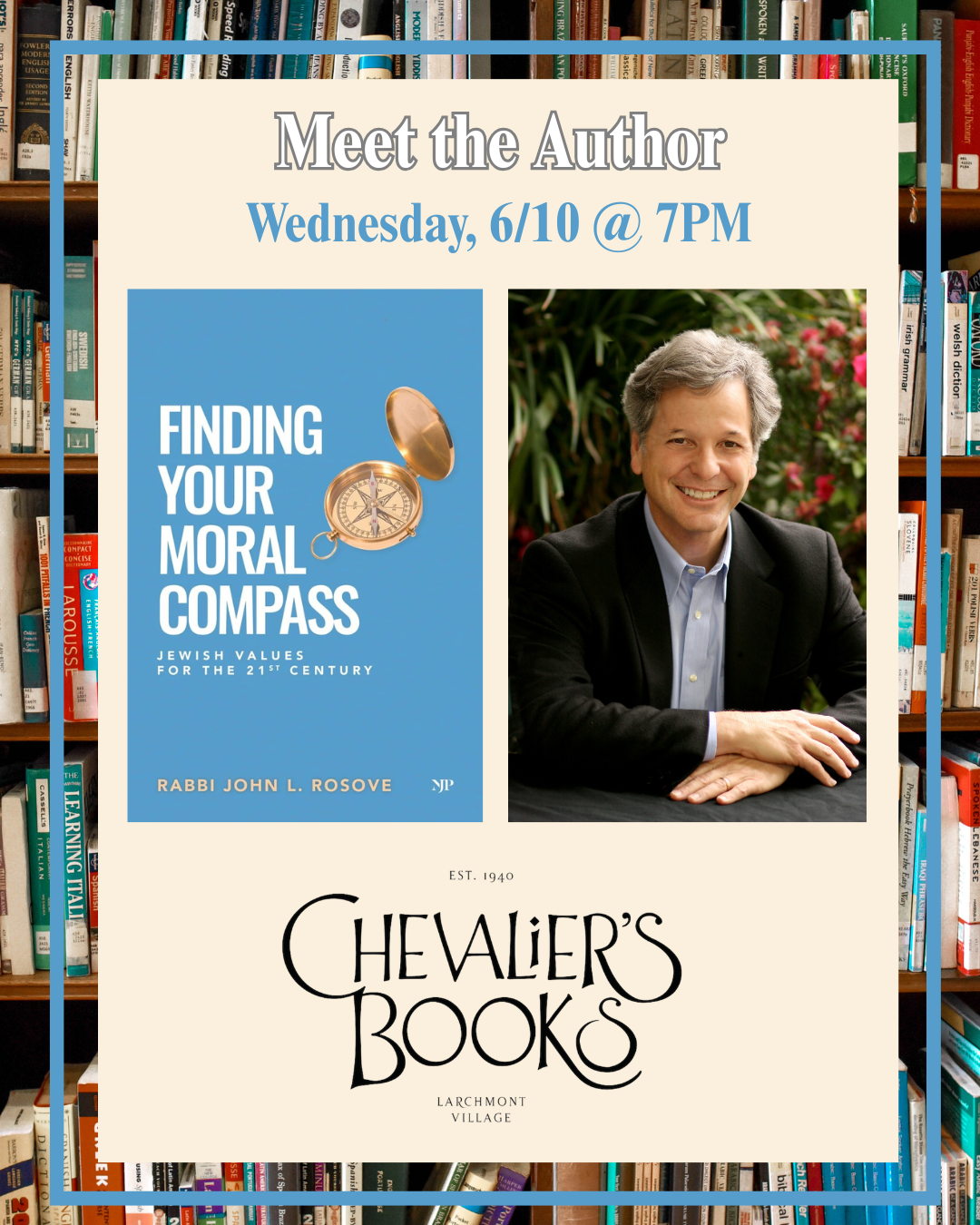
My Book Signing at Chevaliers Bookstore in Los Angeles – Wednesday, June 10 – 7 PM

04 Thursday Jun 2026

Posted by rabbijohnrosove in Uncategorized

≈ 1 Comment


I invite those of you in Los Angeles to join me at Chevaliers’ Book Store (133 North Larchmont Avenue – Hancock Park) where I will talk about and sign my latest book Finding Your Moral Compass – Jewish Values for the 21st Century, published by the University of Toronto New Jewish Press. 

The book is now available for purchase at Chevaliers, the oldest independent bookstore in Los Angeles. 

If you are free and in LA, I would love to see you. 

“Finding Your Moral Compass is a treasury of wisdom. Drawing on decades of personal and professional experience, along with deep reading in Jewish and non-Jewish sources, Rosove presents thoughtful musings on forty Jewish principles that he considers the most valuable for shaping a meaningful life. The book offers inspiration for Jews and non-Jews alike and will be a useful resource for teachers of adults and teenagers.” — Rabbi Dvora Weisberg, The Rabbi Aaron Panken Professor of Rabbinics, Hebrew Union College-Jewish Institute of Religion, LA

“After years of losing much of my faith in moral clarity and hope itself, Rabbi Rosove has the antidote. These essays suggest an elegant formula for a new generation of Jewish leaders, based on a foundational belief in Jewish decency and justice which can transform how we strengthen the Jewish people, as well as how we view our position in our country and in the world.” — Mayim Bialik, Actor, Neuroscientist, and Writer, LA 

“In a time of moral confusion, angst and even despair, John Rosove’s latest book brings a wealth of knowledge and insight about Jewish values and history. John’s deft mix of personal anecdotes with secular history and Jewish texts helps illuminate what it means to be Jewish – and to be human. Whatever your level of religiosity, there is a treasure trove of valuable insights about both the specific dilemmas that we face in our daily lives (Should we give money to beggars on the street?) and the profound questions about what we owe our fellow human beings. John’s chapter on Diaspora Jews’ relationship with Israel – reframing our paradigm from “crisis Zionism” to “aspirational Zionism” — is among the most valuable and profound contributions on this fraught subject. “Finding Your Moral Compass” should be an essential part of any Jew’s home library.” — Jennifer Rubin, American Journalist, Founder and Editor-in-Chief of The Contrarian Substack, Washington, D.C.

“A must read! Rabbi Rosove brilliantly and eloquently distills a lifetime of Jewish learning into forty concise chapters on key Jewish values. Most distinctively, each chapter addresses real life situations, and concludes with additional thoughts from great thinkers, as well as suggestions for further reflection and discussion. Anyone who wants to learn about the central teachings of Judaism in an easy-to-read and relatable format – this is the book! And the additional bonus: By absorbing its teachings, you will lead a more decent and meaningful life.” — Rabbi Ammiel Hirsch, Senior Rabbi of the Stephen S. Wise Free Synagogue and Host of the In These Times Podcast, NY

“In a world where what matters most is bitterly contested, utterly ignored, or in mortal danger of being lost completely, here are forty Jewish values to live by; a beautifully composed and easily accessible discussion of 3000 years of Jewish wisdom. A combination of mind and heart, by a widely admired rabbi who shares what he has learned from a lifetime of Jewish leadership.” — Rabbi Lawrence Hoffman, Professor of Liturgy, Hebrew Union College-Jewish Institute of Religion, NY 

“Finding Your Moral Compass vividly portrays key Jewish values and illustrates them with contemporary and classical anecdotes and apt quotations. In this book Rabbi Rosove invites the reader to ask how these values apply to contemporary issues and personal conduct. In addition he invites a dialogue about how committed liberal Jews can best engage with their relationship with Israel and Israelis in all their complexity. This wonderful explication of how a Jew should live will uplift and challenge all who read it.” — Rabbi David A. Teutsch, Ph.D., The Louis and Myra Wiener Professor Emeritus of Contemporary Jewish Civilization, Reconstructionist Rabbinical College, Philadelphia 

“Rabbi Rosove’s writing about Jewish values is both timely and profound. In an era when many of us feel adrift in a sea of immorality, he offers a lifeline—bringing Jewish teachings to life through personal experience, sacred texts, and contemporary commentary. Deeply rooted in Jewish tradition, his book is wise and thought-provoking, yet accessible. Each chapter ends with questions for discussion, making it ideal for a class, the family dinner table, or small group discussion.” — Rabbi Emerita Andrea London, Beth Emet – The Free Synagogue, Chicago 

“Finding Your Moral Compass is indeed a valuable text about the moral values of the twenty-first century, but it represents so much more. Through this work, John Rosove introduces us to his rabbinate while sharing with us his personal ethical framework as well as providing readers with insights concerning the richness and relevance of Jewish sources and texts. As part of this learning experience, Rabbi Rosove challenges us with his thoughtful and essential questions, offering each of us a pathway to explore our own religious and ethical understandings.” — Steven F. Windmueller, Professor Emeritus of Jewish Communal Studies, Hebrew Union College, LA

For more information see https://chevaliersbooks.com/event/2026-06-10/finding-your-moral-compass-rabbi-john-rosove


Enter your email address to subscribe to this blog and receive notifications of new posts by email.

Join 362 other subscribers

Archive

  • July 2026 (1)
  • June 2026 (3)
  • April 2026 (4)
  • March 2026 (6)
  • February 2026 (6)
  • January 2026 (8)
  • December 2025 (4)
  • November 2025 (6)
  • October 2025 (8)
  • September 2025 (3)
  • August 2025 (6)
  • July 2025 (4)
  • June 2025 (5)
  • May 2025 (4)
  • April 2025 (6)
  • March 2025 (8)
  • February 2025 (4)
  • January 2025 (8)
  • December 2024 (5)
  • November 2024 (5)
  • October 2024 (3)
  • September 2024 (7)
  • August 2024 (5)
  • July 2024 (7)
  • June 2024 (5)
  • May 2024 (5)
  • April 2024 (4)
  • March 2024 (8)
  • February 2024 (6)
  • January 2024 (5)
  • December 2023 (4)
  • November 2023 (4)
  • October 2023 (9)
  • September 2023 (8)
  • August 2023 (8)
  • July 2023 (10)
  • June 2023 (7)
  • May 2023 (6)
  • April 2023 (8)
  • March 2023 (5)
  • February 2023 (9)
  • January 2023 (8)
  • December 2022 (10)
  • November 2022 (5)
  • October 2022 (5)
  • September 2022 (10)
  • August 2022 (8)
  • July 2022 (8)
  • June 2022 (5)
  • May 2022 (6)
  • April 2022 (8)
  • March 2022 (11)
  • February 2022 (3)
  • January 2022 (7)
  • December 2021 (6)
  • November 2021 (9)
  • October 2021 (8)
  • September 2021 (6)
  • August 2021 (7)
  • July 2021 (7)
  • June 2021 (6)
  • May 2021 (11)
  • April 2021 (4)
  • March 2021 (9)
  • February 2021 (9)
  • January 2021 (14)
  • December 2020 (5)
  • November 2020 (12)
  • October 2020 (13)
  • September 2020 (17)
  • August 2020 (8)
  • July 2020 (8)
  • June 2020 (8)
  • May 2020 (8)
  • April 2020 (11)
  • March 2020 (13)
  • February 2020 (13)
  • January 2020 (15)
  • December 2019 (11)
  • November 2019 (9)
  • October 2019 (5)
  • September 2019 (10)
  • August 2019 (9)
  • July 2019 (8)
  • June 2019 (12)
  • May 2019 (9)
  • April 2019 (9)
  • March 2019 (16)
  • February 2019 (9)
  • January 2019 (19)
  • December 2018 (19)
  • November 2018 (9)
  • October 2018 (17)
  • September 2018 (12)
  • August 2018 (11)
  • July 2018 (10)
  • June 2018 (16)
  • May 2018 (15)
  • April 2018 (18)
  • March 2018 (8)
  • February 2018 (11)
  • January 2018 (10)
  • December 2017 (6)
  • November 2017 (12)
  • October 2017 (8)
  • September 2017 (17)
  • August 2017 (10)
  • July 2017 (10)
  • June 2017 (12)
  • May 2017 (11)
  • April 2017 (12)
  • March 2017 (10)
  • February 2017 (14)
  • January 2017 (22)
  • December 2016 (13)
  • November 2016 (12)
  • October 2016 (8)
  • September 2016 (6)
  • August 2016 (6)
  • July 2016 (10)
  • June 2016 (10)
  • May 2016 (11)
  • April 2016 (13)
  • March 2016 (10)
  • February 2016 (11)
  • January 2016 (9)
  • December 2015 (10)
  • November 2015 (12)
  • October 2015 (8)
  • September 2015 (7)
  • August 2015 (10)
  • July 2015 (7)
  • June 2015 (8)
  • May 2015 (10)
  • April 2015 (9)
  • March 2015 (12)
  • February 2015 (10)
  • January 2015 (12)
  • December 2014 (7)
  • November 2014 (13)
  • October 2014 (9)
  • September 2014 (8)
  • August 2014 (11)
  • July 2014 (10)
  • June 2014 (13)
  • May 2014 (9)
  • April 2014 (17)
  • March 2014 (9)
  • February 2014 (12)
  • January 2014 (15)
  • December 2013 (13)
  • November 2013 (16)
  • October 2013 (7)
  • September 2013 (8)
  • August 2013 (12)
  • July 2013 (8)
  • June 2013 (11)
  • May 2013 (11)
  • April 2013 (12)
  • March 2013 (11)
  • February 2013 (6)
  • January 2013 (9)
  • December 2012 (12)
  • November 2012 (11)
  • October 2012 (6)
  • September 2012 (11)
  • August 2012 (8)
  • July 2012 (11)
  • June 2012 (10)
  • May 2012 (11)
  • April 2012 (13)
  • March 2012 (10)
  • February 2012 (9)
  • January 2012 (14)
  • December 2011 (16)
  • November 2011 (23)
  • October 2011 (21)
  • September 2011 (19)
  • August 2011 (31)
  • July 2011 (8)

Categories

  • American Jewish Life (458)
  • American Politics and Life (417)
  • Art (30)
  • Beauty in Nature (24)
  • Book Recommendations (52)
  • Divrei Torah (159)
  • Ethics (490)
  • Film Reviews (6)
  • Health and Well-Being (156)
  • Holidays (136)
  • Human rights (57)
  • Inuyim – Prayer reflections and ruminations (95)
  • Israel and Palestine (358)
  • Israel/Zionism (502)
  • Jewish History (441)
  • Jewish Identity (372)
  • Jewish-Christian Relations (51)
  • Jewish-Islamic Relations (57)
  • Life Cycle (53)
  • Musings about God/Faith/Religious life (190)
  • Poetry (86)
  • Quote of the Day (101)
  • Social Justice (355)
  • Stories (74)
  • Tributes (30)
  • Uncategorized (847)
  • Women's Rights (152)

Blogroll

  • Americans for Peace Now
  • Association of Reform Zionists of America (ARZA)
  • Congregation Darchei Noam
  • Haaretz
  • J Street
  • Jerusalem Post
  • Jerusalem Report
  • Kehillat Mevesseret Zion
  • Temple Israel of Hollywood
  • The IRAC
  • The Jewish Daily Forward
  • The LA Jewish Journal
  • The RAC
  • URJ
  • World Union for Progressive Judaism

Blog at WordPress.com.

  • Subscribe Subscribed
    • Rabbi John Rosove's Blog
    • Join 362 other subscribers
    • Already have a WordPress.com account? Log in now.
    • Rabbi John Rosove's Blog
    • Subscribe Subscribed
    • Sign up
    • Log in
    • Report this content
    • View site in Reader
    • Manage subscriptions
    • Collapse this bar

Loading Comments...