
• About

Rabbi John Rosove's Blog

Rabbi John Rosove's Blog

Author Archives: rabbijohnrosove

“Why the Midterms Terrify American Jews” – Eric Yoffie, Haaretz, October 17

17 Wednesday Oct 2018

Posted by rabbijohnrosove in American Jewish Life, American Politics and Life, Ethics, Israel/Zionism, Social Justice, Women's Rights

≈ 2 Comments

Note: As always, Rabbi Eric Yoffie articulates as well as anyone the core values and central issues confronting the American Jewish community  and Israel. Today, he published in Haaretz his concerns about the mid-term elections and why he believes American Jews are so worried about the outcome.

I reprint his piece here in its entirety because many readers of this blog do not subscribe to Haaretz where his article appears. His piece is, I believe, important enough to disseminate beyond Haaretz readership. Please forward this to anyone you believe ought to read it.


“We know where bigoted, autocratic, indecent and parochial views like those of Donald Trump lead. U.S. Jews should be praying for every Democratic candidate canvasser to succeed: the American Jewish future depends on it

The midterm elections are less than three weeks away, and Donald Trump and his Republican party might even win.

The Republicans are certain to retain control of the Senate, probably adding several seats to their current majority. And while the Democrats are still favored to take the House of Representatives, their lead in the polls is small and shrinking.

What does this mean for American Jews? Nothing good. Mainstream American Jewry is terrified. (More on that in a moment.)

But it is not the Jews alone who are dismayed. Much of middle-class America feels panicky and threatened, fearing both for the future of the Republic and their own well-being.

In my home congressional district in central New Jersey, concern about a Trump victory has generated furious energy and a firestorm of anti-Trump activism. No one remembers when the district was last represented by a Democrat, but the race this year is fiercely competitive.

The Democratic challenger is impressive, smart, and articulate, and is running even in the polls.

His opponent, the incumbent, is a more-or-less moderate Republican. But like virtually all Republicans these days, he refrains from even the gentlest criticism of Donald Trump. The problem with this strategy, of course, is that Donald Trump is the only real issue in the campaign.

The waves of volunteers in my area who are registering voters and canvassing neighborhoods on behalf of the Democrats are an interesting bunch. Most of them have never volunteered before, and some are not even Democrats. But they know a threat when they see one, and when they look at Mr. Trump, they are incredulous at what he is doing to their country.

These volunteers, mostly women, are generally establishment types, not given to alarmism or conspiracy theories. But in Trump they see a man who is fully capable of leading America down the path to autocracy.

It is not the corruption that they fear; New Jersey is hardly a stranger to corruption. Neither is it Trump’s predatory tax policies, intended both to punish blue states and reward the extremely wealthy. Unfair taxation, while deplorable, has been around for a long time.

The volunteers are scared of other, more insidious things: Trump’s brazen, non-stop attacks on the media, intended to delegitimize any criticism before it is even uttered; his heartless and cruel treatment of children, tearing toddlers from their mothers’ arms at the Texas border; his contempt for the law, demanding that his Attorney General pledge loyalty to him rather than to the Constitution; and on and on.

These women are not radicals but they have become resisters. Are there no limits, they ask? Are there no basic democratic norms to which the President can be held? Can we not expect from him some measure of fundamental human decency?

And that is why the midterms have assumed such importance. These activists know that if the Republicans retain control of both the Senate and House, the floodgates will be opened. “I have been endorsed by the people,” Trump will proclaim, with some justification.

If that happens, Americans know what to expect. The President will likely fire Sessions and Rosenstein and terminate the Mueller investigation. He may pardon all those already implicated.

Other possibilities include ratcheting up anti-immigrant rhetoric, instituting a new family separation policy at the U.S.-Mexican border, encouraging more voter suppression at the state level, and pushing out James Mattis and the few competent staffers that remain in the cabinet and White House.

Perhaps he will even signal to the Russians that interference in another presidential election would not be seen as too big a deal.

Not long ago, any one of these actions would have been utterly unthinkable. Today, every one is possible, and many are likely. And the list is far from complete.

And that is the reason that volunteers in my district and around the country are working with such energy, every minute of every day, to win control of the House for the Democrats. They know that with a House majority comes investigative power, and that such power is the only check and balance available to combat an out-of-control president.

Without it, there might be nothing to prevent Trump from undermining our democracy in irreversible ways.

And what of the Jews? Among the volunteers, there are many Jews, both in my district and elsewhere. Most would probably say that they oppose Trump for the same reasons as everyone else.

But my view is that the fear quotient among Jews is probably higher than it is for most Americans. After all, as a dispersed and vulnerable minority for much of their history, Jews have more experience than most other Americans with demagogues and autocrats. Decimated by the Holocaust, they also have a fuller understanding of how fragile modern democratic governments are.

And the result of this experience is that Jews crave the stability and security that attracted them to America in the first place and enabled them to thrive here. They prefer solid, established, middle-class governments. Rank populism scares them. Massive income inequality rattles them. Leaders who play coy with white supremacists frighten them to death.

But a solid, steady America is not Trump’s America. After almost two years of a Trump presidency, American Jews see an angry and divided country, a leader who thrives on chaos and disruption, a governing tone of incitement and petulance, and an America that has been turned upside down before their very eyes.

And if Jews know anything, they know this:  When large segments of the electorate are filled with rage, normal standards of decency and civility fall quite easily, almost without notice.

Does this mean the emergence of anti-Semitism? Well, yes and no.

On the one hand, America is not an anti-Semitic country. Anti-Semitism exists here, but mostly on the fringes. On the other hand, anti-Semitic hate crimes rose almost 60% last year, the largest single-year jump on record.

This trend has attracted attention in my congressional district. In the last few months alone, swastikas have been painted on the walls of local high schools, KKK and other white supremacy literature has been distributed throughout the area, an explosive device was planted in a Jewish cemetery, and the home of a Jewish congressman was defaced.

Each incident, by itself, would likely be seen as “low level.” Collectively, they constitute a worrisome trend.

And the best explanation for what is happening is the nature of Trump’s leadership. The President, it should be noted, is not an anti-Semite and has not attacked the Jews. But he has shown no reluctance to attack and offend African-Americans, Hispanics, Muslims, and immigrants.

In expressing bigoted ideas about other minorities and foreigners, the President has crossed a threshold not even imagined by any other modern President. And the result is that the lowlifes on the anti-Semitic fringe have been emboldened to come out from under their rocks and go after the Jews. And Jewish voters, in my area at least, have taken notice.

And finally, Israel. Support for Israel is strong in my district, and the President’s decision to move the American embassy to Jerusalem won wide backing. Some Jews will vote for Trump’s party for that reason alone.

But most will not. Israel, after all, is an important consideration for American Jews on election day, but rarely the only – or even the decisive factor. And in any case, the idea of Trump as Israel’s savior doesn’t quite compute for many Jews, even enthusiastic Israel supporters like me who praised the embassy move as long overdue.

Let’s be brutally honest here. Trump has an allegiance to the Kremlin, expressed at Helsinki and elsewhere, that is so bizarre that we must wonder if he is even an American patriot. And let’s remember what Russia is doing right now: Allowing Iran to become entrenched in Syria, limiting Israeli intervention against Iran on Syrian soil, and colluding with Iran to evade American sanctions on Iranian oil. Is this really the best time for President Trump to be turning America into a Russian-proxy state?

The bottom line is that Trump is an America Firster, an isolationist, a nativist, and a protectionist. Trump has never really believed in American leadership in the world. And without such leadership, Israel will never be secure.

What Israel needs is an ally in America that is the dominant world power, militarily strong, and committed to prudent globalism. What Trump offers instead is a narrow parochialism that is simply untenable – dangerous for America, dangerous for the world, dangerous for Israel, and dangerous for the Jews. Right-wingers who pay attention to Trump’s bluster and think only of the embassy are being bamboozled.

For all these reasons, most American Jews will vote for Democrats this November.

For all these reasons, masses of American volunteers of all faiths and ethnicities will work until the last possible moment to assure a Democratic House of Representatives in the midterms.

And for all these reasons, if we value our democratic rights, fear the Trumpian drift toward autocracy, care about repairing our social fabric, and desire to recreate a real sense of American community, let us hope and pray those volunteers succeed.

Everything – including the fate of the American experiment and the welfare of the Jewish community – depends on the outcome.”

Eric H. Yoffie, a rabbi, writer and teacher in Westfield, New Jersey, is a former president of the Union for Reform Judaism. Twitter: @EricYoffie
https://bit.ly/2P3rvKM


“The Ban on Lara Alqasem Is a Gift for BDS, and a Disaster for Israel” – by Jeremy Ben-Ami, Haaretz

16 Tuesday Oct 2018

Posted by rabbijohnrosove in American Jewish Life, Israel and Palestine, Israel/Zionism, Jewish History, Jewish Identity

≈ Leave a comment

Note: The following is a clear and compelling statement why Israel’s policy of denying entrance to pro-BDS activists is wrong-headed and counterproductive strategically and democratically.

To be clear, I am opposed to BDS (the Boycott, Divestiture and Sanctions movement against Israel) for the same reasons stated in Jeremy Ben-Ami’s op-ed in Haaretz below.

Israel is, after all, a democracy and the best way to shine a light on ideas that are repugnant to most pro-Israel activists and Israelis is to allow them to be expressed freely and then criticized forthrightly in the public square. Persuasion, not suppression, is what has driven democracy and Jewish tradition over the centuries.

Israel has detained an American student Lara Alqasem (age 22) whose grandparents are Palestinian because of her former activism (2014-2017) in the BDS movement, arguably an anti-Israel movement. Yet, she had applied and was accepted for study at the Hebrew University in Jerusalem. What better way to show a young student what Israel is really all about than to permit her entrance to live in Israel and learn about its vitality and democratic diversity.

For the Haaretz article, go to https://bit.ly/2PwAgK1 or read Jeremy Ben-Ami’s open letter to Israel’s Minister of Strategic Affairs and Public Security Erdan below:


Dear Minister Erdan:

I am aware that, as Israel’s Minister of Strategic Affairs and Public Security, your portfolio includes managing Israel’s response to BDS. Over the years, you and other officials of the Israeli government have met with J Street and with other liberal Jewish leaders to ask for advice on countering the global boycott divestment and sanctions movement.

Allow me to say to you today, in no uncertain terms: What you are doing in the case of Lara Alqasem is not only morally wrong, it is the most un-strategic and damaging move that the state could make if it hopes to minimize support for BDS and promote Israel’s interests and standing around the world.

J Street is a pro-Israel, pro-peace organization that supports a two-state solution and opposes occupation. We oppose the BDS movement because it doesn’t recognize the Jewish people’s right to self-determination, it doesn’t support a two-state solution and it makes no distinction in its fight between occupation and the existence of Israel itself.

As progressives who fight for democratic values, diplomacy and peace, we are well-positioned on campuses and in our communities to make the case against boycotts – even as we oppose many of the policies that your government is implementing.

We firmly believe that the only way for Israel to effectively counter BDS, on campus and beyond, is to pursue and reach a two-state peace agreement that resolves the Israeli-Palestinian conflict and brings an end to the occupation.

Targeting BDS supporters – or those who merely have critical political views – and banning them from entering Israel does not counter their arguments or stem the global tide of concern for the Palestinian people. Like other anti-democratic actions by your government, it empowers Israel’s fiercest critics and undermines pro-Israel, pro-peace advocacy.

What exactly is the threat posed by allowing a 22 year-old American student to study for a year at Hebrew University? How will she harm the economy? How will she damage the strongest military in the Middle East? What is so frightening about someone who seeks to learn more about Israelis and Palestinians?

The only harm being done to Israel right now is the terrible damage to its reputation as a democracy that results from detaining a young student in a holding cell at the airport, for days and weeks on end, because of her political beliefs.

Subjecting those who wish to visit and study in your country to ideological litmus tests cuts at the very heart of the values on which the U.S.-Israel relationship is based and threatens to further shred the ties between us. This is the kind of action we have come to expect from authoritarian regimes – not from fellow democracies and allies.

Let me give you my clearest and simplest advice on how to counter BDS and advance the long-term interests of your country: Drop the case against Lara Alqasem.

Let her study at Hebrew University. Invite her to share her views with you. Encourage her to see the many things in Israel of which we are so rightly proud. Respect her right to tell you and your colleagues what she believes that you are doing wrong. Recognize that the right way to deal with speech you don’t like is to counter it, not silence it.

Let me be equally clear that the surest way to damage support for Israel and build up the BDS movement is to continue to interrogate people about their political beliefs at the border, to penalize young students and to promote laws – both in the Knesset and in the U.S. Congress – designed to criminalize boycotts and non-violent political protests.

Perhaps that is your strategy: instead of treating the BDS movement as the pesky but largely toothless challenge it is, your government treats it as a strategic threat to distract Israelis and Israel’s supporters from the real threat posed to the country’s future by the ever-deepening and never-ending occupation.

I hope that is not the case. But if that is the goal, it is doomed to fail.

In the meantime, know this: the majority of Israel’s supporters in the U.S. will not give up on our efforts to promote a two-state solution, to end the occupation and help secure Israel’s future as a democratic homeland for the Jewish people.

And we will not keep quiet while the misguided policies of your government do such serious damage to the interests of the State of Israel and to the values of the Jewish people.

Jeremy Ben-Ami is president and founder of J Street, the political arm of the pro-Israel, pro-peace movement. Twitter: @JeremyBenAmi


Top of Form

Bottom of Form

Top of Form

Bottom of Form


The heartbreaking testimony of a Holocaust survivor about missing Yemenite Children – by Noah Efron of “The Promised Podcast” – TLV1

14 Sunday Oct 2018

Posted by rabbijohnrosove in Ethics, Israel/Zionism, Jewish History, Social Justice

≈ 1 Comment

Introductory Note: I am grieved to post this, but honesty in Jewish life and in democracies demand that we confront  moral failures wherever and whenever they occur. It is the only way to be assured that they we don’t repeat them.

I post here what constitutes among the most heinous moral failures of the State of Israel in its history. As a Jew, I am ashamed. That being said, anyone who knows me knows that I love the State of Israel. Israel is in my DNA. I love the people and regard the Jewish State as the greatest miracle of the past 2000 years of Jewish history.

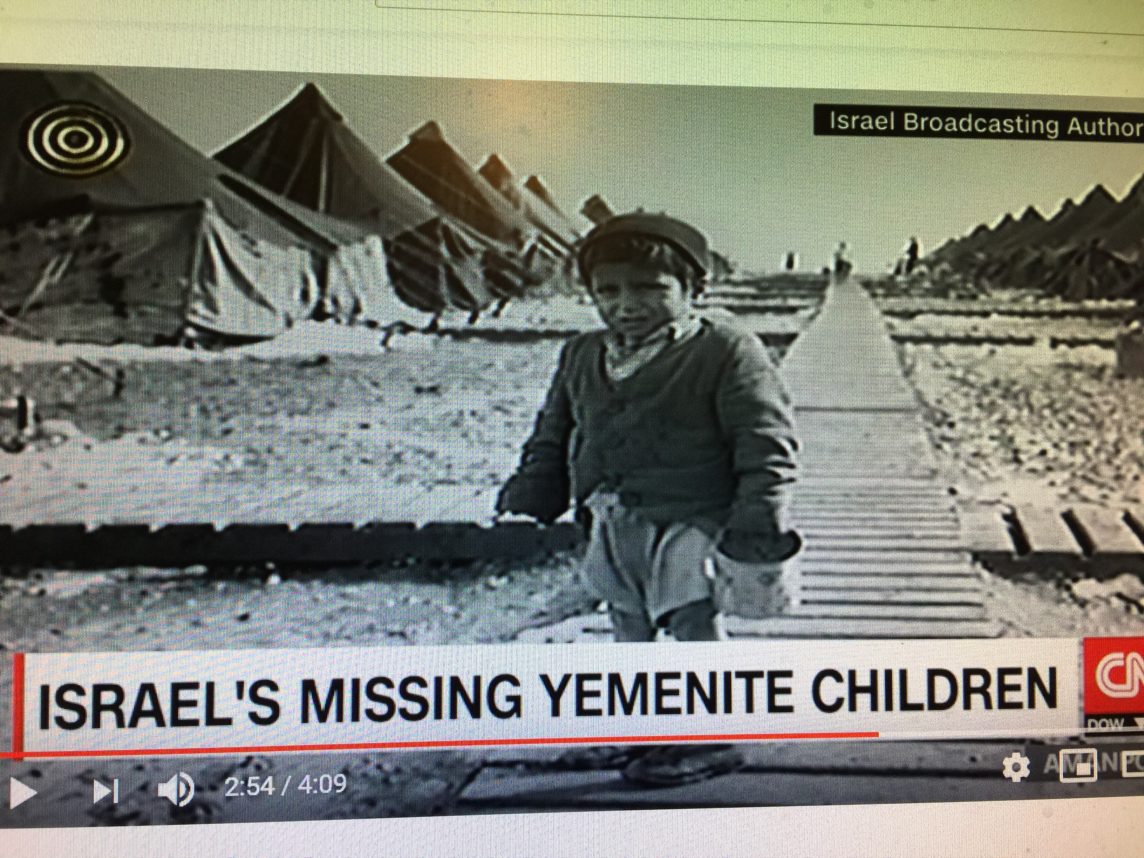
CNN covered the story about the hundreds of missing Yemenite and Arabic Jewish children in the early 1950s when they were brought by their parents to Israel and can be viewed here – https://www.youtube.com/watch?v=kp4IDws6f74

I requested the article below from my friend Noah Efron of “The Promised Podcast” (TLV1) out of Tel Aviv who reported the story this past week on the podcast. Noah had originally brought this story to light in 2014. With the recent statement of an eye-witness, the full episode of what happened to hundreds of Yemenite and Arabic Jewish babies in Israel in the early 1950s was revealed. I share Noah’s commentary on “The Promised Podcast” with his permission:

“We heard this week the remarkable and heartbreaking testimony of 85 year-old Shoshana (שחם) Shaham, a Holocaust survivor who was a student nursemaid in the transit camp, or Maabara, in Rosh Ha’Ayin through the first half of the 1950s, and only now told journalists for the first time that she saw kids of new immigrants in the camp, mostly from Yemin, being given up for unofficial adoption, without their parents knowledge, much less agreement, and of course they would never agree, and then she saw these same parents lied to, told that their kids had died and been immediately buried.

Shacham said:

“We would see cars coming, and from the cars people would emerge, dressed well, in city clothes. They spoke a foreign language. We saw these people putting babies in their cars. So I said, “What a minute, where are they taking them? So they said, ‘We are improving their circumstances. They are going to be in a different family, so they won’t get sick and dehydrated. So they won’t get dehydrated, they’ll give them liquids, they’ll give them food.”  

Shaham said she knew that they were being taken from their parents, beyond a shadow of a doubt. She says that she knew, at the time, that the parents knew nothing of this. She said that when the parents came, the doctors lied to them, saying their kids died. “We were witnesses,” she said. It was one of our crimes on the way to independence.

Shaham’s testimony is among the first to come from someone who was on the side of the people in the white coats. Until now, the only reports we had of this came from heartsick parents.

Those reports — victims testimonies — have been heard by now by a succession of three official committees (one in 1967, the next in 1988, then in 1995) assembled to investigate the disappearances documented in 745 cases, although activist organizations have gathered evidence of several times as many cases, maybe as many as five thousand. The events are known here as “The Yemenite Children Affair,” although in point of fact, a third of the missing children came from Iraq and other middle eastern and north African countries.

Reading the testimonies of long-bereaved parents before one or another of the investigating committees, one learns both that each instance of loss was unique, with its own tragic circumstances, and also that the disappearances followed patterns. Most of them happened in one of two places: a ma’abara children’s house or a medical clinic. Usually, parents were told that their children were being taken for some special care of which they were in absolute need. These parents were not given an option to refuse; in some cases, a baby was pulled from the arms of a parent wailing in protest. When the parent later came to visit their kid, they were told that a tragedy had occurred: the baby died. They were never shown a body, they were not invited to participate in a funeral. They were not given a copy of a death certificate. They were not taken to a cemetery plot. Sometimes, they were told, by way of offering comfort, that they could conceive a new baby, if they wished.

Most of these parents spent the rest of their lives looking for these kids, some into their 90s, and they never found them, which is a thing of incomprehensible weight.

But, there was more. Not only did these parents and sisters and brothers and uncles and aunts have to live their entire lives in the chilled shadow of this loss and cruelty, but they also had the secondary trial of not being believed.

Each official committee concluded that, while the testimony of families were heartbreaking and they were sincere, their kids had almost surely just died, at a time when medicine was poor and disease was hearty and records were scanty. They’d lost their child, and no one doubted the depths of their suffering, but they’d lost their kid to disease, maybe the oldest, if still the saddest, story there is.

But the parents, and in time their surviving kids, and then grandkids, knew that they knew what they knew. And for years, they insisted, and they cajoled, and they protested, and they organized. And for years, they were not believed. For years, people said, “Then why doesn’t some nursemaid come forward and say, I saw this with my own eyes. If it really happened, there would be a nursemaid who would say that.”

Well, now one has.

And I … and the podcast  … are implicated in this, too, in the following way. When I introduced the subject for discussion three years ago, I said this:

Now, there are some persuasive reasons to believe that no babies were kidnapped and given to more presentable – that is, Ashkenazi – families to raise. Shifra Shvarts, the leading historian of health care in Israel, says that she’s examined 30,000-40,000 files form that time, and never seen a clue of kidnapping. And then there were those expert commissions. At the same time, if the babies just died, how did they not let the parents see them, mourn them, bury them? I mean, who does that? 

So my questions for you mooks are these.  If all the evidence says that no kids were kidnapped, and no direct evidence says they were, then why does the belief that they were persist?

And then the discussion pretty much ended with Don [Futterman] saying this:

It’s not the Israel of today, and I think it’s not correct to go back and judge the way the way people behaved then. I’m not talking about the prejudices, but what they were able to do with their limited capacities. Thinking about Israel today, these are two very different countries and times in history.

Which are not the most benighted things to say, but still, you can feel that I’m saying, like so many other well-fed, self-satisfied, dicks over the past 70 years: “Well, surely, something terrible happened to you all those years ago, and I know you think you know what it was, but I’ll tell you that it wasn’t what you think, and the people you blame weren’t really to blame, and it was a long time ago, after all.”

And reading and listening to Shoshana Shaham’s witness this past week, I felt so sad and so terrible, first about what she described, and second about the 70 years of awful denial. And about how easy I found it to join that legacy of denial.

There is so much pain in this world and it takes vigilance, constant vigilance, to not let your heart go hard. And here, yet again, I failed. There’s no one to apologize to, but having put those words out there.”

A sign – A midrash on the rainbow – 2018

11 Thursday Oct 2018

Posted by rabbijohnrosove in Art, Divrei Torah, Musings about God/Faith/Religious life

≈ 1 Comment


God looked upon creation and saw violence, chaos and mean-spirited self-centeredness engulfing every heart. There was neither kindness nor justice in the world. Empathy had ceased. Fear and hatred had replaced peace and love. In an instant God determined to destroy the world and return existence to primordial darkness.

The Eternal God mourned and recalled how great was the effort to create the heavens and earth, give life to growing things, design and fashion the birds, sea creatures and animals in their variety, shape, color, function, and form. That thought grew within the Divine mind. The Creator hesitated and thought thinking how great the tragedy to destroy that which God had called “good.”

God wondered ‘Is there one human on earth, different from the rest, who fathoms Me, who hasn’t been consumed by the sitra achra, the evil that brought darkness to My creation.’

In a blink of the Divine eye, God peered into every human soul seeking that one, better than the rest, who though not yet a complete tzadik might be good enough and able to hear  the Divine voice and save what could be saved.

God found Noah and plucked him out and instructed him to build an ark, to save his family and two of every creature that all might not be lost and the world might begin anew.

As God contemplated the potential devastation Divine tears fell heavily to earth in a torrential downpour that lasted forty days and nights.

When finally God’s tear ducts were dry the waters receded, dry land appeared, and the ark docked. The Eternal God spoke to Noah:

“I am God, Noah, Who created you and brought you into this new land. Look around you and see the cleansed earth. The world is once again new. There is no longer rage nor hatred, violence nor hubris in the human heart. I will make with you a covenant marked by a sign that will remind us both how I created the world in peace, then destroyed it allowing it to begin anew that it should be a place of peace for all time.

And the sign of this covenant will be a radiant smile stretching across the heavens and filling the sky, an arc of light shining through the flood waters, a vision of loveliness inspiring love for and awe of Me. 

This promise, Noah, shall be called the ‘rainbow,’ and this bow in the sky will remind you, your progeny and Me that I will never again bring such devastation to the earth. 

Your duty and the duty of your children and children’s children must be to protect My creation, to preserve and nurture it, for there will come no one after you to set it right if you destroy it.”

God bent towards the earth and stretched the Divine arm across the sky and created an arc. Where God’s hand had been appeared a sheltering bow of every color spread across the blue canvas of sky.

And God spoke of the colors and the rainbow sign:

“First comes red to stand for the blood pulsing through human veins that carries My Godly soul and makes all things live; orange is for the comforting warmth of fire and its potential to create, build and improve upon what I created; yellow is for the glory of the sun that lights the earth and gives vision to earthly souls that they might see Me in all things and live; green is for the grass and the leaves of trees and their fruit, that all creatures might be sustained in life; blue is for the sky, sea and rivers that joins air and ground and makes clear that all is One, divinely linked and a reflection of Me; indigo appears each day at dusk and dawn to signal evening and morning, the passage of time and the seasons, the ever renewing life force that is intrinsic to all things; violet is for the coming of night when the world rests and is renewed, and it carries the hope that all might awake in the morning and utter words of thanksgiving and praise.”

God explained to Noah that the rainbow appears to the human eye as a half circle:

“Do not be fooled, my most righteous one! There is more to life than what the eye can see. There is both the revealed and the hidden, and the hidden half of the bow reaches deep into earth that you and those who yearn after Me might come and discover Truth, and reveal and make whole the revealed and the hidden in My world.”

Remember this blessing, My child, and you will remember My promise – Baruch Atah Adonai Eloheinu Melech ha-olam, zocheir habrit v’neeman biv’rito v’kayam b’maamaro – Praised are You, Eternal God, Sovereign of the revealed and the hidden, Who remembers, is faithful to and fulfills the Divine covenant and promise.”

Written by Rabbi John Rosove and inspired by classic Midrashim

“The Chosen Wars – How Judaism Became an American Religion” by Steven R. Weisman – A Review

08 Monday Oct 2018

Posted by rabbijohnrosove in American Jewish Life, Book Recommendations, Ethics, Jewish History, Jewish Identity, Social Justice

≈ Leave a comment

Steven R. Weisman does the American Jewish community and anyone interested in who we are and how we came to be who we are a deep favor. His history of the American Jewish experience (publ. 2018 – 266 pages) is a wonderful read. He covers the beginning of our history in the new world when Jews first arrived on American shores in New Amsterdam in 1654, spends much time on the dynamic 19th century, and brings it all into the present.

Weisman’s readable narrative is comprehensive. His nuanced discussion of events and trends as they reflect the influences of the American experience on our community gives insight into how we evolved from before the American Revolution through the Civil War into the industrial age and twentieth century as we strove to be at once American and Jewish.

He describes how we acclimated to the new world in every generation without losing a sense of Jewish meaning. He discusses radical and conservative religious, ideological, and practical responses to the myriad of challenges Jews encountered coming from Central Europe, Germany, Russia, and Sefardic lands over a period of two centuries.

Weisman discusses at some length the emergence of the American Reform movement, the founding of the Conservative movement, and how orthodoxy struggled to survive and then staked its ground as immigrant waves from Eastern Europe arrived during the twentieth century.

The title of the book (“The Chosen Wars”) is Weisman’s thesis. So often, there is a tendency to look back with nostalgia on our history and smooth the edges of controversy. To do so, however, is to mischaracterize history itself and especially Jewish history. He shows that we Jews were and continue to be argumentative and rarely unified even as we have aspired for unity.

He writes in the epilogue:

“Judaism’s flourishing in America was not foreordained or inevitable. Neither was it free from conflict and animosity. On the contrary, the disputes among Jews in America were emotional and personal. They were also very American…The Jews shaped their experience in America, and they were shaped by the America they found. The push and pull for Jews followed a historic tension.”

Steven R. Weisman is vice president for publications and communications at the Peterson Institute for International Economics. He previously served as a correspondent, editor and editorial board member of The New York Times. He is the author of “The Great Tax Wars: How the Income Tax Transformed America.”

I recommend this volume highly. If you want deeper understanding about who we are as an American Jewish community, how we got here, and what contemporary challenges we face, this book will not only frame it all for you but inspire you with the hope that, indeed, we are NOT the ever-dying people.

Senator Susan Collins – Two important op-eds – NY Times and Washington Post

07 Sunday Oct 2018

Posted by rabbijohnrosove in American Politics and Life, Ethics, Social Justice, Women's Rights

≈ 2 Comments

What happened this last week in the United States Senate has disturbed deeply the majority of the country given the low approval rating of Judge Kavanaugh and the Senate’s majority vote for him to assume a seat on the High  Court.

So many wanted to see a few Republican and Democratic Senators show that they are “Profiles in Courage” who would choose to vote on principle “no” on Kavanaugh’s nomination.

The following op-ed articles in the NY Times and Washington Post articulate well the meaning of Maine’s Senator Susan Collins’s pivotal speech and deciding vote for Kavanaugh.

After she made her speech, former Obama Administration leader Susan Rice said that she may challenge Collins in her 2020 reelection bid. If Rice does, I will support her with my dollars. One friend, Glenn Krinsky, who referred me to these two articles, promised to fly to Maine and knock on doors in an effort to elect Rice and defeat Collins.

Here are the two op-eds.

Susan Collins Is the Worst Kind of Maverick – She votes with the most right-wing members of her party, even while attempting to occupy some imaginary moral high ground. – By Jennifer Finney Boylan – New York Times – https://nyti.ms/2zUTIuT

Susan Collins’s Declaration of Cowardice – By Dana Milbank – Washington Post

https://wapo.st/2EcF85Q

The Talmud has something to say about “Bart” Kavanaugh and current Republican Senators

04 Thursday Oct 2018

Posted by rabbijohnrosove in American Politics and Life, Ethics, Social Justice, Women's Rights

≈ 1 Comment

“Our masters taught: Some used to say, ‘Happy our youth which has not disgraced our old age.’ ….Others used to say, ‘Happy our old age which has atoned for our youth.’”

– Babylonian Talmud, Sukkah 53a

What makes a strong and weak person and nation?

01 Monday Oct 2018

Posted by rabbijohnrosove in American Politics and Life, Ethics, Quote of the Day, Uncategorized

≈ 2 Comments

“A strong nation, like a strong person, can afford to be gentle, firm, thoughtful, and restrained. It can afford to extend a helping hand to others. It is a weak nation, like a weak person, that must behave with bluster and boasting and rashness and other signs of insecurity.”

-Jimmy Carter, 39th US President, Nobel laureate (b. 1 Oct 1924)

When prayer is projected onto large screens in place of using prayer books

30 Sunday Sep 2018

Posted by rabbijohnrosove in American Jewish Life, Inuyim - Prayer reflections and ruminations, Musings about God/Faith/Religious life

≈ 6 Comments

Several years ago I attended a session at the Biennial Conference of the Reform movement (the Union for Reform Judaism) on the visual benefits of projecting the prayer book and the weekly Torah portion onto large screens in place of prayer books. It was at the time a new way to draw a congregation together while freeing the pews of books and papers. Though I understood the benefit of having the text available in plain sight to everyone present, especially in a large congregation, and the ability to add new songs and poetry that are not contained already in prayer books, I was uncomfortable with it and preferred then and still prefer to have an actual prayer book in my hands.

Having said this, at my congregation we use large screens for prayer twice a year, on the mornings of Rosh Hashanah and Yom Kippur at our family services with pre-school age through first grade children, their parents and grandparents. All the 700 in attendance need to do do is look forward towards the bimah and there they can read/sing the blessings and view colorful illustrations and photographs. For this particular population, projected prayer works well.

It’s one thing, however, to use projected prayer and illustrations/photographs for small children and their parents, and it’s quite another to use it in place of prayer books at Shabbat services for elementary school-age students, teens, and adults.

In recent days on the private Reform Rabbi List-Serve called RAVKAV where rabbis talk to each other about anything and everything of current concern, there has been a thoughtful discussion about the benefits and deficits of projected prayer in place of using actual siddurim. I found the discussion provocative and engaging, and so I shared some of the posts (I removed the writers’ names to maintain confidentiality) with my fellow clergy in my congregation. I received the following statement from our cantorial soloist and music director, Shelly Fox. Shelly is a 2nd year cantorial student at the Academy for Jewish Religion (AJR) here in Los Angeles. She is a world class singer and a thoughtful, evocative and sensitive Jew and prayer leader. I share her words with her permission:

“It’s one thing to project the words to prayers and enable people to follow along and lift their faces out of a book and sing together, but once we start talking about projecting imagery and then taking it further and using a large screen LED TV for clear, bright images, now we’re getting into the territory of another screen to watch.

I think that when people see a TV screen they shut off their brains. They get lulled into watching, not doing. I also think that prayer is both communal and personal and to give everyone imagery to watch takes them out of their own heads. It’s my same argument to musical settings of prayers in what I call “interpretive English.” I am not opposed to singing prayers in English but it bothers me when a prayer isn’t a direct translation[i.e. from the Hebrew, Ladino, or Yiddish] but is the songwriter’s impression of the prayer. I want the freedom to interpret a prayer how I feel it, which can change on any given day or at different times in my life. Giving someone a specific image to look at while praying cuts them off from their own inner dialog. …I think this is part of a larger trend of the dumbing down of our society. The less people think for themselves, the less they engage in critical thinking. We will have a nation of people plugged into (lulled by) screens and that leaves them vulnerable to whoever wants to control them, be it for good or for ill.” 

I agree with Shelly. After all, we Jews are Am haSefer – The People of the Book. I always prefer holding a book in my hands. I don’t read books on Kindle and though it’s more convenient to download books especially when traveling instead of carrying them in my luggage, I prefer the latter to the former.

A colleague wrote to me after I posted Shelly’s response on RAVKAV. He agreed with her saying: “We are a book culture — which means that we should be able to browse through a book and study it. The last thing we need is to strengthen our addiction to screens.”


Reform Judaism doubles down on Israel engagement and Reform Zionism

27 Thursday Sep 2018

Posted by rabbijohnrosove in American Jewish Life, Israel/Zionism, Jewish History, Jewish Identity, Social Justice, Women's Rights

≈ Leave a comment

Our Reform movement has taken the drift among some American liberal Jews seriously and is stressing the importance of the peoplehood and State of Israel as intrinsic to the fabric of American liberal Jewish identity.
 
Read this article – it’s important!
 
http://jewishjournal.com/analysis/239498/reform-judaism-doubles-zionism/
← Older posts
Newer posts →

Enter your email address to subscribe to this blog and receive notifications of new posts by email.

Join 362 other subscribers

Archive

  • September 2026 (4)
  • August 2026 (2)
  • July 2026 (4)
  • June 2026 (3)
  • April 2026 (4)
  • March 2026 (6)
  • February 2026 (6)
  • January 2026 (8)
  • December 2025 (4)
  • November 2025 (6)
  • October 2025 (8)
  • September 2025 (3)
  • August 2025 (6)
  • July 2025 (4)
  • June 2025 (5)
  • May 2025 (4)
  • April 2025 (6)
  • March 2025 (8)
  • February 2025 (4)
  • January 2025 (8)
  • December 2024 (5)
  • November 2024 (5)
  • October 2024 (3)
  • September 2024 (7)
  • August 2024 (5)
  • July 2024 (7)
  • June 2024 (5)
  • May 2024 (5)
  • April 2024 (4)
  • March 2024 (8)
  • February 2024 (6)
  • January 2024 (5)
  • December 2023 (4)
  • November 2023 (4)
  • October 2023 (9)
  • September 2023 (8)
  • August 2023 (8)
  • July 2023 (10)
  • June 2023 (7)
  • May 2023 (6)
  • April 2023 (8)
  • March 2023 (5)
  • February 2023 (9)
  • January 2023 (8)
  • December 2022 (10)
  • November 2022 (5)
  • October 2022 (5)
  • September 2022 (10)
  • August 2022 (8)
  • July 2022 (8)
  • June 2022 (5)
  • May 2022 (6)
  • April 2022 (8)
  • March 2022 (11)
  • February 2022 (3)
  • January 2022 (7)
  • December 2021 (6)
  • November 2021 (9)
  • October 2021 (8)
  • September 2021 (6)
  • August 2021 (7)
  • July 2021 (7)
  • June 2021 (6)
  • May 2021 (11)
  • April 2021 (4)
  • March 2021 (9)
  • February 2021 (9)
  • January 2021 (14)
  • December 2020 (5)
  • November 2020 (12)
  • October 2020 (13)
  • September 2020 (17)
  • August 2020 (8)
  • July 2020 (8)
  • June 2020 (8)
  • May 2020 (8)
  • April 2020 (11)
  • March 2020 (13)
  • February 2020 (13)
  • January 2020 (15)
  • December 2019 (11)
  • November 2019 (9)
  • October 2019 (5)
  • September 2019 (10)
  • August 2019 (9)
  • July 2019 (8)
  • June 2019 (12)
  • May 2019 (9)
  • April 2019 (9)
  • March 2019 (16)
  • February 2019 (9)
  • January 2019 (19)
  • December 2018 (19)
  • November 2018 (9)
  • October 2018 (17)
  • September 2018 (12)
  • August 2018 (11)
  • July 2018 (10)
  • June 2018 (16)
  • May 2018 (15)
  • April 2018 (18)
  • March 2018 (8)
  • February 2018 (11)
  • January 2018 (10)
  • December 2017 (6)
  • November 2017 (12)
  • October 2017 (8)
  • September 2017 (17)
  • August 2017 (10)
  • July 2017 (10)
  • June 2017 (12)
  • May 2017 (11)
  • April 2017 (12)
  • March 2017 (10)
  • February 2017 (14)
  • January 2017 (22)
  • December 2016 (13)
  • November 2016 (12)
  • October 2016 (8)
  • September 2016 (6)
  • August 2016 (6)
  • July 2016 (10)
  • June 2016 (10)
  • May 2016 (11)
  • April 2016 (13)
  • March 2016 (10)
  • February 2016 (11)
  • January 2016 (9)
  • December 2015 (10)
  • November 2015 (12)
  • October 2015 (8)
  • September 2015 (7)
  • August 2015 (10)
  • July 2015 (7)
  • June 2015 (8)
  • May 2015 (10)
  • April 2015 (9)
  • March 2015 (12)
  • February 2015 (10)
  • January 2015 (12)
  • December 2014 (7)
  • November 2014 (13)
  • October 2014 (9)
  • September 2014 (8)
  • August 2014 (11)
  • July 2014 (10)
  • June 2014 (13)
  • May 2014 (9)
  • April 2014 (17)
  • March 2014 (9)
  • February 2014 (12)
  • January 2014 (15)
  • December 2013 (13)
  • November 2013 (16)
  • October 2013 (7)
  • September 2013 (8)
  • August 2013 (12)
  • July 2013 (8)
  • June 2013 (11)
  • May 2013 (11)
  • April 2013 (12)
  • March 2013 (11)
  • February 2013 (6)
  • January 2013 (9)
  • December 2012 (12)
  • November 2012 (11)
  • October 2012 (6)
  • September 2012 (11)
  • August 2012 (8)
  • July 2012 (11)
  • June 2012 (10)
  • May 2012 (11)
  • April 2012 (13)
  • March 2012 (10)
  • February 2012 (9)
  • January 2012 (14)
  • December 2011 (16)
  • November 2011 (23)
  • October 2011 (21)
  • September 2011 (19)
  • August 2011 (31)
  • July 2011 (8)

Categories

  • American Jewish Life (458)
  • American Politics and Life (417)
  • Art (30)
  • Beauty in Nature (24)
  • Book Recommendations (52)
  • Divrei Torah (159)
  • Ethics (490)
  • Film Reviews (6)
  • Health and Well-Being (156)
  • Holidays (136)
  • Human rights (57)
  • Inuyim – Prayer reflections and ruminations (95)
  • Israel and Palestine (358)
  • Israel/Zionism (502)
  • Jewish History (441)
  • Jewish Identity (372)
  • Jewish-Christian Relations (51)
  • Jewish-Islamic Relations (57)
  • Life Cycle (53)
  • Musings about God/Faith/Religious life (190)
  • Poetry (86)
  • Quote of the Day (101)
  • Social Justice (355)
  • Stories (74)
  • Tributes (30)
  • Uncategorized (856)
  • Women's Rights (152)

Blogroll

  • Americans for Peace Now
  • Association of Reform Zionists of America (ARZA)
  • Congregation Darchei Noam
  • Haaretz
  • J Street
  • Jerusalem Post
  • Jerusalem Report
  • Kehillat Mevesseret Zion
  • Temple Israel of Hollywood
  • The IRAC
  • The Jewish Daily Forward
  • The LA Jewish Journal
  • The RAC
  • URJ
  • World Union for Progressive Judaism

Blog at WordPress.com.

  • Subscribe Subscribed
    • Rabbi John Rosove's Blog
    • Join 362 other subscribers
    • Already have a WordPress.com account? Log in now.
    • Rabbi John Rosove's Blog
    • Subscribe Subscribed
    • Sign up
    • Log in
    • Report this content
    • View site in Reader
    • Manage subscriptions
    • Collapse this bar
Loading Comments...