
• About

Rabbi John Rosove's Blog

Rabbi John Rosove's Blog

Tag Archives: gaza

“There is No Warrant to Israel ‘Genocide’ Claim”

01 Wednesday May 2024

Posted by rabbijohnrosove in Uncategorized

≈ 1 Comment

Tags

gaza, genocide, Human rights, Israel, palestine

A Jerusalem Post Op-Ed written by the ethicist Rabbi Dr. Eugene Korn (April 27) persuasively dispels the slanderous charge of “genocide” against the State of Israel in its war against Hamas (see Op-Ed below). Dr. Korn notes that Raphael Lemkin (1900-1959), a Polish Jewish lawyer who coined the term “genocide” and who campaigned for the establishment of the UN Genocide Convention in 1951, described “genocide” as a particularly heinous crime distinguishable from all other war crimes. Lemkin defined genocide as “the intent to destroy a human group as such, directed at individuals only because they belong to that group.” Encyclopedia Britannica is more specific and defines “genocide” as “the deliberate systematic destruction of a group of people because of their ethnicity, nationality, religion, or race.” 

The key requirement in determining whether genocide has been committed is a nation at war’s “deliberate intent” to murder a group of people in whole or in part. Consequently, the charge of “genocide” leveled in The Hague by South Africa against the State of Israel and presently under consideration in The Hague does not apply because the war Israel is waging is against Hamas and is NOT against the Palestinian people, though they are the ones who are suffering.

Hamas is a terrorist military organization that seeks the destruction of the State of Israel and the murder of all Israelis and Jews. That Israel was called to answer the charge of genocide and that this unique charge has been repeated so cavalierly by many contemporary American college protesters, Palestinian resistance groups and the media does not make it so. That’s not to say that the death of any civilian is a tragedy. It is, and in this just war thrust upon Israel after Hamas’ brutal attack against thousands of innocent Israeli civilians on October 7, the resulting death of innocent Palestinians is an awful tragedy.

No nation, however, would stand by and not respond militarily to Hamas’ attack. Hamas leadership has been clear about its intent in this war; to draw Israel out to attack Gaza and cause as much civilian death and injury as possible, and then to disseminate the images of destruction and death day after day, week after week and month after month in its de-legitimization campaign against the State of Israel. Hamas’ military and political leadership promised to continue attacking Israel as it did on October 7 over and over again.  

To the charge of genocide, from the beginning of this war, it needs to be recognized that Israel sent hundreds of thousands of text messages, robocalls, and leaflets throughout Gaza to warn Palestinian civilians to leave specific targets that Israeli intelligence concluded were sites occupied by Hamas commanders and fighters, military strong-holds, missile sites, and weapons depots. Hamas had embedded itself everywhere above ground in homes, apartment buildings, community centers, schools, mosques, and hospitals, and below ground in its 400 miles of tunnels. Many thousands of Palestinians, however, did not leave those targets for a variety of reasons. Some understandably did not want to leave their homes. Others were threatened by Hamas if they tried to leave and were shot at if they did. Hamas wanted Palestinians to become the victims of Israeli bombing. The visuals of the destruction are mind-numbing and terrifying, and that is exactly what Hamas wanted the world to see. One Hamas commander said in an interview that Hamas would be happy if even 100,000 Palestinian civilians die in this war.

Yes, Israel likely has made mistakes, and some targeting may have crossed red lines resulting in the death of innocent civilians. I have questioned the massive use of 2000-pound “dumb bombs” that have destroyed entire apartment buildings with the intent to take out Hamas commanders and deeply embedded tunnels beneath the buildings because of the resulting civilian deaths. Though it is ghoulish to talk about the numbers of casualties, Dr. Korn does so by comparison in his Op-Ed below. Israel’s record, even using Hamas statistics, is far better in its civilian-Hamas death ratio than in any war in the 20th and 21st centuries by any other nation in the world. No one really knows, by the way, how many civilians have been killed and injured because Hamas’ figures are all part of its de-legitimization campaign against Israel. Israel estimates that between 13,000 and 14,000 Hamas fighters have been killed.

Those protesting Israel’s war against Hamas on college campuses who proclaim “We are Hamas” and “Free Palestine from the River to the Sea” are wittingly or unwittingly calling for the destruction of Israel. They may know what they are saying, and if so, their morality is to be condemned as genocidal by definition. If they don’t know what they are saying, or what these slogans really mean, or if they deny and/or refuse to acknowledge what Hamas did to Israeli civilians on October 7, or if they refuse to acknowledge Hamas’ history of reactionary and repressive policies towards its own people (Hamas’ first act after its violent coup de ’etat against the Palestinian Authority in 2007 in Gaza was to march PA leaders to the top floors of the highest buildings and throw them to their deaths), or they don’t realize that Hamas executes LGBTQ individuals and women who resist Hamas’ authority, they ought to study the real history of the Middle East conflict and ask themselves who is really on the right side of history in this war.

I understand well as a Jew, a Zionist and a humanitarian the moral position of those who are against all wars. I struggled during the Vietnam War about whether I was a pacifist or not because I was so against America’s involvement in that war and was of draft age. I decided that since I would have fought against the Nazis in World War II and on the side of Israel in the 1967 and 1973 wars, I was not a pacifist, though throughout my adult life I have been a peace activist especially between Israel and the Palestinian people. I respect those who on principle are opposed to all wars, and I especially respect the peace-makers. When this war ends, I hope that Israel and the Palestinians will find a pathway to resolve their conflict for the sake of both peoples’ security, independence and dignity. Hamas and its extremist Islamic allies (e.g. Iran, Hezbollah, etc.), however, are not legitimate partners to peace as they are maximalist and uncompromising terror organizations with the clearly articulated intent to destroy the State of Israel, to murder every Israeli and every Jew on its way to establishing an extremist Muslim caliphate over all of Palestine “from the river to the sea.”

It is one thing for college and university students to want this war to end, who yearn for the killing to stop, for the hostages to be returned to their families, and to want justice for the Palestinian people and a Palestinian state on part of historic Palestine – I want all of that too – but it is another thing to side with Hamas and Islamic extremists who want the destruction of Israel and the murder of Jews and then in ignorance or with hubris charge Israel with genocide.

Though I believe in the right of students to peacefully demonstrate on college and university campuses on behalf of moral and just issues as an expression of their American First Amendment rights, I believe that there is a tremendous lack of understanding and knowledge about Hamas and the history of the Israeli-Palestinian conflict amongst many of those currently demonstrating against this war.

I have written since the 100th day that Israel should sue for peace and get back all its hostages as soon as possible, to stop the fighting to avoid more death, injury and destruction to Gazan civilian life and to the lives of young Israeli soldiers, and to pour massive amounts of humanitarian aid into Gaza. Thankfully, due to President Biden’s strong pressure on PM Netanyahu, approximately 350 trucks filled with food, water, and medical supplies are now coming into Gaza daily over newly opened crossings from Israel into Gaza and the US humanitarian pier is about to be completed and operating.

Former Israeli Prime Minister Ehud Olmert and many Israeli army and intelligence leaders have said that Israel’s continuing the war to root out Hamas in Rafah is NOT worth the cost in human life, and that Israel should stop the fighting now, declare victory and sue for peace and the return of the hostages. Those are all positions worthy of college and university students.

I hope that reasonable students will pause from the demonstrations and study seriously the history of the Israeli-Palestinian conflict from both sides, step away from those demonstrators who call for the destruction of the State of Israel, and refuse to be ensnared by their maximalist anti-Israel and antisemitic rhetoric that charges Israel with the slander of genocide. (See my last blog “Confronting Antisemitism on College Campuses” in which I described what antisemitism is and isn’t, and what it means to be anti-Zionist and anti-Israel).

Here is Dr. Korn’s Op-Ed

“Since October 7, ‘genocide’ has rolled effortlessly off our tongues. To Israelis, Hamas’s murder, rape, and kidnapping of more than 1,400 people prove that Hamas is committed to its goals of making Palestine Judenrein through violent jihad and exterminating Jews. 

To many on campus, social media, and in the partisan halls of the United Nations, Israel’s response to Hamas’s orgy of death is self-evident genocide. This rhetoric is awash in certainty, even though factual analyses yield little evidence of actual genocide.

Raphael Lemkin coined the term “genocide” after reflecting on the mass slaughter of civilians in World War II. He understood genocide as a particularly heinous crime distinguishable from other war crimes, defining it as “the intent to destroy a human group as such, directed at individuals only because they belong to that group.” 

Encyclopedia Britannica currently defines genocide as “the deliberate systematic destruction of a group of people because of their ethnicity, nationality, religion, or race.” 

In 1951, the crime of genocide gained legal force when the Convention on the Prevention and Punishment of the Crime of Genocide was ratified by more than 130 countries.

What constitutes genocide?

Mass killing by itself does not constitute genocide, and World Wars I and II demonstrate the distinction. The Carnegie Institute estimates the number of World War I war-related deaths at 16-17 million, yet only the Ottoman murders of Armenians (1-1.5 million), Assyrians (750,000), and ethnic Greeks (348,000) were genocidal. World War II was far more lethal. 

Estimates run from 70 to 85 million people killed, but deaths from systematic group extermination comprised but a small fraction of these: Jews (5.9 million), ethnic Slavs (2-2.5 million), Roma (250,000), Freemasons (80,000-200,000), disabled persons (250,000-300,000), and homosexuals (10,000-15,000). Thus, only 16% of World War I and 10-13% of World War II deaths were the result of genocide.

Many point to the large number of deaths in Gaza as proof of Israeli genocide. As of April 6, the Hamas-run Gaza Ministry of Health claimed that 33,137 Gazans had been killed in the war, while Israel maintains that more than 13,000 of those deaths were Hamas combatants. If we accept these unconfirmed figures, approximately 20,000 Gazan civilians have died.

To determine whether these deaths constitute genocide, compare the Gaza war to other modern wars:

The percentages of Gazans killed (1.52%) and civilians killed out of the total population (0.92%) are all dramatically lower than their corresponding categories in other major wars. During World War I, 3.8% of all Russians died, while 8.57% of its civilians were killed. In World War II, 6.1% of German citizens died and 1.13% of German civilians were killed, while 10.5% of all Russians and 4.1% of Russian civilians were killed. In the Korean War, 12-15% of North Koreans were killed, while 10.2% of North Korean civilians died.

None of those campaigns were categorized as genocide since they reflect only the lethal nature of these wars. If those vastly more lethal campaigns were not genocide, it is difficult to see how the Israeli campaign in Gaza, with its immensely lower percentages of population and civilians killed, could qualify as genocide.

We can also analyze how 1.52% of Gazans killed compares to the corresponding percentages of the actual genocides against the Armenians in World War I (80%), the Jews (67%) and Roma (25-33%) in World War II, and the Tutsis in Rwanda in 1994 (85%).

The percentage of Gazans killed relative to the group population is at least 15 times lower than the percentages of the populations killed in the above genocides. The discrepancy is even greater if we consider all Palestinians in Gaza and the West Bank, over which Israel has substantial military control. In that case, the percentage of Palestinian people killed (0.66%) is more than 39 times lower than the percentages killed in any of the genocides. Again, the results of the Israeli campaign bear no statistical similarities to actual genocides.

Another important indicator of genocide is the ratio of civilian casualties to enemy combatant deaths. If the intent is the destruction of a group, qua group, then civilians will represent a high casualty ratio relative to combatants. Conversely, a low ratio of civilian-to-combatant deaths augurs for general lethality, not genocide.

In the non-genocidal campaigns of World War II, the civilian-to-combatant death ratio was approximately 2:1; in the Korean War, it was 3:1; in the Persian Gulf War, it was 9:1; and in the Iraq War, it was 2:1. In the present Gaza war, it is 20,000/13,000 or 1.54:1.The low 1.54:1 Gaza ratio is notable because the war is being fought in dense urban areas where civilians have little protection, while Hamas fighters are protected in underground tunnels.

Moreover, Hamas has positioned its military assets in and under schools, hospitals, and residential buildings. 

The Gaza fighting is comparable to the 2016-2017 international campaign against ISIS in Mosul, which was also fought in dense urban areas. The Mosul civilian-to-combatant death ratio was 9:1, as is the UN’s estimated ratio for urban warfare, so the civilian-to-combatant death ratio in Gaza is approximately six times lower than that of standard urban warfare.

In sum, the Gaza deaths resemble the pattern of general warfare and are manifestly dissimilar to instances of actual genocide. There is no statistical warrant to justify the claim that Israel is committing genocide in Gaza.

No person who values life can remain insensitive to the immense tragedy in Gaza. William Tecumseh Sherman was correct: War is hell. However, lethal war by itself is not genocide. Unfortunately, fact-based analyses will not stop many from uncritically insisting that genocide is occurring in Gaza. 

Emotional recoil easily overcomes careful thinking. More pointedly, there is great political value for some in describing Israel’s actions as genocide: it condemns Israel of the most heinous of crimes, thereby strengthening the radical argument to dismantle the Jewish state.

THERE ARE also moral and historical consequences to this error. As the false claim goes viral, genocide becomes conflated with the general hellishness of war and loses its unique descriptive and prescriptive meaning. 

If the war in Gaza constitutes genocide, then so do World War I, World War II, the Korean War, and all conflicts with horrific lethality.

This logic’s trajectory denies legitimacy to any middle ground between peace and genocide, rejecting any moral position between pacifism and all-out conflict unbridled by moral rules. 

The Nazi extermination campaigns against Jews, Roma, ethnic Slavs, and homosexuals, qua peoples, become no worse than any bloody war.

Should this occur, genocide as a distinctive concept of extreme evil will have died, as will our conviction to prevent its recurrence. “Never Again” will become “Again” in history, perhaps in our lifetime.”

Dr. Eugene Korn is an ethicist living in Jerusalem.
https://www.jpost.com/opinion/article-798738

Confronting Antisemitism on College Campuses

28 Sunday Apr 2024

Posted by rabbijohnrosove in Uncategorized

≈ 8 Comments

Tags

antisemitism, gaza, Israel, palestine, zionism

The American Jewish community has rightly responded with alarm at the dramatic rise in antisemitic incidents in America in recent years, especially since October 7, 2023 when Hamas terrorists viciously attacked Israeli civilians in southern Israel. We are also feeling stung by the dramatic surge of anti-Israeli protest demonstrations on college campuses. University presidents are struggling to address this sudden increase of protesters while striving to preserve free speech and condemning antisemitic intimidation and rhetoric that can lead to violence against Jewish students and supporters of Israel. Many colleges and universities, struck by the speed and intensity with which the demonstrations have arisen and grown, have canceled classes for the remainder of the semester and graduation ceremonies altogether. The metastasizing effect of antisemitism is stunning, though not surprising at a time in which ignorance of Israeli and Middle East history, Judaism and Zionism, compounded by the media’s repetitive focus on the tragedy that has unfolded in Gaza and engulfed the 2-million mostly innocent Palestinian civilians, and in light of the widening cultural and political polarization and upheaval that has taken hold in American culture that began with the presidency of Donald Trump.

What do we do about all of this? First, it’s important for everyone, and especially young college and university demonstrators, to consider what antisemitism really is, what it isn’t, and what constitutes legitimate criticism against the policies of the State of Israel.

A short blog does not provide nearly enough space to discuss the age-old phenomenon of antisemitic hate. That said there are a number of modern and classic iterations of antisemitism that are being promulgated by the hard political left and the conservative right in the United States. They include Holocaust denial, offensive stereotypes of Jews as Christ-killers, puppet masters, imposters, and swindlers who manipulate national events for malign purposes. Antisemitism casts Jews as foreigners, controllers of banking, the media, entertainment, politics, and government. It denies the Jewish people’s right to national self-determination and a nation state anywhere in the Biblical Land of Israel based on the false premise that there never was a Jewish presence there despite massive literary and archaeological evidence to the contrary. Antisemitism applies double standards to Jews and the Jewish state not applied to any other people or nation, uses the symbols and images associated with classic antisemitism to characterize Israel, Israelis and Jews, draws comparisons of contemporary Israeli policy to that of the Nazis, and holds Jews collectively responsible for actions of the State of Israel. At its core, antisemitism is self-righteously based in the irrational and in fear and ignorance of Israelis, Jews and Judaism. It is anti-liberal, intolerant, racist, and immoral.

Not all anti-Zionism, however, is antisemitism for there are many anti-Zionists who are proudly self-identifying Jews. To characterize Zionism quickly is also beyond the purview of a blog. But I can say at least the following; that the Zionist movement began in the late 19th century as a political movement to address European antisemitism and to bring oppressed and persecuted Jews to the ancient Homeland of the Jewish people and build the institutions of a future state of the Jewish people. It was also a cultural movement to renew the Hebraic spirit amongst the masses of Jews around the world and in Palestine based upon the teachings of the ancient Prophets of Israel who called for a society based upon justice, compassion and peace. There are many streams of Zionism today that have developed over the years from left-wing to right-wing, political to orthodox to Reform, to secular.

Legitimate criticism of Israeli government policies and freedom of thought, press and assembly are not only intrinsic to Israeli culture but to Diaspora Jewish culture too. Criticism of Israeli policies is therefore not necessarily antisemitic, though some of it is if such criticism is based on the denial of the inherent right of the Jewish people to a state of their own. To be able to judge whether anti-Zionism is also antisemitic, it is necessary to study and understand Jewish, European and Middle East history, how and why the Zionist movement emerged and grew, and the history of the State of Israel and its relationship with its Arab neighbors and the Palestinian people.

For Jewish students and supporters of Israel to fear walking on any college or university campus anywhere in America ought to alarm not just the Jewish community, but people across religious, cultural, racial, ethnic, and gender lines. That there are students at Columbia University and other campuses who chant their approval of Hamas ought to terrify anyone who values freedom and a liberal progressive society. When Hamas took control of Gaza in a violent military coup in 2007, its first action was to march leaders of the rival Palestinian Authority to the highest building in Gaza and throw them to their deaths. LGBTQ individuals are punished severely by Hamas as are women who stand up for their rights. Hamas, an extremist Islamic terror organization that is uncompromising and repressive, does not value human rights nor the lives of its own citizens who Hamas has used consistently as human shields in its many wars against Israel. How American students who profess to be humanitarians and progressives can chant their support of Hamas and the destruction of the democratic liberal state of Israel is confounding.

I have written in former blogs about this Israel-Hamas war, that it is not a war against the Palestinian people but rather an existential struggle against Islamic extremism that seeks the destruction of Israel on any land between the river and the sea and the murder of all Israelis and Jews. I have written as well consistently for the return of the Israeli hostages as a first order of business for Israel and for a massive infusion of humanitarian aid into Gaza for Palestinian civilians. I have supported the hope that when the fighting is over that Gaza ought to be governed by a moderate alliance of Arab states led by a reconstituted Palestinian Authority without Hamas being a part of the next government. And I hope that the Israeli military will not continue its war in Rafah and cause more death and suffering as it continues its mission to root out and kill Hamas, and instead enter into a formal alliance with Saudi Arabia and other moderate western-oriented Arab states along with the United States against Iran and its proxies.

I understand and empathize with those students on American campuses who are deeply pained by the suffering of innocent Palestinians caught up in this awful war initiated by Hamas. I support their outrage and am disgusted for all kinds of reasons by Prime Minister Netanyahu and his failures as a leader of Israel. I am concerned that Israel has used far too many 2000-pound “dumb bombs” to root out Hamas commanders hiding in their 400 miles of deeply dug tunnels everywhere under Gaza and consequently killed too many innocent Palestinians whenever it dropped those bombs. But, I ask those students to weigh their motives that have drawn them to the ramparts of protest against Israel, and to ask themselves whether they are also offended by the suffering of Israelis on October 7 at the hands of Hamas, and whether they are as concerned for those Israelis who have been held as hostages by Hamas as they are for the Palestinians who have suffered for years because of Hamas’ brutal totalitarian rule. And I ask them to search their own hearts and souls and ask if they are propelled by deep-seated antisemitism or not.

This war is not only a war between Hamas and Israel. It is a struggle between western civilization and extremist Islam. That is why the United States, Britain, France, Jordan, Egypt, and some say even Saudi Arabia, joined in shooting down thousands of Iranian drones and missiles aimed at Israel to do extensive damage and killing of Israelis on April 13th. Those countries understand what this conflict is really all about and I would hope that thoughtful university and college students who represent the intellectual cream of American society would understand what is really going on in the Middle East too.

Why Congressional Ban on UNRWA Funding to Palestinian Civilians in Gaza is Wrong-headed

29 Friday Mar 2024

Posted by rabbijohnrosove in Uncategorized

≈ Leave a comment

Tags

gaza, Israel, news, palestine, unrwa

Introductory notes: In ordinary times, the continued existence of UNRWA is a subject for debate as it is the only UN agency devoted to a specific refugee group in the world – the Palestinians. After reports emerged following October 7 that a dozen or more terrorists were employees of UNRWA (one was caught on camera taking an Israeli body on the road in southern Israel, loading it into his car and taking it as a dead “hostage” into Gaza), calls for nations to stop funding the organization became widespread.

There were roughly 10,000 Palestinian employees of UNRWA in Gaza before October 7, so it stands to reason that some were members of Hamas or were supporters of the terrorist organization. That said, Palestinian civilians are facing an imminent life and death crisis that requires redress, and UNRWA is the only organization able to get massive humanitarian aid to those civilians in desperate need of humanitarian support.

We Jews and lovers of Israel have a Jewish moral obligation to feed the hungry and help save and sustain the lives of innocent men, women and children in Gaza.

The following is a report written by Dr. Debra Shushan, Director of Policy at J Street, in which she reviews the challenges facing Gaza’s civilian population and why UNRWA must be funded. Read her review that follows and her policy report through the link at the end of this blog.

Debra writes:

“With its food insecurity crisis accelerating rapidly, reports show that the Gaza Strip could soon experience over 200 deaths from starvation per day and the most intense famine since World War II. Despite this, Congress passed and President Biden signed into law a major Fiscal Year 2024 spending package that includes a one-year ban on US funding for UNRWA – the UN agency charged with providing essential services to Palestinian refugees. NGOs in Gaza have made clear that UNRWA’s infrastructure and capacity for providing humanitarian aid is irreplaceable. While there is no ideal Plan B, it is imperative that the US government construct and implement the best possible alternative.

In this column, I break down the key elements of US actions to support the life-and-death effort to surge humanitarian aid into Gaza, including:

  • Increasing contributions to other UN agencies and NGOs providing aid in Gaza
  • Encouraging other countries to restore, and increase, their contributions to UNRWA
  • Exploring any remaining avenues for providing US funding to UNRWA
  • Using US leverage to facilitate a massive influx of aid into Gaza
  • Expediting additive options, such as establishing a maritime corridor.

In the interest of Palestinian welfare, Israeli and regional stability, and US leadership and national security interests, the Biden Administration and allies in Congress must work together to implement the best possible Plan B – while gearing up for the fight to restore funding to UNRWA in Fiscal Year 2025 appropriations.

After Congressional Ban on UNRWA Funding, Biden Administration Must Find a Plan B.”

Women Wage Peace

24 Sunday Mar 2024

Posted by rabbijohnrosove in Uncategorized

≈ Leave a comment

Tags

gaza, Israel, palestine, peace, politics

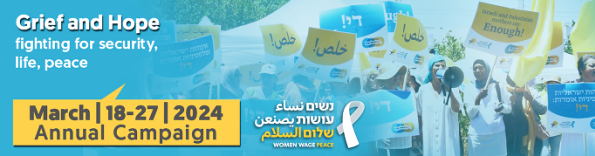
The following annual campaign for security, life and peace is in memory of Vivian Silver, a beloved and widely known Canadian-Israeli human rights activist who was murdered by Hamas terrorists on the 7th of October at Kibbutz Be’eri in Southern Israel. Please read and give generously if your heart is so moved.

“We’re not stopping without an agreement. We still mean that. Our commitment to future generations here faced an excruciating test on October 7 when our losses included one of our beloved co-founders, Vivian Silver.

Others we love have been killed in the aftermath or are still captive or are living as innocents trapped in hell. Despite the terrible shadow cast on our efforts, Women Wage Peace is not stopping.

We are working hand-in-hand with our Palestinian sisters, Women of the Sun, for lives that can be lived in peace, dignified by justice and equality.

Recently, the impact of our unwavering determination was confirmed with an official nomination, alongside Women of the Sun, for the 2024 Nobel Peace Prize.

Both movements were also honored when Time Magazine chose its twelve Women of the Year for 2024, among them Dr. Yael Admi, another co-founder of Women Wage Peace, and Reem Hajajre, the founder of Women of the Sun.

The war that erupted after October 7th has deteriorated the Israeli-Palestinian conflict to an unprecedented low, but we are determined to seize this moment as an opportunity for change. The concept of managing the conflict has failed and it is time to act for a political solution.

Your unwavering support, your own determination to believe that peace is possible when women lead, has become more than much-needed fuel for our diverse activities.

It has been a source of strength as we shift from grieving to grasping – grasping this moment as one of profound change. We are seizing this opportunity by mounting an ambitious campaign that continues to widen our connection to more Israeli and Palestinian women as well as to moderate Arab nations and the international community.

Since October 7th, our initiatives have taken different directions; some are ongoing, some will be launched soon: ƒ

1. a daily presence of WWP members in Tel Aviv’s ‘Hostage Square’, alongside tormented family members of the hostages calling for the return of the hostages, which will enable a ceasefire;

2. delivery of humanitarian aid, and a return to negotiations towards a long-term diplomatic solution; ƒ

3. empowering Arab-Israeli women as peace-builders, recognizing their crucial role in building bridges between Jewish and Arab women in Israeli society and between Jewish Israeli women and Palestinian
women; ƒ

4. joining forces with Israeli groups to bring about a courageous, moderate, peace-seeking, egalitarian government; ƒ

5. planning a public campaign to convey the message that security can be achieved only through a diplomatic solution; ƒ

6. preparing to revive our bi-national in-person workshops, once checkpoints are re-opened; ƒ

7. expanding international endorsement of our Mothers’ Call, working for an end to mutual dehumanization and creating an infrastructure to support shared processes of reconciliation; ƒ

8. last but hardly least, launching a large and complex joint project with Women of the Sun, called Women Building Bridges, with a peace-building training program for environmental, religious, and traditional leaders from both sides, supplemented by joint Israeli-Palestinian study tours.

A few of the many actions aided by last year’s crowdfunding campaign include:ƒ

-organizing a bi-national training program for peace activism, with WOS supporting lawful protest against the proposed judicial overhaul, a major threat to peace and women’s participation in decision-makingƒ;

-hosting Reem, the leader of Women of the Sun, in gatherings with hundreds of Israelis to meet our partner movement and to restore hopeƒ;

-convening an all-day event with Women of the Sun on October 4 in Jerusalem and at the Dead Sea, with 1500 Israeli and Palestinian women marching together and calling for negotiations.

Join us as we continue to wage peace. Your contribution is your powerful affirmation that where women lead, peace and justice can more easily follow.

Our Annual Crowdfunding Campaign will be launched on March 18th and continue until March 27th.

Each donation is doubled!

Watch this short video – https://www.youtube.com/watch?v=0qRoGPz1JQk

Donate here NOW – https://causematch.com/wwp24-en


ƒ

ƒ
ƒ

The Democrats Are Right. Being pro-Israel Means Being pro-Palestinian – Haaretz op-ed

20 Wednesday Mar 2024

Posted by rabbijohnrosove in Uncategorized

≈ 1 Comment

Tags

gaza, Israel, news, palestine, politics

Introductory note: This op-ed was posted today at Haaretz – for those with a subscription, here it is

Faced with an increasingly recalcitrant Netanyahu government, Senate Leader Chuck Schumer and his Democratic colleagues are leading a welcome shift in policy. Both Israel and the U.S. have a moral obligation to do better

John Rosove

Elliott Tepperman

March 20, 2024

When we woke up on October 7 to the shocking news of the Hamas terror attack in Israel, we were deeply shaken–as were Jews around the world.

As accounts of Hamas’ barbarism emerged – and as we spoke with loved ones in Israel–the anguish only grew worse. With over 1,200 murdered, well over 200 taken hostage, and hundreds of thousands displaced, the pain of the attack and its aftermath has been enduring for Israelis and Jews around the world alike.

The ensuing war against Hamas in Gaza has brought no end to the grief. Over 30,000 Palestinians have been killed, more than 1 million forced to flee their homes, and the entire population is enduring unimaginable suffering with scarce medical supplies and hundreds of thousands on the brink of starvation.

We’ve watched as Israeli Prime Minister Benjamin Netanyahu’s government has exacerbated the pain and suffering of Israelis and Palestinians alike, running counter to our Jewish values, to the foundations of the U.S.-Israel relationship, and to Israel’s own national interests.

As Jewish Americans and rabbis who care deeply for our Jewish homeland, our U.S. ally Israel, and its citizens–among whom we count our own friends and family–we understand the moral struggle U.S. lawmakers now face as they wrestle with both how to support Israelis and bring the death and suffering in Gaza to an end.

Rightfully, Capitol Hill has been spending a lot of time on the crisis since October 7, and we have been particularly proud of those U.S. senators leading the way. While so many have struggled to hold the humanity of both Israelis and Palestinians in their hearts, some are showing true, courageous leadership – precisely what this perilous hour demands.

In an unprecedented speech on the Senate floor last week, Senate Majority Leader Chuck Schumer opened his remarks saying he spoke for the “silent majority” of Jewish Americans “whose nuanced views … have never been well represented in this country’s discussions about the war in Gaza.”

In a bold but important call, he went on to urge Israelis to hold new elections, noting Netanyahu “has put himself in coalition with far-right extremists like Ministers [Bezalel] Smotrich and [Itamar] Ben-Gvir, and as a result, he has been too willing to tolerate the civilian toll in Gaza, which is pushing support for Israel worldwide to historic lows.”

Other signs of understanding that the crisis demands an overdue, different approach came last month when U.S. President Joe Biden issued National Security Memorandum 20–widely reported to have been coordinated with Maryland Democrat Senator Chris Van Hollen and inspired by his amendment to the Senate supplemental aid package. The memorandum stipulates countries receiving U.S. military aid must comply with U.S. and international law and align with our country’s interests and values. In so doing, the memorandum requires Israel to conduct the war in a way that prioritizes the safety of civilians both in its military operations and its facilitation of humanitarian aid delivery.

In a separate move, Van Hollen joined his Democratic Senate colleagues Jeff Merkley, Dick Durbin, Elizabeth Warren, and Peter Welch in calling for a comprehensive approach to immediately mitigate the humanitarian crisis in Gaza–while clearly acknowledging Israel’s right to go after Hamas and reiterating the need to free hostages held in captivity.

Another example of a welcome shift was Senators Jon Ossoff and Raphael Warnock, both Democrats from Georgia, leading 25 Senators in advocating for a “mutual ceasefire” to gain the release of the remaining Israeli hostages and stop the killing of Gazan civilians, simultaneously recognizing Hamas must “be removed from power in Gaza.”

And last week, Senators Richard Blumenthal (D-Conn.) and Chris Coons (D-Del.) published an opinion piece in Foreign Policy, stating Israel should take steps to increase the flow of humanitarian aid into Gaza and that the United States is “prepared to take more persuasive steps to ensure compliance with U.S. policy on civilian protection and humanitarian assistance.”

Most of these calls occurred in the shadow of the Senate’s passage of the bipartisan national security supplemental package, which, in addition to security aid to Israel, Taiwan, and Ukraine, included humanitarian aid for Palestinians in Gaza. Appallingly, former President Donald Trump and Speaker Mike Johnson have sought to block the bill from a vote in the House for short-term political reasons, even though it is all but certain to pass with bipartisan support.

What is clear to us, as Jewish leaders who care deeply for the safety of Israelis and the country’s future, is that the Democratic lawmakers mentioned have a deep, nuanced understanding of what it means to be pro-Israel. Faced with an increasingly recalcitrant Netanyahu government, it is not enough to spout platitudes or support symbolic resolutions. The U.S.-Israel relationship deserves and is strengthened by a more substantive approach.

These senators realize that to be pro-Israel also means being pro-Palestinian. As October 7 and its aftermath have made clear yet again, the fates of these two peoples–who share a land and a history, and neither of whom is leaving–are inextricably linked.

We in the pro-Israel community would be wise to understand, as these legislators do, that providing Palestinians with stability, security and self-determination while promoting reforms in governance and education will also serve to benefit Israel’s security in the future. Compounding an already-dire humanitarian calamity in Gaza, on Israel’s doorstep, is in nobody’s interests.

We find solace and hope in the efforts of our Congressional representatives to help bring this war to an end, the hostages home, and desperately needed aid to Gaza.

We thank them for the political courage they have displayed in recent months. Schumer himself summed up the welcome, straight-talking new direction, when he noted in his speech that we hope will be a roadmap forward, “We should not let the complexities of this conflict stop us from stating the plain truth: Palestinian civilians do not deserve to suffer for the sins of Hamas, and Israel has a moral obligation to do better. The United States has an obligation to do better.”

Rabbi John L. Rosove is a national co-chair of the J Street Rabbinic and Cantorial Cabinet. He is a past national chair of ARZA, the Association of Reform Zionists of America, and Rabbi Emeritus of Temple Israel of Hollywood.

Rabbi Elliott Tepperman is a national co-chair of the J Street Rabbinic and Cantorial Cabinet. He has been the spiritual leader of Bnai Keshet in Montclair, NJ since 2002, and he is the immediate past president of the Reconstructionist Rabbinical Association. @RavElliott

INTERNATIONAL COURT OF JUSTICE – Separate Opinion of Judge ad hoc Aharon Barak of Israel

29 Monday Jan 2024

Posted by rabbijohnrosove in Uncategorized

≈ 2 Comments

Tags

gaza, genocide, Human rights, Israel, palestine

Introductory Notes:

South Africa’s effort to impugn the dignity of the State of Israel and the truth about its intent in the prosecution of the war against Hamas for the crime of Genocide is not only wrong on the merits, but an insult to the memory of any people who legitimately were targeted by nations for that very crime, including the Jewish people during the Shoah. I have written in a former blog that no doubt mistakes have been made by Tzahal in this terrible war that resulted tragically in the killing of many Palestinian civilians in Gaza following the atrocities committed by Hamas against Israeli civilians in southern Israel on October 7.

Former Israeli Supreme Court Justice Aharon Barak is a revered jurist in Israel representing the best in Israeli jurisprudence. He is also a survivor of the Holocaust. Justice Barak was one of the justices at the International Criminal Court in the Hague that adjudicated the charge by South Africa that Israel was committing Genocide against the Palestinian people.

The following is Justice Barak’s speech at the ICJ in its entirety. However, for the ease of reading, I eliminated all the citations. For those wishing to check those sources, see the link at the end of this blog. I have also bolded certain statements for the sake of clarity and emphasis.

From time to time, I post speeches and policy statements of others and use this blog as an educational vehicle to inform on issues of vital importance in America and Israel. This is one of those times. This 5000-word statement by Justice Barak is worth reading in its entirety. Justice Barak’s speech follows:

SEPARATE OPINION OF JUDGE AD HOC BARAK

South Africa came to the Court seeking the immediate suspension of the military operations in the Gaza Strip. It has wrongly sought to impute the crime of Cain to Abel. The Court rejected South Africa’s main contention and, instead, adopted measures that recall Israel’s existing obligations under the Genocide Convention. The Court has reaffirmed Israel’s right to defend its citizens and emphasized the importance of providing humanitarian aid to the population of Gaza. The provisional measures indicated by the Court are thus of a significantly narrower scope than those requested by South Africa.

Notably, the Court has emphasized that “all parties to the conflict in the Gaza Strip are bound by international humanitarian law”, which certainly includes Hamas. The Court has also stated that it “is gravely concerned about the fate of the hostages abducted during the attack on Israel on 7 October 2023 and held since then by Hamas and other armed groups, and calls for their immediate and unconditional release.”

GENOCIDE: AN AUTOBIOGRAPHICAL REMARK

The Genocide Convention holds a very special place in the heart and history of the Jewish people, both within and beyond the State of Israel. The term “genocide” was coined in 1942 by a Jewish lawyer from Poland, Raphael Lemkin, and the impetus for the adoption of the Genocide Convention came from the carefully planned and deliberate murder of six million Jews during the Holocaust.

I was five years old when, as part of Operation Barbarossa, the German army occupied the city in which I was born, Kaunas, in Lithuania. Within a few days, almost 30,000 Jews in Kaunas were taken from their homes and put into a ghetto. It was as if we were sentenced to death, awaiting our execution. On 26 October 1941, every Jew in the ghetto was instructed to gather in the central square, known as “Democracy Square.” Around 9,000 Jews were taken from the square on that day and executed by machine gun fire.

There was constant hunger in the overcrowded ghetto. But despite all the difficulties, there was an organized community life. It was a community of individuals condemned to death, yet in their hearts there was a spark of hope for life and a desire to preserve basic human dignity.

At the beginning of 1944, the Nazis rounded up all children under the age of 12, loaded them onto trucks and shot them during the infamous “Kinder Aktion.” It was clear that I had to leave in order to survive. I was smuggled out of the ghetto in a sack and taken to a Lithuanian farmer. A couple of weeks later my mother and I were transferred to another farmer. We had to be very discreet, so the farmer built a double wall in one of the rooms. We hid in that narrow space until we were finally liberated by the Red Army on 1 August 1944. Only five per cent of the Jews of Lithuania had survived.

Genocide is more than just a word for me; it represents calculated destruction and human behaviour at its very worst. It is the gravest possible accusation and is deeply intertwined with my personal life experience.

I have thought a lot about how this experience has affected me as a judge. In my opinion, the effect has been twofold. First, I am deeply aware of the importance of the existence of the State of Israel. If Israel had existed in 1939, the fate of the Jewish people might have been different. Second, I am a strong believer in human dignity. The Nazis and their collaborators sought to reduce us to dust and ashes. They aimed to strip us of our human dignity. However, in this, they failed. During the most challenging moments in the ghetto, we preserved our humanity and the spirit of humankind. The Nazis succeeded in murdering many of our people, but they could not take away our humanity.

The rebirth following the Holocaust is the rebirth of the human being, of the centrality of humanity and of human rights for every person. Many international instruments focusing on the rights of the individual were adopted after 1945, and the protection of human rights is also deeply rooted in the Israeli legal system.


ISRAEL’S COMMITMENT TO THE RULE OF LAW AND INTERNATIONAL HUMANITARIAN LAW

Israel is a democracy with a strong legal system and an independent judicial system. Whenever there is tension between national security interests and human rights, the former must be attained without compromising the protection of the latter. As I have written: “Security and human rights go hand in hand. There is no democracy without security; there is no democracy without human rights. Democracy is based upon a delicate balance between collective security and individual liberty”.

The need for such balancing has served as a silver lining in the rulings of the Supreme Court of Israel. Once, in the midst of a military operation in Gaza, the Supreme Court ordered the army to repair the water pipes that had been damaged by army tanks, and to do so while the operation was still ongoing. On the same occasion, it ordered the army to provide humanitarian aid to civilians and to halt hostilities to allow for the burial of the dead.

In its judgment on “targeted killings,” the Supreme Court ruled that Israel must always act in accordance with international humanitarian law, and that Israel must refrain from targeting terrorists when excessive harm to civilians is anticipated.

As a judge in the Israeli Supreme Court, I wrote that every Israeli soldier carries with him (or her), in their backpack, the rules of international law.

This means that international law guides the actions of all Israeli soldiers wherever they are. I also wrote that when a democratic State fights terrorism, it does so with one hand tied behind its back.

Even when fighting a terrorist group like Hamas that does not abide by international law, Israel must abide by the law and uphold democratic values.

The Israeli Supreme Court has also held that torture may not be used during the interrogation of terrorists, that religious sites and clergy must be protected, and that all captives must be afforded fundamental guarantees.

Naturally, as in any democratic society, some of these rulings have been criticized in Israel. Still, the public stands behind them and the military upholds them on a regular basis. Rulings of the Israeli Supreme Court, many of them based on international law, are the standards by which Israel conducts itself.

International law is also an integral part of the military code and the conduct of the Israeli army. The Code of Ethics of the Israeli Defense Forces states that “[a]n IDF soldier will only exercise their power or use their weapon in order to fulfill their mission and only when necessary. They will maintain their humanity during combat and routine times. The soldier will not use their weapon or power to harm uninvolved civilians and prisoners and will do everything in their power to prevent harm to their lives, bodies, dignity and property.”

When those norms are violated, the Attorney General, the State Attorney and the Military Advocate General take the necessary measures to bring those responsible to justice, and their decisions are subject to judicial review. In appropriate cases, the Israeli Supreme Court may instruct them how to act. This is Israel’s DNA. Governments have been replaced, new justices have come to the Supreme Court, but the DNA of Israel’s democracy does not change.

Israel’s multiple layers of institutional safeguards also include legal advice provided in real time, during hostilities. Strikes that do not meet the definition of a military objective or that do not comply with the rule of proportionality cannot go forward. The holdings of the Israeli Supreme Court and Israel’s institutional framework demonstrate a commitment to the rule of law and human life,  a commitment that runs through its collective memory, institutions, and traditions.

THE COURT’S PRIMA FACIE JURISDICTION

The Court has affirmed its prima facie jurisdiction for the purpose of indicating provisional measures. However, it is doubtful whether South Africa brought this dispute in good faith. After South Africa sent a Note Verbale to Israel on 21 December 2023, concerning the situation in Gaza, Israel replied with an offer to engage in consultations at the earliest possible opportunity. South Africa, instead of accepting this offer, which could have led to fruitful diplomatic talks, decided to institute proceedings against Israel before this Court. It is regrettable that Israel’s attempt to open a dialogue was met with the filing of an application.

If anything, history has taught us that the best attempts at peace in the Middle East have generally been a result of political negotiations and not judicial recourse. The 1978 peace talks between Egypt and Israel at Camp David are a good example of this. These talks succeeded when a third party – the United States – entered the process and assisted the parties in reaching an agreement. In my opinion, a similar scenario could have unfolded here. While the jurisdictional clause of the Genocide Convention does not require formal negotiations, the principle of good faith dictates that at least some efforts should be made to resolve disputes amicably before resorting to the Court. South Africa made no such effort and denied Israel a reasonable opportunity to engage meaningfully in a discussion on how to address the difficult humanitarian situation in Gaza.

The present case involves an additional difficulty. The other belligerent in the armed conflict in Gaza, Hamas, is not a party to the present proceedings. Thus, it is not possible to indicate measures directed at Hamas in the Order’s operative clause. While this does not prevent the Court from exercising its jurisdiction, it is an essential matter to be considered when determining the appropriate measures or remedies in this case.

THE ARMED CONFLICT IN GAZA

The Court briefly recalls the immediate context in which the present case came before it, namely the attack of 7 October 2023 by Hamas and the military operation launched by Israel in response to that attack. The Court, however, fails to give a complete account of the situation which has unfolded in Gaza since that fateful day.

On 7 October 2023, on the day of the Sabbath and the Jewish holiday of “Simchat Torah,” over 3,000 Hamas terrorists, aided by members of the Palestinian Islamic Jihad, invaded Israeli territory by land, air and sea. The assault began in the early morning hours, with a barrage of rockets over the entire country and the infiltration of Hamas into Israeli territory. Alerts sounded all over Israel, civilians and soldiers took shelter, and many were later massacred inside those shelters. In other places, houses were burned down with civilians still in their safe rooms, burning alive or suffocating to death. At the Reim Nova Music Festival, young Israelis were murdered in their sleep or while running for their lives across open fields. Women’s bodies were mutilated, raped, cut up and shot in the worst possible places. Overall, more than 1,200 innocent civilians, including infants and the elderly, were murdered on that day. Two hundred and forty Israelis were kidnapped and taken to the Gaza Strip, and over 12,000 rockets have been fired at Israel since 7 October. These facts have been largely reported and are indisputable.

Israel, faced with an ongoing assault on its people and territory, launched a military operation. The Israeli authorities declared that the purpose of the operation is to dismantle Hamas and destroy its military and governmental capabilities, return the hostages, and secure the protection of Israel’s borders.

Hamas has vowed to “repeat October 7 again and again.”

Hamas is thus an existential threat to the State of Israel, and one that Israel must repel. This terrorist organization rules over the Gaza Strip, exercising military and governmental functions. Hamas seeks to immunize its military apparatus by placing it within and below civilian infrastructure, which is itself a war crime, and intentionally places its own population at risk by digging tunnels under their homes and hospitals. Hamas fires missiles indiscriminately at Israel, including from schools and other civilian installations in Gaza, in the full knowledge that many of them will fall inside Gaza causing death and injuries to innocent Palestinians. This is Hamas’s well-known modus operandi.

A few examples illustrate this well. When humanitarian aid enters Gaza, Hamas hoards it for its own purposes. Hamas has made clear that its tunnel network is designed for its fighters, rather than for civilians seeking shelter from the hostilities. Hamas has compromised the inherently civilian nature of schools and hospitals in Gaza, using them for military purposes by storing or launching rockets from and under these sites.

The fate of the hostages is especially disturbing. The act of hostage taking committed by Hamas on 7 October constitutes a grave breach of the Geneva Conventions of 12 August 1949 and is criminalized under the Rome Statute.

Hamas has not provided the names of the hostages, or any information regarding who is dead and who is still alive. Nor have they allowed the International Committee of the Red Cross (ICRC) to visit the hostages, as the law requires. The ICRC has not been able to provide medical supplies to the hostages, does not know their whereabouts, and has not succeeded in securing their release. As I write, this agony has now been ongoing for over 100 days.

This is not to undermine the suffering of innocent Palestinians. I have been personally and deeply affected by the death and destruction in Gaza. There is a danger of food and water shortages and the outbreak of diseases. The population lives in precarious conditions, facing the unfathomable consequences of war. In the role that has been entrusted to me as a judge ad hoc, but also as a human being, it is important for me to express my most sincere and heartfelt regret for the loss of innocent lives in this conflict.

The State of Israel was brought before this Court as its leadership, soldiers, and children processed the shock and trauma of the attack of 7 October. An entire nation trembled and, in the blink of an eye, lost its most basic sense of security. Fears of additional attacks were palpable as infiltrations continued in the days following the attack. The immediate context in which South Africa’s request was brought to the Court should have played a more central role in the Court’s reasoning. While it in no way relieves Israel of its obligations, this immediate context forms the inescapable backdrop for the legal analysis of Israel’s actions even at this stage of the proceedings.

THE APPROPRIATE LEGAL FRAMEWORK FOR ANALYZING THE SITUATION IN GAZA

South Africa seized the Court on the basis of the Genocide Convention, Article IX of which provides the Court with jurisdiction to resolve disputes related to the “interpretation, application or fulfillment” of that treaty, “including those relating to the responsibility of a State for genocide”. This does not mean that the Genocide Convention provides the appropriate legal prism through which to analyze the situation.

In my view, the appropriate legal framework for analyzing the situation in Gaza is International Humanitarian Law (IHL) – and not the Genocide Convention. IHL provides that harm to innocent civilians and civilian infrastructure should not be excessive in comparison to the military advantage anticipated from a strike. The tragic loss of innocent lives is not considered unlawful so long as it falls within the rules and principles of IHL.

The drafters of the Genocide Convention clarified in their discussions that “[t]he infliction of losses, even heavy losses, on the civilian population in the course of operations of war, does not as a rule constitute genocide. In modern war belligerents normally destroy factories, means of communication, public buildings, etc. and the civilian population inevitably suffers more or less severe losses. It would of course be desirable to limit such losses. Various measures might be taken to achieve this end, but this question belongs to the field of the regulation of the conditions of war and not to that of genocide.”

Violations of IHL occurring in the context of the armed conflict, must be investigated and prosecuted by the competent Israeli authorities.

LACK OF INTENT

Central to the crime of genocide is the element of intent, namely the intent to destroy, in whole or in part, a national, ethnic, racial, or religious group as such. International courts have been reluctant to establish such intent and characterize atrocities as genocide. The International Criminal Tribunal for Rwanda (ICTR) was established primarily to prosecute the crime of genocide. Nonetheless, it set a high threshold for proving the specific intent required for genocide. In its very first case, the Akayesu case, the ICTR described the required specific intent as a “psychological relationship between the physical result and the mental state of the perpetrator” which “demands that the perpetrator clearly seeks to produce the act charged.”

This high bar explains some of the full or partial acquittals at the ICTR13. An analogous bar was also adopted by the International Criminal Tribunal for Yugoslavia.

The Court, with regard to State responsibility, has similarly adopted a restrictive approach in cases involving genocide on the merits. In Application of the Convention on the Prevention and Punishment of the Crime of Genocide (Bosnia and Herzegovina v. Serbia and Montenegro), the Court concluded that – save in the case of Srebrenica – the widespread and serious atrocities committed in Bosnia and Herzegovina were not carried out with the specific intent to destroy, in part, the Bosnian Muslim group. Some years later, in Application of the Convention on the Prevention and Punishment of the Crime of Genocide (Croatia v. Serbia), the Court found that the required intent was lacking altogether and therefore dismissed Croatia’s claims in their entirety.

I accept that the proof of intent required at this preliminary stage is different from the one required at the merits stage. It is not necessary, at this stage, to convincingly show the mens rea of genocide by reference to particular circumstances, or for a pattern of conduct to be such that it could only point to the existence of such intent.

However, some proof of intent is necessary. At the very least, sufficient proof to make a claim of genocide plausible.

I strongly disagree with the Court’s approach regarding plausibility and, in particular, I disagree on the question of intent.

The Court may indicate provisional measures “only if it is satisfied that the rights asserted by the party requesting such measures are at least plausible.” In the present case, the Court concluded, with scant evidence, that “the right of the Palestinians in Gaza to be protected from acts of genocide” is plausible.

To understand the Court’s erroneous approach, it is important to compare the present case to the Gambia case: Application of the Convention on the Prevention and Punishment of the Crime of Genocide. To conclude that the asserted rights were plausible, in the Gambia case, the Court relied on two reports issued by an Independent International Fact-Finding Mission.

These reports were based on the meticulous collection of evidence over two years, which included 400 interviews with victims and eyewitnesses, analysis of satellite imagery, photographs and videos, the cross-checking of information against credible secondary information, expert interviews and raw data.

The independent experts traveled to Bangladesh, Indonesia, Malaysia and Thailand to interview victims and witnesses and hold other meetings. Furthermore, the Mission’s secretariat undertook six additional field missions.In its report of 12 September 2018, the IIFFM concluded that there were “reasonable grounds to conclude that serious crimes under international law ha[d] been committed,” including genocide

The IIFFM also stated that “on reasonable grounds . . . the factors allowing the inference of genocidal intent [were] present.”

The IIFFM reiterated its conclusions, based on further investigations, in its second report of 8 August 2019.

In the present case, there is no evidence comparable to that available to the Court in the Gambia case. To determine the plausibility of rights in the present case, the Court relies on four sets of facts. First, it looks at the figures for deaths, injuries and damage to infrastructure reported by the United Nations Office for the Coordination of Humanitarian Affairs (OCHA). Second, it relies on a statement made by the Under-Secretary-General of OCHA, a report of the World Health Organization, and a statement by the Commissioner-General of UNRWA. Third, it notes the statements of three Israeli officials. Fourth, it considers the views expressed by a group of Special Rapporteurs and the CERD Committee.

Regarding the figures for death, injuries and damage to infrastructure, the Court omits to mention that such figures come from the Ministry of Health of Gaza, which is controlled by Hamas. They are not the United Nations’ figures. Furthermore, these figures do not distinguish between civilians and combatants, or between military objectives and civilian objects. It is difficult to draw any conclusions from them.

The statements by the Under-Secretary-General of OCHA, the WHO and the Commissioner-General of UNRWA are insufficient to prove plausible intent. None of these statements mention the term genocide or point to any trace of intent. They indeed describe a tragic humanitarian situation, which is the unfortunate result of an armed conflict, but there is no reference to the subject-matter of the Genocide Convention. Furthermore, the Court is unaware of the underlying information or methodology used by the individuals who made these statements. This is in stark contrast to the evidence available to the Court in the Gambia case.

The declarations made by the President of Israel and the Minister of Defense of Israel are not a sufficient factual basis for inferring a plausible intent of genocide. Both authorities have issued several statements clarifying that Israel’s intent is the destruction of Hamas, not the Palestinians in Gaza. For example, on 29 October 2023, Israel’s Minister of Defense stated that “we are not fighting the Palestinian multitude and the Palestinian people in Gaza.” On 29 November 2023, the President of Israel said that “Israel is doing all it can, in cooperation with various partners, to increase the flow of humanitarian aid to the citizens of Gaza.” Regretfully, the Court did not take note of these statements. Finally, regarding the statements made by the Minister of Energy and Infrastructure, the latter is not an official with authority over the military. The relevant factual basis allowing for an inference of intent to commit genocide must stem from the organs which are capable of having an effect on the military operations. These organs have repeatedly explained that the purpose of the military operation is to target Hamas, not the Palestinians in Gaza.

It is concerning that certain Israeli officials have used inappropriate and degrading language, as noted by the group of Special Rapporteurs and the CERD Committee. Indeed, it is an issue that will have to be investigated by the competent Israeli authorities. However, to infer an intent to commit genocide from these statements, which were made in the wake of horrific attacks against the Israeli population, is plainly implausible.

The evidence presented by Israel shows that it is the opposite intent that is plausible and guides the military operation in Gaza. Israel pointed out that it has adopted several measures to minimize the impact of hostilities on civilians. For example, Israel continues to supply its own water to Gaza by two pipelines; it has increased access to medical supplies, facilitated the establishment of field hospitals and distributed fuel and winter equipment. Furthermore, the Prime Minister of Israel stated on 17 October 2023 “[a]ny civilian death is a tragedy . . . we’re doing everything we can to get the civilians out of harm’s way,” and on 28 October 2023 that “the IDF is doing everything possible to avoid harming those not involved”.

It is surprising that the Court took note of Israel’s statements explaining the steps it has taken to alleviate the conditions faced by the population in Gaza, together with the Attorney General’s statement announcing the investigation of any calls for the intentional harm to civilians, but then it completely failed to draw conclusions from these statements when examining the existence of intent. It is even more surprising that the Court did not view any of these measures and statements as sufficient to rule out the existence of a plausible intent to commit genocide.

The Court’s approach to plausibility in the present case is not akin to the one it took in the Gambia case, where the Court had compelling evidence of “clearance operations” committed against the Rohingya. These “clearance operations” included sexual violence, torture, the methodical planning of mass killing, denial of legal status, and instigation of hatred based on ethnic, racial, or religious grounds.

It is concerning that applying the Genocide Convention in these circumstances would undermine the integrity of the Convention and dilute the concept of genocide. The Genocide Convention seeks to prevent and punish the physical destruction of a group as such. It is not meant to ban armed conflict altogether. The Court’s approach opens the door for States to misuse the Genocide Convention in order to curtail the right of self-defense, in particular in the context of attacks committed by terrorist groups.


THE MEASURES INDICATED BY THE COURT

I now turn to the measures indicated by the Court. It is important to recall that the Court has not made any findings with regard to South Africa’s claims under the Genocide Convention. The conclusions reached by the Court in this preliminary stage do not prejudge in any way the claims brought by South Africa, which remain wholly unproven.

Regarding the conditions for the Court to indicate provisional measures, for the reasons stated above, I am not persuaded by South Africa’s arguments on the plausibility of rights, since there is no indication of an intent to commit genocide. This is why I voted against the first and second provisional measures indicated by the Court. Nevertheless, it is of the utmost importance to highlight that the first and second measures indicated by the Court merely restate obligations that Israel already has under Articles I and II of the Genocide Convention. The Court has made explicit what is already implicit in light of Israel’s existing obligations under the Convention.

Although I am convinced that there is no plausibility of genocide, I voted in favor of the third and fourth provisional measures.

With regard to the third measure, which concerns acts of public incitement, I have voted in favor in the hope that the measure will help to decrease tensions and discourage damaging rhetoric. I have noted the concerning statements by some authorities, which I am confident will be dealt with by the Israeli institutions.

With regard to the fourth measure, I voted in favor, guided by my deep humanitarian convictions and the hope that this will alleviate the consequences of the armed conflict for the most vulnerable. Through this measure, the Court reminds Israel of essential international obligations, which are already present in the DNA of the Israeli military.

This measure will ensure that Israel continues to enable the delivery of humanitarian aid to Gaza, which I see as an obligation arising under IHL.

However, it is regretful that the Court was unable to order South Africa to take measures to protect the rights of the hostages and to facilitate their release by Hamas. These measures are based on IHL, as are those enabling the provision of humanitarian aid. Moreover, the fate of the hostages is an integral part of the military operation in Gaza. By taking measures to facilitate the release of the hostages, South Africa could play a positive role in bringing the conflict to an end.

I voted against the fifth provisional measure, which concerns the preservation of evidence. I did not vote against this measure because evidence is not important, but because South Africa has not shown that Israel has destroyed or concealed evidence. This claim is baseless and therefore should not have been entertained by the Court.

Genocide is a shadow over the history of the Jewish people, and it is intertwined with my own personal experience. The idea that Israel is now accused of committing genocide is very hard for me personally, as a genocide survivor deeply aware of Israel’s commitment to the rule of law as a Jewish and democratic State. Throughout my life, I have worked tirelessly to ensure that the object and purpose of the Genocide Convention is realized in practice; and I have fought to make sure that genocide disappears from our lives.

Had the Court granted South Africa’s request to put an immediate end to the military operation in Gaza, Israel would have been left defenseless in the face of a brutal assault, unable to fulfill its most basic duties vis-à-vis its citizens. It would have amounted to tying both of Israel’s hands, denying it the ability to fight even in accordance with international law. Meanwhile, the hands of Hamas would have been free to continue harming Israelis and Palestinians alike.

It is with great respect that I have joined this Court as an ad hoc judge. I was appointed by Israel; I am not an agent of Israel. My compass is the search for morality, truth and justice. It is to protect these values that Israel’s daughters and sons have selflessly paid with their lives and dreams, in a war that Israel did not choose.

(Signed) Aharon BARAK.
___________

For complete text and all footnoted references, see – https://www.icj-cij.org/node/203452

J STREET WELCOMES RENEWED BIDEN ADMINISTRATION EFFORTS TO BROKER HOSTAGE RELEASES, HALT TO GAZA WAR

26 Friday Jan 2024

Posted by rabbijohnrosove in Uncategorized

≈ Leave a comment

Tags

gaza, hamas, Israel, middle-east, palestine

Introductory Notes:

Many Israeli military strategists now believe that eliminating Hamas entirely from Gaza as a governing and military authority (a principle Israeli goal in this war) is impossible given the 400 miles of subterranean tunnels everywhere under Gaza in which Hamas’ leadership and fighters hide. They also believe that if the Israeli-Hamas war continues it will be unlikely for Israel to gain the release of the remaining Israeli hostages, estimated at 136 souls (between 10 and 30 are believed to have been murdered by Hamas – many kidnapped Israelis have been sexually abused by their Hamas captors). The rising death and injury toll of Israeli soldiers and the death and injury of thousands of Palestinian civilians constitute a veritable humanitarian catastrophe.

This war must come to an end. All Israeli hostages must be returned to their families as soon as possible. Massive humanitarian aid must reach Palestinian civilians in southern Gaza, 85 percent of whom are homeless, food insecure and vulnerable to communicable diseases.

The following is a press statement issued this week by J Street, a pro-Israel, pro-peace and pro-democracy organization in Washington, D.C.

A disclaimer: I serve as one of four national co-chairs of the J Street Rabbinic and Cantorial Cabinet. I support this statement.

January 25, 2024 – J Street press brief, Washington, D.C.

J Street welcomes and fully supports President Biden’s reported decision to deploy CIA Director William J. Burns to assist in brokering a deal to temporarily halt the hostilities in Gaza, release all remaining hostages, and allow for an urgent, overdue influx of humanitarian aid to civilians.

“Charging the CIA Director with this role indicates that this is a serious, urgent and delicate effort to broker the release of remaining hostages and put a stop to the horrific devastation in Gaza,” said J Street President Jeremy Ben-Ami. “As Israel’s key partner with tremendous influence in the region, these goals must be a priority for the United States. It’s past time to recognize that this war, as it is being pursued by the Netanyahu government, is not achieving its stated aims. It’s time to lead with diplomacy.”

Earlier this week, J Street strongly supported a call from General Gadi Eisenkot – an Israeli War Cabinet member and retired Chief of Staff of the Israel Defense Forces – for urgent diplomatic efforts to broker a negotiated stop to the fighting and to bring freedom to the hostages and relief to the people of Gaza. We continue to stand in solidarity with the families of hostages in Israel who are leading powerful protests to call for diplomatic efforts to ensure the safety and swift release of hostages – the only channel that has delivered significant no results so far.

J Street continues to call on the Biden administration to use all available leverage to press the Israeli government to facilitate an immediate, dramatic surge in humanitarian assistance to the civilian population of Gaza. The toll inflicted upon civilians by this war has been unbearably high, and the suffering must stop now.

J STREET TO BIDEN: ACT NOW TO SAVE LIVES, HOSTAGES, CHANCE FOR LONG-TERM PEACE

22 Friday Dec 2023

Posted by rabbijohnrosove in Uncategorized

≈ 1 Comment

Tags

gaza, hamas, Israel, palestine, politics

Introductory Notes:

As a national co-chair of the J Street Rabbinic and Cantorial Cabinet, I fully support J Street’s policy statement below concerning the Israel-Hamas war. It requires a close read to appreciate the complexity of the disastrous war started by Hamas’s brutal attack against Israeli civilians and its massive hostage taking on October 7 that has resulted in a humanitarian disaster in Gaza. J Street’s position is nuanced and represents a positive path forward and hopefully, will be accepted as a whole by the Biden Administration, Congress, the Israeli government, what remains of the Palestinian Authority and other Arab nations.

In brief, J Street expresses our full support for Israel and its right to defend itself against the terrorist organization Hamas, to remove Hamas from power over Gaza using only “intelligence-led precision strikes with precision munitions, and special operations forces” and not massive bombing, to promote a pause (not a ceasefire) to negotiate the release of all hostages and allow the infusion of massive amounts of humanitarian aid into Gaza, to urge the United States and the Biden Administration to propose a massive Marshall-like plan after the war for the restoration of Gaza, to work with a post-Netanyahu government and a restructured Palestinian Authority with the support of Arab nations to resolve the Israeli-Palestinian conflict in two-states for two peoples with security guarantees for both Israel and the Palestinians, and to institute strict oversight and scrutiny of American arms in compliance with international law.

I urge you to read the following carefully and share it with everyone you know, especially young American Jews and non-Jews.

December 21, 2023

“Two and a half months after the horrific October 7 attack by Hamas, J Street’s support for the people and state of Israel remains unwavering. We continue to affirm Israel’s right and obligation to defend its territory, provide security for its citizens and bring to justice those who perpetrated this barbaric attack.

However, as six Members of Congress with significant national security experience wrote this week to President Biden, the civilian death toll and humanitarian crisis in Gaza that the Netanyahu government’s military operation have caused are unacceptable and out of line with American interests and values.

These Members – each of whom learned bitter lessons about war and counterterrorism in Iraq and Afghanistan – urged the President to “use all our leverage to achieve an immediate and significant shift [in Israel’s] military strategy and tactics in Gaza.”

In recent days, Secretary of Defense Lloyd Austin warned Israel that when you drive the civilian population into the arms of the enemy, you can “replace a tactical victory with a strategic defeat.” And former Chair of the Joint Chiefs of Staff Mark Milley weighed in similarly on the nature of the war, noting that “military doctrine has evolved … and the preferred doctrine today in highly dense urban areas is to do intelligence-led precision strikes with precision munitions, and special operations forces.”

J Street too opposes the Netanyahu government’s disastrous approach to the war.

We call on President Biden to heed the advice of this wide array of national security experts and veterans of counterterrorism operations and to convey to the Netanyahu government, both publicly and privately, that the time has come to end the all-out military campaign and massive aerial bombardment of Gaza and immediately shift to a far more targeted and limited operation.

In light of the Netanyahu government’s repeated refusal to heed the administration’s call and advice, J Street urges the Administration to take further, firmer steps to bring about this change including:

  1. Proposing a renewed pause in the fighting that enables the safe return of the remaining hostages and a dramatic surge in humanitarian assistance.

The terms of a renewed break in hostilities would include Hamas’ release of additional hostages in exchange for an extended break in the fighting and a further release of prisoners. We would also support the Administration proposing a longer-term end to the fighting were Hamas required in addition to releasing all the hostages to relinquish its remaining arsenal and accept passage for its leadership to a third country.

A renewed pause should bring a dramatic, urgent infusion of humanitarian aid, inclusive of food, water and medical supplies for families in Gaza. The civilian population of Gaza – the majority of whom are children and 85 percent or more of whom are displaced from their homes – are living in unbearable conditions. We commend the Administration’s efforts to reopen the Kerem Shalom crossing to facilitate movement of more aid into Gaza. This must be paired with the entry of humanitarian aid organizations to establish more field hospitals, shelters and distribution mechanisms.

  1. Shifting America’s posture at the United Nations.

The United States should stop vetoing Security Council resolutions related to the conflict that seek to find ways to advance the release of hostages, the provision of humanitarian assistance and a pathway to diplomatic resolution of the conflict. Rather, the US should draft and lead resolutions that accord with our policy and values, possibly outlining terms for further pauses in the fighting, holding Israel and other actors accountable when their actions violate international law or contradict US interests and renewing the global commitment to a two-state solution, while articulating parameters to guide negotiations.

  1. Outlining a plan for post-war Gaza reconstruction and a pathway to a viable Palestinian state.

The Administration should provide a detailed public plan for the day after the present crisis that begins with reconstruction and redevelopment of the devastation in Gaza and leads to the creation of a viable, independent state of Palestine alongside a secure Israel. The plan should provide for a revitalized and reformed Palestinian Authority that unites the West Bank and Gaza and creates the conditions in which Israel can normalize relations with all regional neighbors and the broader Arab and Muslim world.

The President should make clear that any American investment or involvement in post-war reconstruction – for instance in a multinational Marshall Plan-style effort – will be accompanied by an American commitment to recognition of Palestinian statehood – despite Prime Minister Netanyahu’s opposition. Already in recent days, the UAE has made clear that financial and other commitments from the Arab world to post-war development in Palestine will only come when there is an Israeli commitment to a two-state solution.

  1. Instituting strict oversight and scrutiny of arms and material purchased with US assistance to ensure they are used in compliance with domestic and international law.

Senator Chris Van Hollen’s proposed amendment to the President’s supplemental assistance request provides a commonsense and universal approach to oversight of weapons purchased with American assistance. The President should ask Congress to include such transparency measures in the supplemental package they are considering and should indicate that the Administration will use all the tools already at its disposal under existing law to ensure that the Israeli government – along with all other countries receiving US assistance – acts within the bounds of domestic and international law.

The death toll in this conflict is too great and the suffering unbearable – leading many passionate and committed individuals and organizations to call on Israel to unilaterally cease fire. J Street does not join in calling for a ceasefire because we do not see a viable path to a stable, peaceful future for either Israelis or Palestinians with Hamas in control of Gaza and still committed in its charter to Israel’s destruction and publicly pledging to repeat the October 7 attack if given the chance.

Having said this, we also see no viable path to sustainable, long-term resolution of this conflict if the Netanyahu government continues to add to the already unacceptable civilian toll and humanitarian crisis in Gaza and to disregard American recommendations on the conduct of the war.

We urge the Biden administration to take immediate action to ensure that the Israeli government significantly shifts course before this conflict costs more lives and wreaks more pain and devastation. 

The way the current campaign is being pursued only jeopardizes Israel’s efforts to defeat Hamas and secure the release of the hostages – while laying the groundwork for even deeper, long-term security challenges.

Newer posts →

Enter your email address to subscribe to this blog and receive notifications of new posts by email.

Join 366 other subscribers

Archive

  • March 2026 (2)
  • February 2026 (6)
  • January 2026 (8)
  • December 2025 (4)
  • November 2025 (6)
  • October 2025 (8)
  • September 2025 (3)
  • August 2025 (6)
  • July 2025 (4)
  • June 2025 (5)
  • May 2025 (4)
  • April 2025 (6)
  • March 2025 (8)
  • February 2025 (4)
  • January 2025 (8)
  • December 2024 (5)
  • November 2024 (5)
  • October 2024 (3)
  • September 2024 (7)
  • August 2024 (5)
  • July 2024 (7)
  • June 2024 (5)
  • May 2024 (5)
  • April 2024 (4)
  • March 2024 (8)
  • February 2024 (6)
  • January 2024 (5)
  • December 2023 (4)
  • November 2023 (4)
  • October 2023 (9)
  • September 2023 (8)
  • August 2023 (8)
  • July 2023 (10)
  • June 2023 (7)
  • May 2023 (6)
  • April 2023 (8)
  • March 2023 (5)
  • February 2023 (9)
  • January 2023 (8)
  • December 2022 (10)
  • November 2022 (5)
  • October 2022 (5)
  • September 2022 (10)
  • August 2022 (8)
  • July 2022 (8)
  • June 2022 (5)
  • May 2022 (6)
  • April 2022 (8)
  • March 2022 (11)
  • February 2022 (3)
  • January 2022 (7)
  • December 2021 (6)
  • November 2021 (9)
  • October 2021 (8)
  • September 2021 (6)
  • August 2021 (7)
  • July 2021 (7)
  • June 2021 (6)
  • May 2021 (11)
  • April 2021 (4)
  • March 2021 (9)
  • February 2021 (9)
  • January 2021 (14)
  • December 2020 (5)
  • November 2020 (12)
  • October 2020 (13)
  • September 2020 (17)
  • August 2020 (8)
  • July 2020 (8)
  • June 2020 (8)
  • May 2020 (8)
  • April 2020 (11)
  • March 2020 (13)
  • February 2020 (13)
  • January 2020 (15)
  • December 2019 (11)
  • November 2019 (9)
  • October 2019 (5)
  • September 2019 (10)
  • August 2019 (9)
  • July 2019 (8)
  • June 2019 (12)
  • May 2019 (9)
  • April 2019 (9)
  • March 2019 (16)
  • February 2019 (9)
  • January 2019 (19)
  • December 2018 (19)
  • November 2018 (9)
  • October 2018 (17)
  • September 2018 (12)
  • August 2018 (11)
  • July 2018 (10)
  • June 2018 (16)
  • May 2018 (15)
  • April 2018 (18)
  • March 2018 (8)
  • February 2018 (11)
  • January 2018 (10)
  • December 2017 (6)
  • November 2017 (12)
  • October 2017 (8)
  • September 2017 (17)
  • August 2017 (10)
  • July 2017 (10)
  • June 2017 (12)
  • May 2017 (11)
  • April 2017 (12)
  • March 2017 (10)
  • February 2017 (14)
  • January 2017 (22)
  • December 2016 (13)
  • November 2016 (12)
  • October 2016 (8)
  • September 2016 (6)
  • August 2016 (6)
  • July 2016 (10)
  • June 2016 (10)
  • May 2016 (11)
  • April 2016 (13)
  • March 2016 (10)
  • February 2016 (11)
  • January 2016 (9)
  • December 2015 (10)
  • November 2015 (12)
  • October 2015 (8)
  • September 2015 (7)
  • August 2015 (10)
  • July 2015 (7)
  • June 2015 (8)
  • May 2015 (10)
  • April 2015 (9)
  • March 2015 (12)
  • February 2015 (10)
  • January 2015 (12)
  • December 2014 (7)
  • November 2014 (13)
  • October 2014 (9)
  • September 2014 (8)
  • August 2014 (11)
  • July 2014 (10)
  • June 2014 (13)
  • May 2014 (9)
  • April 2014 (17)
  • March 2014 (9)
  • February 2014 (12)
  • January 2014 (15)
  • December 2013 (13)
  • November 2013 (16)
  • October 2013 (7)
  • September 2013 (8)
  • August 2013 (12)
  • July 2013 (8)
  • June 2013 (11)
  • May 2013 (11)
  • April 2013 (12)
  • March 2013 (11)
  • February 2013 (6)
  • January 2013 (9)
  • December 2012 (12)
  • November 2012 (11)
  • October 2012 (6)
  • September 2012 (11)
  • August 2012 (8)
  • July 2012 (11)
  • June 2012 (10)
  • May 2012 (11)
  • April 2012 (13)
  • March 2012 (10)
  • February 2012 (9)
  • January 2012 (14)
  • December 2011 (16)
  • November 2011 (23)
  • October 2011 (21)
  • September 2011 (19)
  • August 2011 (31)
  • July 2011 (8)

Categories

  • American Jewish Life (458)
  • American Politics and Life (417)
  • Art (30)
  • Beauty in Nature (24)
  • Book Recommendations (52)
  • Divrei Torah (159)
  • Ethics (490)
  • Film Reviews (6)
  • Health and Well-Being (156)
  • Holidays (136)
  • Human rights (57)
  • Inuyim – Prayer reflections and ruminations (95)
  • Israel and Palestine (358)
  • Israel/Zionism (502)
  • Jewish History (441)
  • Jewish Identity (372)
  • Jewish-Christian Relations (51)
  • Jewish-Islamic Relations (57)
  • Life Cycle (53)
  • Musings about God/Faith/Religious life (190)
  • Poetry (86)
  • Quote of the Day (101)
  • Social Justice (355)
  • Stories (74)
  • Tributes (30)
  • Uncategorized (835)
  • Women's Rights (152)

Blogroll

  • Americans for Peace Now
  • Association of Reform Zionists of America (ARZA)
  • Congregation Darchei Noam
  • Haaretz
  • J Street
  • Jerusalem Post
  • Jerusalem Report
  • Kehillat Mevesseret Zion
  • Temple Israel of Hollywood
  • The IRAC
  • The Jewish Daily Forward
  • The LA Jewish Journal
  • The RAC
  • URJ
  • World Union for Progressive Judaism

Blog at WordPress.com.

  • Subscribe Subscribed
    • Rabbi John Rosove's Blog
    • Join 366 other subscribers
    • Already have a WordPress.com account? Log in now.
    • Rabbi John Rosove's Blog
    • Subscribe Subscribed
    • Sign up
    • Log in
    • Report this content
    • View site in Reader
    • Manage subscriptions
    • Collapse this bar