It was a warm spring Los Angeles afternoon. My brother and I were lying on our backs and looking into a cloudless blue sky. I was six years-old (he was seven) and he said: “You know – there’s no ceiling!”
That was for me an ah-ha moment, the first time in my life that I felt overcome with a sense of awe and wonder and the intuition of the infinity of the universe. That sensibility is expressed powerfully in the Biblical Book of Job (37:14-17):
“Hearken to this, O Job, stand, / And take in the wonders of God. / Do you know when God directs them, / And His thunderhead’s lighting shines? / Do you know of the spread of cloud, / The wonders of the Perfect in knowledge, / When your garments feel warm / As the earth is becalmed from the south?”
That childhood experience of what Rabbi Abraham Joshua Heschel called “radical amazement” was the beginning of my lifelong religious and spiritual quest.
My motivation to understand the enduring mystery of existence, the nature of my life and the character of my soul was compounded several years later when suddenly my father died at the age of fifty-three from a heart attack. As time passed and I struggled to integrate the emotional shock of losing him into how I lived my daily life and how I moved through the weeks, months and years without him, I was left with ultimate questions and no answers.
What did my father’s life and death mean? What remains of us over time besides the inert matter after death that we bury into the earth? Is there such a thing as a soul that exists beyond the grave that is eternal? What is human consciousness that enables us to self-reflect upon the nature of our lives and that we human beings have the capacity to experience awe and wonder?
The answer to the deepest question that emerged when my father died so suddenly so long ago has continued to elude me – Is there a God?
In many religions, and in some Jewish communities, “Do you believe in God?” is a threshold question. Answer yes, and you are one of the fold. Answer no, and you have a problem. So it is with reticence or a mildly defiant tone that many Jews tell me, “Rabbi, I don’t believe in God!” I sometimes think that on some level they expect someone (me) to hear that statement and “cast them out.” The conversation gets interesting if we talk about the nature of the God they find so incredible. Often it turns out to be Michelangelo’s white-haired figure touching fingers with Adam on the Sistine Chapel ceiling – a commanding, rewarding, and punishing God – the God of the Hebrew Bible, traditional prayer book and High Holiday Machzor. Most liberal Jews do not accept the notion of such a God, especially given the evidence all around us that innocent people suffer and that the all-knowing, all-powerful, and all-good God of tradition has either turned the Divine back on us, ignores us, or doesn’t exist.
When people tell me that they don’t believe in God because they have seen no empirical proof for God’s existence, or they cannot accept the God of Jewish tradition, I understand – because I don’t believe in that God either.
Today, so many of us are hungry for the spiritual answers that our linear rational minds cannot deliver – and the embracing sense of community that their openness can help create. We are new and different kinds of Jews, some of whom neither our mystical nor our rational ancestors would recognize as particularly Jewish or rational at all. One says, “I’m a religious person in that I feel a connection to something eternal and infinite that’s in my soul and in yours. But I don’t believe in a personal God, and all this talk about God as King and me as servant is meaningless to me.” Another says, “I’m grateful for the gifts of health, meaningful work, and love. Sometimes I feel overwhelmed by gratitude and a sense of inadequacy to express how much I feel blessed, and that’s about as close as I come to prayer. But that prayer is addressed to life itself and to no one in particular, and surely not to ‘God.’”
The question that is most pertinent to us in these times is not “Do I believe in God?” It is “How do I and how can I experience myself as a spiritual being?”
A search that starts with that question does not ask us to marshal empirical evidence for a God-force existing somewhere outside of us, but instead shifts our focus to our own experiences. When we embark on an interior search, we can live as fully spiritual beings without having to concern ourselves with, affirm, or deny belief in God at all. Instead, we open ourselves to awe, wonder, and gratitude; and in the vastness of all that, we connect with our souls and with the ancient mysteries threaded through our lives.
Over the years, I’ve found that my capacity to experience awe and wonder has grown in direct proportion to how grateful I feel for the gifts in my life.
It’s the mystic’s God, the God of “inwardness” that expands us in this way and allows us to tap into the hidden spiritual waters within. The truth of the mystics is that the individual isn’t separate from God. God is the mystery in our souls. Rabbi Nachman of Breslov taught that the Divine Presence flows constantly as the light of awareness into the world and that an inner vessel needs to be created within every human being to receive the light. The vessel of our soul – once we’re in touch with it – receives the light in moments of awe and wonder over the miracles of the universe, as well as in moments of love and connection with others. Rabbi Nachman taught that a vessel is made whenever the heart opens to give love to others. This is one meaning of the verse in Exodus “And let them make Me a sanctuary that I may dwell among them.” (25:8)
This mystical experience of Godliness is not only revitalizing, it breaks down unnecessary barriers and enables a far more inclusive and expansive vision of Jewish life and humankind as a whole. Reaching across time, space, and human distinctions, it inspires the understanding that divinity shines everywhere.
Here is what I think is important to know: Every peak emotional moment of joy, awe, gratitude, and humility is similar to the classic religious and prophetic moments recorded in the great books of Jewish literature – it’s the revelation of some deeper spiritual truth. Recognizing that, as we contemplate the depths of space or each other’s eyes, we’re reminded that we’re part of something far greater than ourselves.
Rabbi Heschel, among our people’s greatest poets of the soul, describes what the spiritual experience is all about:
“Our radical amazement responds to the mystery, but does not produce it. You and I have not invented the grandeur of the sky nor endowed the human being with the mystery of birth and death. We do not create the ineffable, we encounter it . . . The awareness of the ineffable is that with which our search must begin . . . The search of reason ends at the shore of the known; on the immense expanse beyond it only the sense of the ineffable can glide . . . reason cannot go beyond the shore, and the sense of the ineffable is out of place where we measure, where we weigh.” (Abraham Joshua Heschel, Between God and Man: An Interpretation of Judaism (London: Collier MacMillan, 1959), 49.
Jewish tradition does many things, and two of the most important are that it feeds the mind and inspires the soul. I do not think we need to put aside our left-brain training as we open ourselves to what the mystics can teach us. Rather, we can ask the question that will take us closer to our souls: “How do I and how can I experience myself as a spiritual being?” How can we connect to what is eternal and infinite in ourselves and the world? How can we connect with the sense of awe and wonder over the miracles of our universe on the one hand and gratitude for the simple facts of our existence on the other? Our search for answers, whether we use the word “God” or not, pulls us into the deep and vital current of Judaism. It doesn’t demand that the atheists and agnostics among us suspend their doubts and disbeliefs. It doesn’t ask us to slink away if we don’t believe in God. Instead, it asks all of us to become more aware of the musings of the right hemisphere of our brains and to think about the spiritual significance of the hours and days, months and years of our lives: our ability to fall in love; our ability to celebrate and rejoice at weddings, births, B’nai Mitzvah celebrations, conversions, anniversaries, and our family gatherings; our ability to treasure and enjoy our alone time; our ability to create and enjoy the creations of human hands, hearts, minds, and souls in all forms of art; our ability to engage in good works in the community; and our ability to respond with gratitude for the miracles we enjoy every day.
We don’t need to believe in a removed, plague- and miracle-wielding God to be Jews and spiritual beings. Our task instead is to be more than secular actors in our human drama as it unfolds, to understand that we aren’t separate willful beings making our way in a chaotic, meaningless existence, but a unique glow of light in our souls – the beautiful, inexplicable, an awe-inspiring spark of life. It is by seeing the light in one another and then drawing our separate lights together into a larger glow that we reveal to ourselves and to each other, discover and understand the deeper truth about the world. It may be true, as Rabbi Menachem Mendel of Vitebsk (1730-88) once noted, that “the human being is the language of God,” because God is present in each of our souls, each longing to know the Source from which we come and to which we return.
Whether we speak of that source as God or nature or life or love, we and the mystics and the scientists are all talking about the same thing, and Judaism is embracing enough to welcome us all.
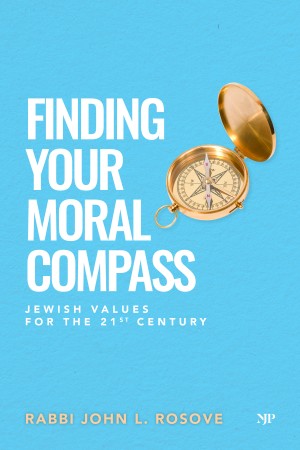
Note: This blog is edited from the first chapter of my book Finding Your Moral Compass – Jewish Values for the Twenty-First Century (Toronto: University of Toronto New Jewish Press, 2026), 9-17. It also appears in Because My Soul Longs for You – Integrating Theology into Our Lives, edited by Rabbi Edwin C. Goldberg and Rabbi Elaine S. Zecher (New York: CCAR Press, 2021), 3-10.